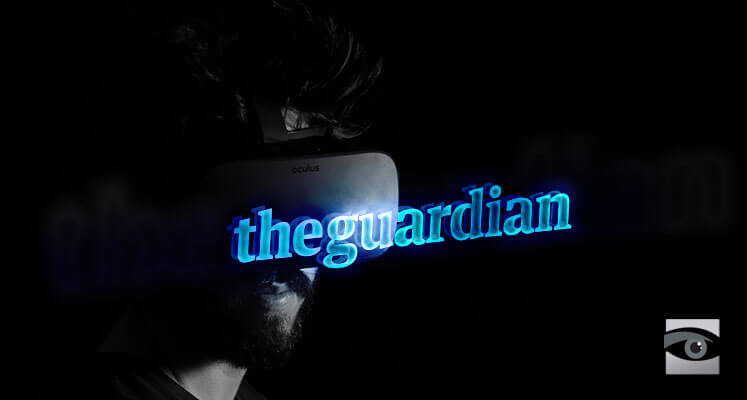
The Guardian reports on an exhibition at the Israel Museum “that gives Israelis the chance to experience a Palestinian family’s living room – by wearing virtual reality goggles.”
The context? The “entrenched separation of two societies that live side by side but, increasingly, worlds apart.”
According to reporter Oliver Holmes:
Israel has built a concrete barrier and barred most Palestinians from entering.
He also refers to “the wall that divides the West Bank.”
Given that over 90% of Israel’s (as yet uncompleted) security barrier is a chain-link fence, the description of a “concrete barrier” or “wall” is grossly misleading and inaccurate.
Holmes continues:
It [Israel] has banned its own citizens from entering Palestinian-controlled West Bank cities. Gaza, which is geographically disconnected from the West Bank, has been put under blockade and few can leave.
Why is it illegal for Israelis to enter “Palestinian-controlled West Bank cities?” It’s not because Israel has decided to prevent Israelis and Palestinians from mixing together.
Sadly, it’s a necessity to prevent Israelis from being murdered or kidnapped by Palestinian terrorists, a piece of context that has been omitted. Likewise, the only reason for a blockade of Gaza is for security reasons.
There is nothing wrong with highlighting efforts to promote understanding between Israelis and Palestinians. But Holmes’ final choice of quote from an Israeli academic is certainly interesting and possibly betrays his own politics:
Me and my friends are on the left side of the left wing. We don’t think of ourselves as Zionists. Our goal is one state with Jews and Arabs living as equals together. Still, most of our friends, they are not close friends with Arabs.
This is unequivocally a fringe political perspective within Israel given that it calls for a one-state solution as an end to Israel as a Jewish state. Why would Holmes choose to end his piece with such an unrepresentative view? In the context of the article, it appears to be a simple and positive call for peaceful coexistence. The reality is quite different and is left unexplained.
Even in a story meant to convey something positive, The Guardian still manages to twist the reality.
© Divuach Ne’eman R”A, 2025