Key Takeaways:
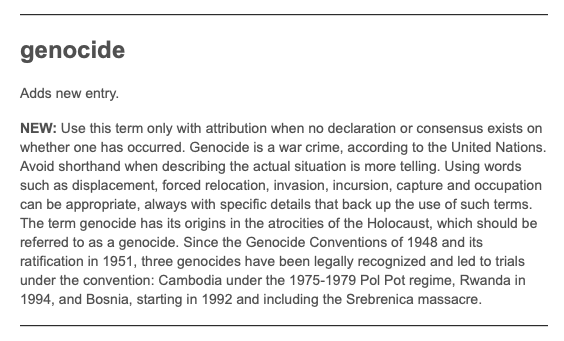
- AP’s style guide shift reflects a troubling trend: The Associated Press’ updated guidance on “genocide” acknowledges the term’s growing use, risking further normalization of an accusation that demands exceptional evidentiary rigor.
- Genocide is being stripped of its legal precision: The term has a specific definition rooted in demonstrable intent to destroy a protected group, not simply civilian suffering or contested wartime claims.
- Media imprecision carries serious consequences: When outlets lower the threshold for invoking genocide, they dilute the historical and legal significance of crimes like the Holocaust, Rwanda, and Srebrenica.
Few crimes carry the weight of genocide.
It recalls images of gas chambers, killing fields, mass graves, machete-wielding militias, and entire groups marked for annihilation. It is how we describe humanity’s darkest chapters because it describes something specifically horrific: the deliberate effort to exterminate, in whole or in part, a nation, ethnicity, or religious group from existence.
That is why we should be concerned that this term has begun to lose its meaning. Recently, the Associated Press updated its style guide on the use of the word “genocide.” While the guidance presents itself as a call for precision, it also reflects another reality: one of the world’s most influential news organisations is adapting to an environment in which genocide accusations have become all too commonplace. Rather than defending the exceptional nature of the term, the guidance acknowledges its growing ubiquity in public discourse. The result is not greater clarity, but the further normalisation of one of history’s gravest accusations.
A Crime Defined by Intent
“Genocide” as a concept did not emerge from political debate. It was created by Polish-Jewish lawyer Raphael Lemkin during the Second World War as he struggled to describe the Nazi attempt to destroy European Jewry, while also reflecting on his earlier research of the Armenian Genocide. Lemkin understood that existing language was inadequate. Mass murder did not fully capture what was occurring. The Nazis were not merely killing individuals. They were attempting to eradicate an entire people, their culture and their history, from the face of the earth.
Lemkin combined the Greek word genos (“people” or “tribe”) with the Latin suffix -cide (“killing”) to create a term for a crime he believed demanded recognition in its own category. His work helped shape the United Nations Genocide Convention of 1948 and established genocide as the gravest crime in international law.
Intent was the most crucial point. Despite what many people misunderstand, genocide was never defined by the scale of death. War can produce enormous civilian casualties without constituting genocide. Natural disasters can kill hundreds of thousands without constituting genocide. Even atrocities and war crimes are not necessarily genocide. The defining feature is the deliberate intention to eliminate a protected group because of its identity.
The Holocaust remains the paradigmatic genocide because it represented perhaps the most systematic attempt in human history to eradicate an entire people. Six million Jews were murdered because they were Jews. The Nazi regime built an industrialized machinery of extermination dedicated to that goal. Since then, only a handful of events have achieved broad legal recognition as genocides under international law.
The Khmer Rouge regime in Cambodia murdered approximately two million people through executions, starvation, and forced labor. In Rwanda, around 800,000 Tutsis and moderate Hutus were slaughtered in roughly one hundred days in a campaign explicitly designed to eliminate the Tutsi population. In Bosnia, the massacre at Srebrenica and related campaigns of ethnic cleansing led international courts to conclude that genocide had occurred.
The scale of these crimes is difficult to comprehend. In Cambodia, entire families were worked, starved, and executed in the killing fields. In Rwanda, neighbors hacked neighbors to death with machetes while bodies filled churches, schools, and roadsides. In Bosnia, thousands of Muslim men and boys were systematically separated from their families and murdered at Srebrenica. These were not merely episodes of wartime suffering. They were deliberate attempts to destroy human groups because of who they were.
These are among some of the worst crimes ever committed. The word genocide was reserved for such events precisely because they occupied a category of evil distinct from ordinary warfare or crimes against humanity, however brutal. Yet in contemporary political discourse, that distinction is breaking down.
When Genocide Becomes a Political Label
As we have seen during the Israel-Hamas war, the word is now frequently used as a synonym for civilian suffering, displacement, military occupation, inequality, or unpopular government policies. Despite the clarity of the UN Convention, activists and commentators routinely invoke genocide before any legal determination has been made and often in situations where evidence of genocidal intent remains highly contested or entirely absent.
The word “genocide” was coined by a Jewish lawyer to describe the Holocaust. For two-and-a-half years, it’s been systematically deployed against the Jewish state — not as a legal conclusion, but as a political weapon.@HausdorffMedia breaks it down:
• What the ICJ’s… pic.twitter.com/391E5LhkJa— HonestReporting (@HonestReporting) May 19, 2026
The irony is profound. A concept developed in large part as a response to the destruction of European Jewry is now routinely weaponized against the Jewish state. Media organizations have elevated self-described “genocide scholars” with minimal expertise as authorities on one of the most serious accusations imaginable, while membership of the International Association of Genocide Scholars surged ahead of a vote on whether Israel should be designated a perpetrator of genocide. This highlighted how genocide is increasingly treated not as a legal finding established through evidence, but as a political conclusion reached in advance.
For $30, anyone can be a “genocide expert.” No credentials needed. That’s how we got the viral claim that 86% of scholars claim Israel is committing genocide.
Reality: only ~120 of ~500 “members” voted. This isn’t consensus. It’s hacktivism.H/t @aizenberg55 pic.twitter.com/P0rRWe3p6d
— HonestReporting (@HonestReporting) September 4, 2025
If genocide comes to mean any military campaign with civilian casualties, then the distinction between genocide and war disappears. If genocide just means suffering on a large scale, then famine, natural disasters, civil wars, and deliberate extermination become morally indistinguishable. If every conflict is described as genocide, then the Holocaust, Rwanda, Cambodia, and Srebrenica cease to occupy a unique place in human history.
Why Precision Matters
While awful and likely crimes against humanity, massacres are not automatically genocides. War crimes are not automatically genocides. Occupations are not automatically genocides. Precision is not a form of denial. It is a prerequisite for understanding reality.
The danger of rhetorical inflation extends beyond historical memory. When the accusation of genocide is deployed with abandon, it becomes harder to identify genuine genocides when they occur. This outcome would have horrified Raphael Lemkin. He did not spend years fighting to establish genocide as a distinct crime, only for the concept to become a catch-all slogan detached from its original meaning.
The Associated Press is not responsible for creating this trend, but its influence makes the problem all the more significant. Style guides do not just reflect language; they shape it. By instructing journalists to use genocide allegations so long as they are attributed to those making the claim, the guidance lowers the threshold for one of the gravest accusations in the world. Attribution is an important journalistic tool, but it is not a substitute for evidence or legal consensus. The danger is that genocide will be treated as a political allegation rather than an exceptional crime.
The twentieth century taught humanity that some crimes are so grave that they require their own language. The purpose of that language was not merely to condemn evil but to identify it accurately.
Genocide is not just another word for suffering. It is not a synonym for war, displacement, or civilian casualties. It describes the deliberate attempt to destroy a human group because of its identity. If we forget that distinction, we will not honor the victims of genocide. We will erase the very meaning of the crime that Raphael Lemkin fought to define.
Liked this article? Follow HonestReporting on Twitter, Facebook, Instagram and TikTok to see even more posts and videos debunking news bias and smears, as well as other content explaining what’s really going on in Israel and the region. Get updates direct to your phone. Join our WhatsApp and Telegram channels!
© Divuach Ne’eman R”A, 2025