Key Takeaways:
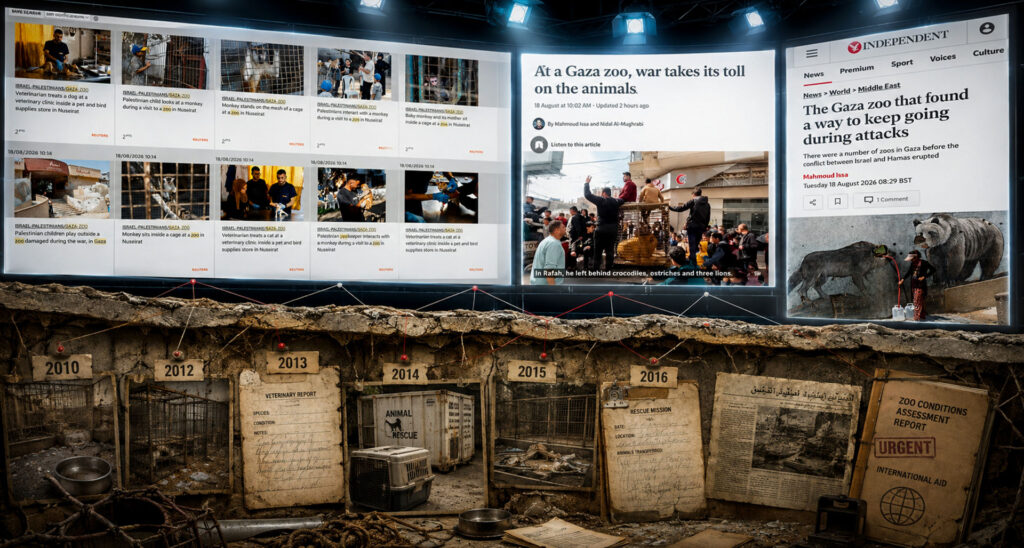
- Reuters produced a broad Gaza zoo package, documenting animals, families, children, veterinary care and damaged facilities while framing the animals’ plight largely through the war.
- Gaza’s zoo problems long predated October 7. In 2019, Four Paws evacuated 43 animals after starvation deaths and “terrible conditions”; veterinarian Amir Khalil also appears in Reuters’ 2026 report.
- Reuters’ own photos complicate that framing. They show a functioning Nuseirat zoo with visiting families, children interacting with animals, veterinary treatment and a lion still housed there.
Hospitals, schools and sporting venues have all become recurring symbols in the international media narrative surrounding Gaza. Now another has been added to the list: the local zoo.
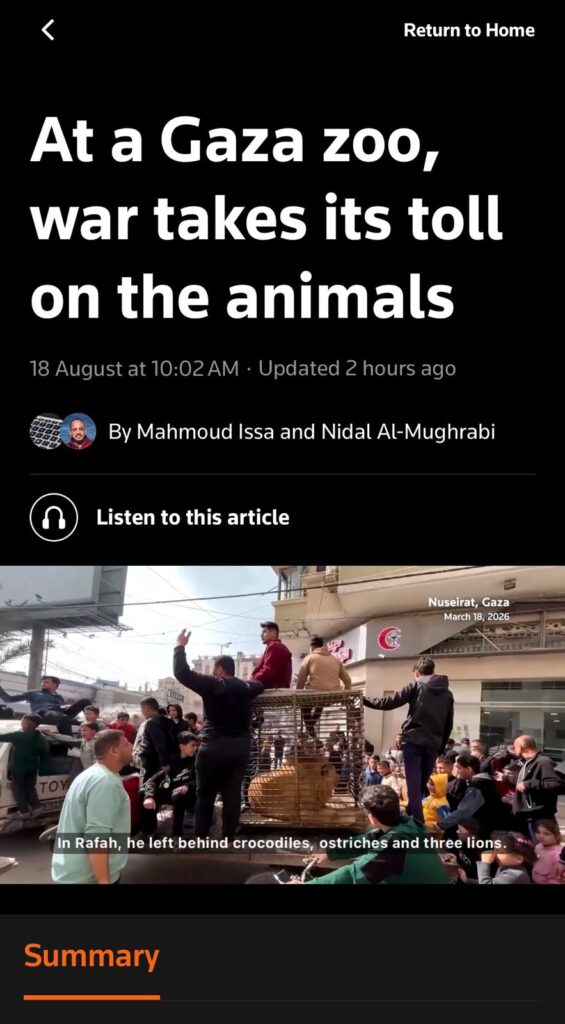
On August 18, Reuters published “At a Gaza zoo, war takes its toll on the animals,” reported by Gaza-based photographer Mahmoud Issa and correspondent Nidal al-Mughrabi in Cairo. The story follows zookeeper Mahmoud Gomaa, who previously operated an attraction in Rafah and, according to Reuters, fled in 2024 before repeatedly moving his surviving animals and eventually reopening a facility in Nuseirat in 2026.
There, children can once again visit lions, monkeys, parrots and other animals. It is presented as another human-interest story about the effects of war on Gaza and, more specifically, on those creatures unable to escape it.
But an important piece of context is largely missing from the Reuters account. Gaza’s zoos had a documented history of severe animal-welfare problems long before October 7, 2023, and one of the experts quoted in the latest story was directly involved in dealing with those problems years earlier.
Gaza’s Zoo Problems Did Not Begin With This War
In April 2019, more than four years before the October 7 Hamas attacks and the war that followed, The Guardian reported that 43 animals were being evacuated from a Gaza zoo and transferred to Jordan in an operation carried out by Four Paws, the international animal-welfare organization.
The animals included lions, monkeys, ostriches, peacocks and a hyena, while the circumstances that prompted their removal were grim. Four lion cubs had died during cold weather, two young lions had reportedly been declawed so visitors could pose for photographs with them, and Four Paws said cages had become too small as the animals reproduced. Those remaining were described as thin, weak and living in “terrible conditions,” while other animals had died from starvation and inadequate care.
None of this occurred during the current war.
The Guardian did report the zoo owner’s claim that Gaza’s economic situation and the Israeli-led blockade had contributed to his inability to care properly for the animals. That was relevant context, but so too was the documented reality that Gaza’s zoos were already suffering serious problems involving captivity, neglect and animal welfare years before October 7.
That makes one detail in Reuters’ new report particularly noteworthy. Veterinarian Amir Khalil of Four Paws appears in the 2026 feature, where Reuters identifies him as someone who has rescued animals from other Gaza zoos and quotes him discussing the physical and psychological impact of the current war.
What Reuters does not tell readers is what those earlier rescues actually involved. Khalil led the 2019 operation that removed dozens of animals following starvation deaths and other serious welfare concerns. In other words, the history was hardly obscure; Reuters was interviewing someone who had been personally involved in it.
What Reuters’ Own Photographs Show
Reuters’ framing also sits somewhat awkwardly alongside its own photographic evidence.
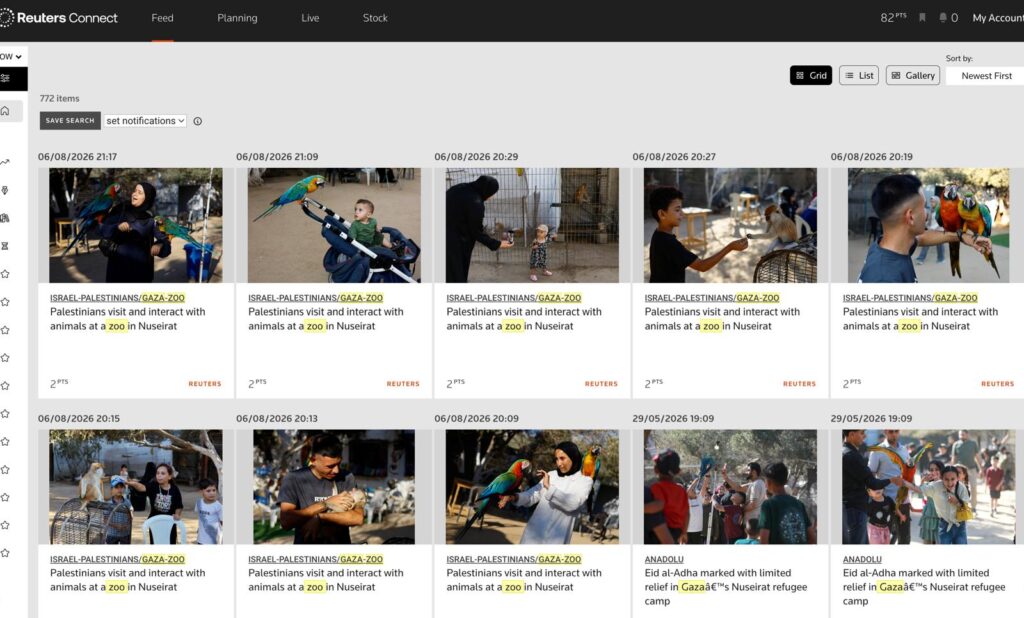
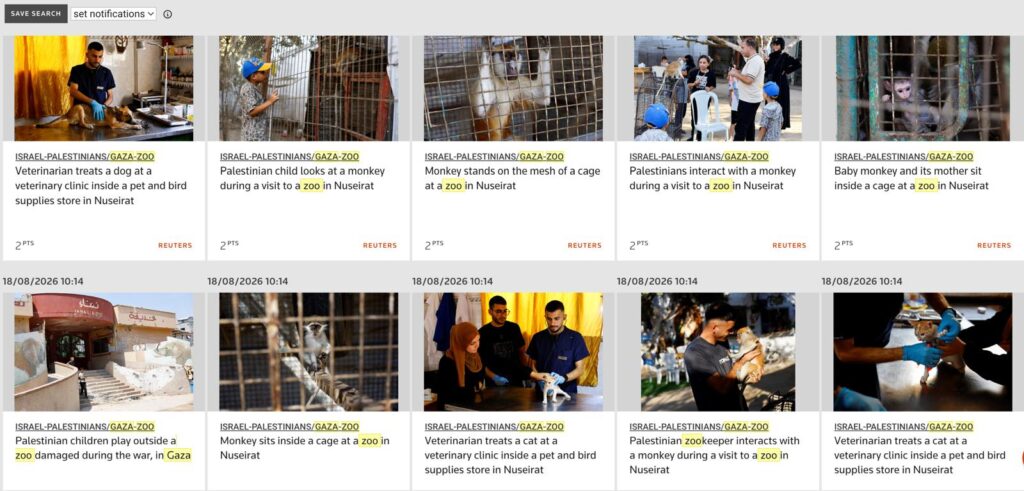
Issa produced an extensive visual package distributed through Reuters Connect under the slug “ISRAEL-PALESTINIANS/GAZA-ZOO.” The photographs show damaged facilities and animals receiving treatment, but they also show something else: an operating recreational attraction.
Palestinian families can be seen visiting the zoo, children interacting with animals, macaws perched alongside visitors and monkeys being fed through cages. A lion remains housed at the facility, while other images show cats and dogs receiving veterinary treatment. Reuters itself explains that Gomaa reopened the attraction in order to give Gaza’s children somewhere to find enjoyment after years of war.
None of this means the hardship described by Reuters is imaginary. The report says that food, medicines and vaccines have become difficult to obtain, while Gomaa says crocodiles and ostriches he was forced to leave behind were later found dead and that three lions disappeared.
War has plainly made the already difficult task of keeping exotic animals in Gaza even harder. Yet Reuters’ own photographs document something more complicated than simply a zoo devastated by war: they show a zoo continuing to operate during one, with families visiting, children interacting with animals and veterinary care still being provided.
That does not negate suffering. It does, however, provide important context for how that suffering is presented.
How a Gaza Zoo Becomes an International Story
The Reuters package did not remain on the wire. The story appeared in publications including the Jerusalem Post and Internazionale, while The Independent separately turned the zoo into another international feature about Gaza.
This is how a local story becomes part of a much larger narrative. A Gaza photographer produces the images, Reuters combines them with a written feature, and the wire service distributes both internationally to publications whose audiences are unlikely to know anything about Gaza’s previous record of animal-welfare problems.
A photograph of a lion or monkey in Gaza therefore becomes more than simply a photograph of an animal. It becomes another visual representation of what the war has done to Gaza, which is precisely why the context surrounding those images matters.
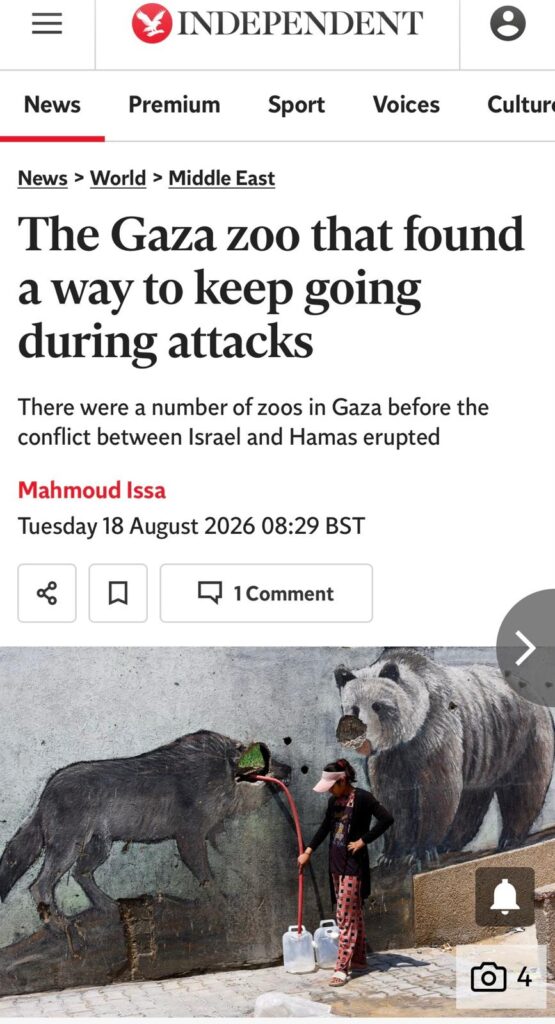
The Photographer Behind the Images
Mahmoud Issa is not simply an anonymous photographer whose pictures happened to reach Reuters. He is an established Gaza photojournalist whose work has circulated internationally throughout the conflict and whose imagery has previously appeared in HonestReporting’s examination of the photographers supplying material from inside Gaza.
His role in this case was substantial. Reuters Connect carries a deliberately assembled photographic package showing visitors, children, animals, veterinary treatment, cages and damaged facilities, while Issa also shares the byline on the accompanying Reuters story with al-Mughrabi.
The photographs establish the visual environment through which readers encounter the story, while the copy provides the narrative used to interpret them. Reuters, in turn, supplies the distribution network capable of carrying that package from a zoo in Gaza into news publications around the world.
That makes the editorial decisions surrounding what is included, and what is omitted, all the more significant.
When Context Disappears
There is nothing inherently wrong with reporting on animals suffering during war, just as there is nothing wrong with reporting on attempts to provide children with some form of recreation amid destruction and displacement. The relevant journalistic question is whether readers are being given enough information to understand what they are seeing.
Reuters places the difficulties facing Gaza’s zoo animals overwhelmingly within the context of the current war. Yet international animal-welfare organizations and news outlets were documenting serious problems at Gaza zoos years earlier. Animals starved, lion cubs died, young lions were declawed so visitors could pose with them and dozens of animals eventually had to be removed by an international welfare organization.
One of the people directly involved in that operation was interviewed for Reuters’ new story, yet almost none of that history survives into the latest account.
That matters because journalism does not have to publish a false photograph or invent a fact in order to leave readers with a distorted impression. Every photograph in the Reuters package can be genuine and every hardship described can be real, while the resulting story can still be incomplete if longstanding problems are presented almost exclusively through the prism of the current war.
Reuters’ own photographs demonstrate why the reality is more complicated. Almost three years into the war, Palestinian families are visiting a functioning Gaza zoo, children are feeding monkeys and interacting with parrots, and animals are receiving veterinary treatment. At the same time, there is no reason to dismiss the additional hardship the war has inflicted on the animals or those attempting to care for them.
Both things can be true.
What cannot be ignored is the historical record. Years before October 7, animals in Gaza’s zoos were already starving, dying and being evacuated by international welfare organizations.
War may have compounded those problems, but it did not create their history.
And when an international wire service leaves that distinction out of the story, readers are not getting the full picture.
Liked this article? Follow HonestReporting on Twitter, Facebook, Instagram and TikTok to see even more posts and videos debunking news bias and smears, as well as other content explaining what’s really going on in Israel and the region. Get updates direct to your phone. Join our WhatsApp and Telegram channels!
© Divuach Ne’eman R”A, 2025