


Key Takeaways:
- Farsi social media is filled with pro-Israel and anti-regime sentiment, a reality largely absent from Western media coverage.
- While reporters rely on tightly controlled access inside Iran, unfiltered voices online tell a very different story.
- Experts say these posts reflect genuine anger toward the regime, challenging the narrative that Iranians uniformly oppose outside strikes.
As the current war with Iran unfolds, one arena remains largely absent from Western media coverage: Farsi social media.
In recent weeks, Persian-language platforms have seen a surge of posts expressing support for Israeli and American strikes against Iranian regime targets. Yet this sentiment is almost entirely missing from mainstream reporting. Instead, major outlets continue to rely on tightly-controlled access inside Iran, presenting curated street interviews as a reflection of public opinion.
The gap is striking.
On X, a user identified as Alireza Kiani posted a message thanking Israel, sharing footage of an IDF strike on an Islamic Revolutionary Guard Corps base. “Thanks to Israeli friends,” he wrote in Farsi.
سپاس از دوستان اسرائیلی https://t.co/EWRoSiGEuJ
— Alireza Kiani (@alirezakiani2) March 23, 2026
In a separate video shared on YouTube, an Iranian woman expressed gratitude to both the United States and Israel for targeting IRGC headquarters. She thanked them for striking “the killers” and added that it was done “for all those who were murdered.”
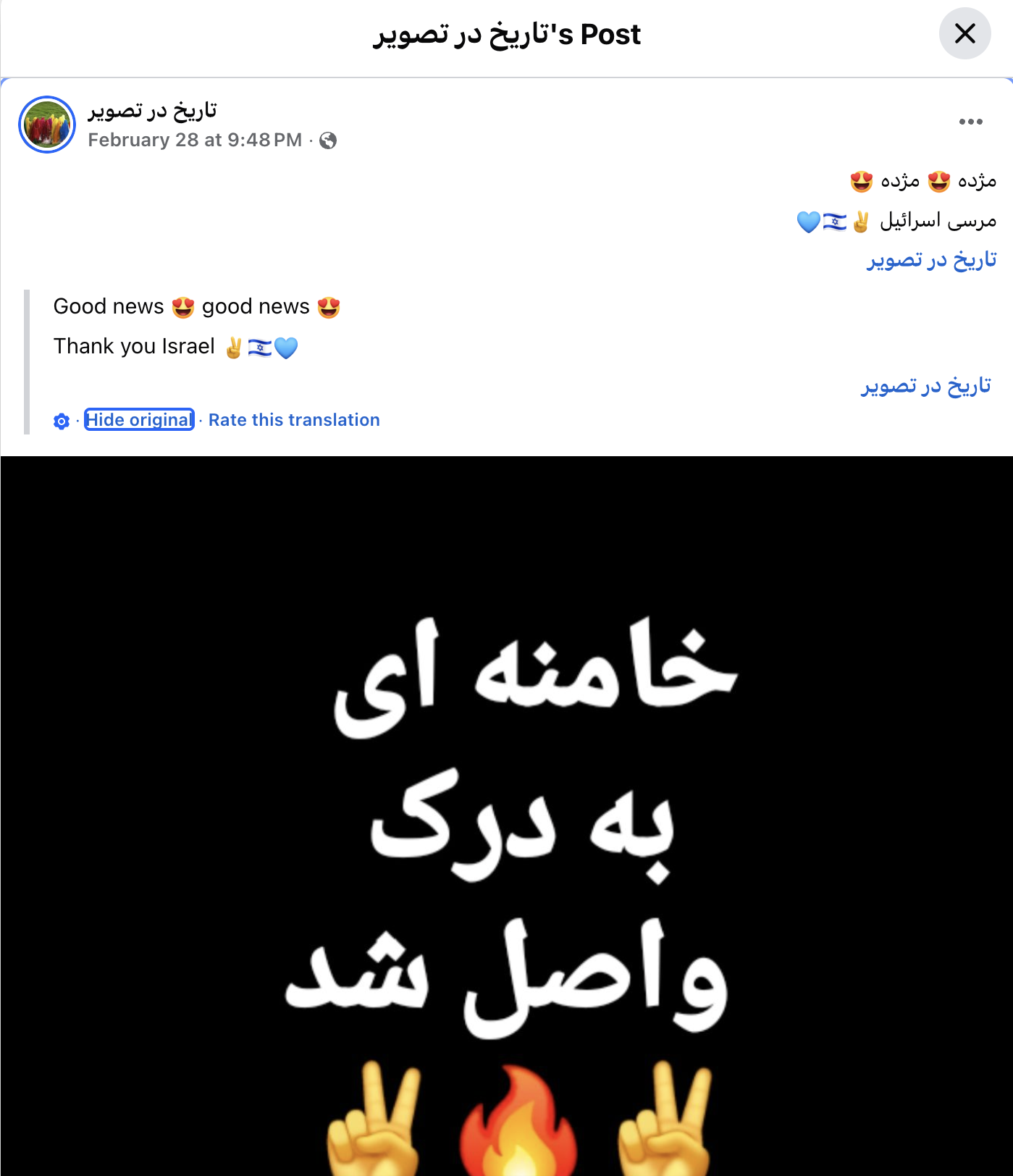
On Facebook, another user posted an image reading “Khamenei has gone to hell,” accompanied by the caption: “Good news, thank you Israel.”
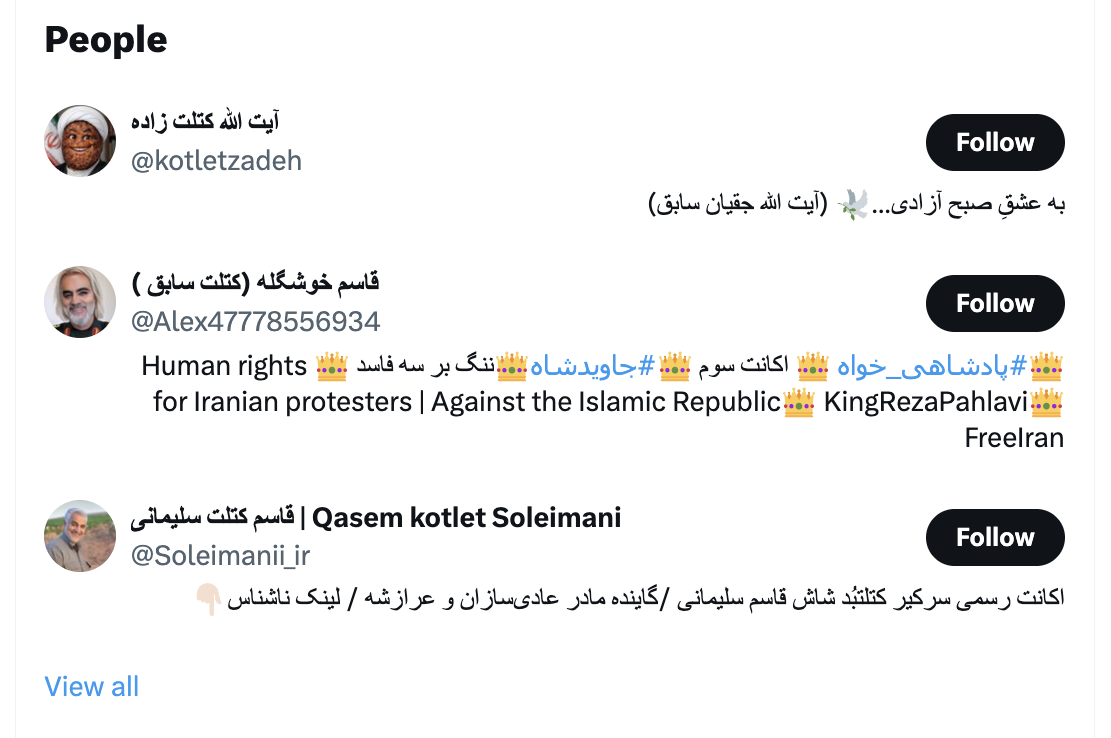
Many Iranians on social media have also adopted the Farsi word “کتلت” (kotlet), meaning a meat cutlet, in their usernames, using it as dark humor to celebrate the elimination of regime officials, implying they have been reduced to “cutlets.”
Related Reading: Access or Accommodation? Sky News’ Reporting From Iran Raises Serious Questions
These are not isolated examples.
To better understand this phenomenon, HonestReporting spoke with Alex Greenberg, an Iran expert at the Jerusalem Institute for Strategy and Security and a former member of the IDF Military Intelligence Research Department. He cautioned that it is difficult to determine whether specific posts originate from within Iran, where there is an internet blackout, or from the diaspora. But he emphasized that the sentiment itself is significant.
“These posts reflect a real mood,” Greenberg said. “Many Iranians feel terrorized by a regime that has been butchering their families. Some families need to pay ransom to retrieve the bodies of murdered relatives. The regime has no legitimacy.”
This reality rarely makes it into Western reporting.
Instead, viewers are presented with on-the-ground coverage from correspondents such as CNN’s Fred Pleitgen and Sky News’ Dominic Waghorn, who report from Tehran with official approval. Their access is necessarily mediated. Interviews are conducted in an environment shaped by surveillance, censorship, and fear.
Now we know why Dominic Waghorn was one of the few Western journalists allowed into Iran.
To echo Iranian regime propaganda so eloquently requires rare qualities like skilled writing and no moral backbone. https://t.co/W3aaUuS5l7
— HonestReporting (@HonestReporting) March 19, 2026
The result is a narrow picture.
Reporters speak to civilians affected by the war, but there is no possibility for engagement with dissenting voices or critics of the regime. The broader context of repression and the risks associated with expressing opposition are often underplayed. Social media, where more candid expressions can emerge, is largely ignored.
Greenberg argues that this reflects a deeper assumption in Western coverage.
“Out of habit or antisemitism, people assume that populations under attack will oppose those carrying out the strikes,” he said. “But in Iran, many see the regime as the real enemy. Most were hoping for an American or Israeli strike.”
That complexity challenges a familiar narrative.
It is easier to report from the street, escorted by an official, than to navigate a fragmented and partially censored online space. It is easier to present visible suffering than to explore underlying political sentiment. It also looks like a courageous journalistic achievement. But in doing so, coverage risks missing a crucial part of the story.
Farsi social media, despite its limitations, offers something that state-managed access cannot: a glimpse into voices that do not pass through official filters.
Ignoring that arena means ignoring part of the reality.
At a time when information is tightly controlled inside Iran, the question is not whether social media is a flawless source. It is whether journalists can afford to overlook it altogether.
Right now, they do.
Liked this article? Follow HonestReporting on Twitter, Facebook, Instagram and TikTok to see even more posts and videos debunking news bias and smears, as well as other content explaining what’s really going on in Israel and the region. Get updates direct to your phone. Join our WhatsApp and Telegram channels!