UPDATE
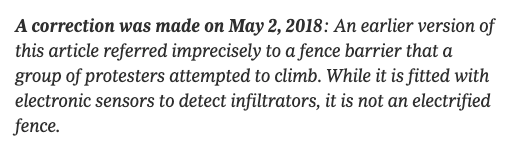
Following the publication of this post and in response to your complaints, the New York Times has issued the following correction:
The New York Times decided to report from inside the heart of the Palestinian violence currently taking place on Israel’s border with Gaza under the headline: “Plan to Storm Fence Gets Bloody Preview in Gaza.”
So what of this fence?
For the first time in five weeks of protests, some reached the second barrier — an electrified, sensor-laden fence that marks the edge of Israeli territory — and tried to climb it or pull it down. A few hundred yards beyond it lies the Israeli farming community of Nahal Oz. …
Ibrahim Shahin, 26, said he was among a group of about 12 men who cut through the barbed wire and then began climbing the electrified fence.
An “electrified” fence?
Were the 12 men climbing this fence wearing rubber gloves and boots?
Of course not.
Because nobody will be shocked or electrocuted if they touch either the Gaza fence or the security barrier that prevents Palestinian terrorists from infiltrating into Israel from the disputed territories.
[elementor-template id="323780"]Describing both of these structures as “electrified” conjures such images and this language is regularly employed by anti-Israel propagandists to challenge the reality of these fences as defensive and non-lethal measures.
But don’t just take it from us. The New York Times itself looked at the border zone, including the fence, in great detail in an earlier feature that is even linked to from within the story that erroneously describes the fence as “electrified.”
The fence that separates Gaza’s 2 million people from Israel is not the sturdiest of barriers. To penetrate Israel, a Gazan would have to get past a crude barbed-wire barrier and cross a short distance, then get over or through a 10-foot-high “smart fence” packed with sensors to detect infiltrators. If a crowd of thousands surged toward the fence, it would take about 30 seconds to cross, the contractor who built it told Bloomberg News.
Indeed, the fence is electronic and will alert the IDF to any tampering or breach but it will certainly not provide any real obstacle for any determined infiltrator wielding wire cutters.
Language matters. Facts matter. The New York Times has clearly erred as its own prior description of the fence demonstrates.
Despite a request for a correction, the NY Times has yet to follow through.
Help us get the correction: Send an email to [email protected] quoting this link and requesting that the reference to “electrified” be removed.
© Divuach Ne’eman R”A, 2025