Key Takeaways:
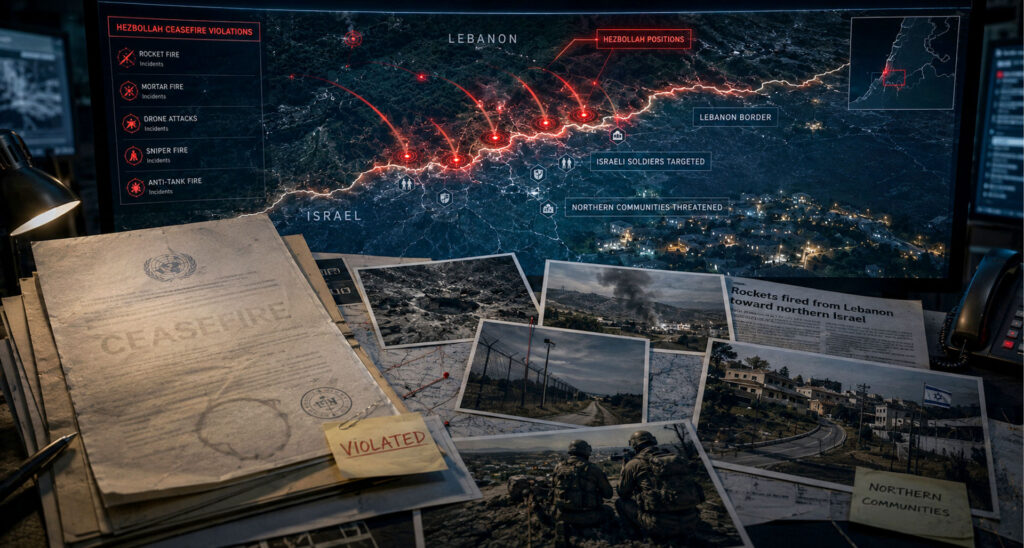
- Since the ceasefire between Israel and Lebanon began on April 17, 2026, Hezbollah has consistently violated it by attacking Israeli soldiers stationed in southern Lebanon as well as Israeli communities along its northern border.
- For the first 24 days of the ceasefire, Hezbollah attacked Israeli forces and territory 220 times, including with drones, rockets, explosive devices, and other weapons.
- Despite this pattern of violence and intransigence, the media has turned a blind eye to Hezbollah’s ceasefire violations, choosing instead to portray Israel as the primary aggressor and threat to the viability of the ceasefire.
Since the ceasefire between Israel and Lebanon began on April 17, 2026, much of the media coverage has portrayed Israel’s defensive actions in southern Lebanon as a threat to the agreement’s stability while either ignoring or minimizing the repeated ceasefire violations committed by the Iran-backed terrorist group Hezbollah.
A recent France24 article, for example, focused heavily on Israeli strikes against terror targets in southern Lebanon — actions permitted under the ceasefire agreement — while reducing Hezbollah’s attacks to vague “exchanges of fire.”
Similarly, a Washington Post report published a week earlier falsely claimed that Hezbollah had only targeted Israeli troops in southern Lebanon, rather than Israeli territory itself. The error was later corrected after HonestReporting highlighted the inaccuracy.
Yet despite a dominant media narrative suggesting Israel is the primary party endangering the ceasefire, the facts point in the opposite direction.
No, @France24_en, there is no ceasefire between Israel and Hezbollah.
There is a ceasefire between Israel and Lebanon – one Hezbollah has repeatedly violated.
And under that agreement, Israel retains the right to act against imminent Hezbollah threats.
Facts? Wrong.
Context?… pic.twitter.com/MOFwysNhbd— HonestReporting (@HonestReporting) May 11, 2026
According to the Alma Research and Education Center, Hezbollah has not reduced its rate of attacks since the ceasefire began. In fact, the group may be increasing its operational tempo.
While most Hezbollah attacks have targeted Israeli forces operating in southern Lebanon, the organization has also repeatedly attacked civilian communities inside northern Israel.
Crucially, Alma notes that Hezbollah’s attacks are not — as often portrayed in media reports — responses to Israeli actions. Rather, they constitute “an independent and ongoing pattern of activity.”
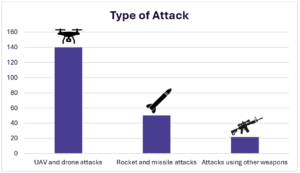
According to Alma’s tally of ceasefire violations, Hezbollah carried out 220 attack waves against Israeli personnel and territory between April 17 and May 10, 2026.
Of those attacks, 82.7% targeted IDF forces in southern Lebanon, while 18.3% targeted sovereign Israeli territory. Although most attacks on Israeli territory focused on communities near the northern border, others reached deeper into Israel, including the Acre and Haifa areas.
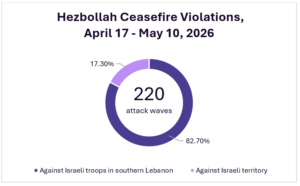
The majority of Hezbollah’s attack waves involved drones and UAVs — many carrying explosives — accounting for 140 incidents. Rockets and missiles were used in 58 attacks, while an additional 22 incidents involved anti-aircraft fire, small arms fire, anti-tank weapons, and explosive devices.
Hezbollah’s attacks have continued beyond the reporting period covered by Alma.
Recent incidents include:
- May 12: A drone swarm directed against Israeli forces in southern Lebanon (which wounded two soldiers) and against communities in northern Israel.
- May 13: A drone attack on northern Israel, near Kiryat Shmona.
- May 14: A drone attack on the northern city of Rosh Hanikra, which wounded three Israeli civilians.
View this post on Instagram
Although Hezbollah was not formally a signatory to the current ceasefire between Israel and Lebanon, its attacks still violate the earlier ceasefire agreement reached in November 2024. Hezbollah has systematically violated that agreement since its inception.
As previously documented by HonestReporting, Hezbollah committed 1,925 ceasefire violations between November 27, 2024, and December 15, 2025. These included rearming, refusing to disarm, and maintaining military infrastructure south of the Litani River in direct violation of the agreement.
Yet throughout this period, much of the media remained disproportionately focused on Israel’s responses to Hezbollah aggression rather than the violations themselves.
When media outlets place Israel’s defensive actions under intense scrutiny while minimizing Hezbollah’s repeated attacks, they create a distorted narrative in which Israel is portrayed as the primary aggressor threatening the ceasefire’s viability, while Hezbollah is stripped of agency and responsibility for its own actions.
Liked this article? Follow HonestReporting on Twitter, Facebook, Instagram and TikTok to see even more posts and videos debunking news bias and smears, as well as other content explaining what’s really going on in Israel and the region. Get updates direct to your phone. Join our WhatsApp and Telegram channels!
© Divuach Ne’eman R”A, 2025