


Key Takeaways
- Ramadan imagery from Gaza follows a recurring visual grammar: long communal tables, compressed crowds, and rubble-framed backdrops engineered for emotional impact rather than documentary neutrality.
- Images captured inside Hamas-controlled territory — including recurring work from Anadolu-linked photographers such as Khames Alrefi — move through global wire services and into international broadcast platforms without scrutiny of staging conditions.
- The issue is not religious observance. It is the systematic visual instrumentalization of civilians and sacred symbolism within a supply chain that converts ritual into geopolitical narrative.
The Ramadan Recurrence
As Ramadan begins, a familiar sequence of images emerges from Gaza.
Long iftar tables appear between damaged buildings. Families are photographed breaking fast beside collapsed concrete. Children sit against shattered mosque domes. Decorative lighting hangs across corridors of destruction.
These images circulate rapidly. They are often first distributed by regional agencies – frequently Anadolu Agency – then syndicated by international wire services such as AFP, Reuters, Getty, and AP. Within hours, they appear on global platforms and broadcasters, presented as documentary evidence of civilian endurance.
Across years and conflict phases, the recurrence is notable.
The compositional structure is consistent.
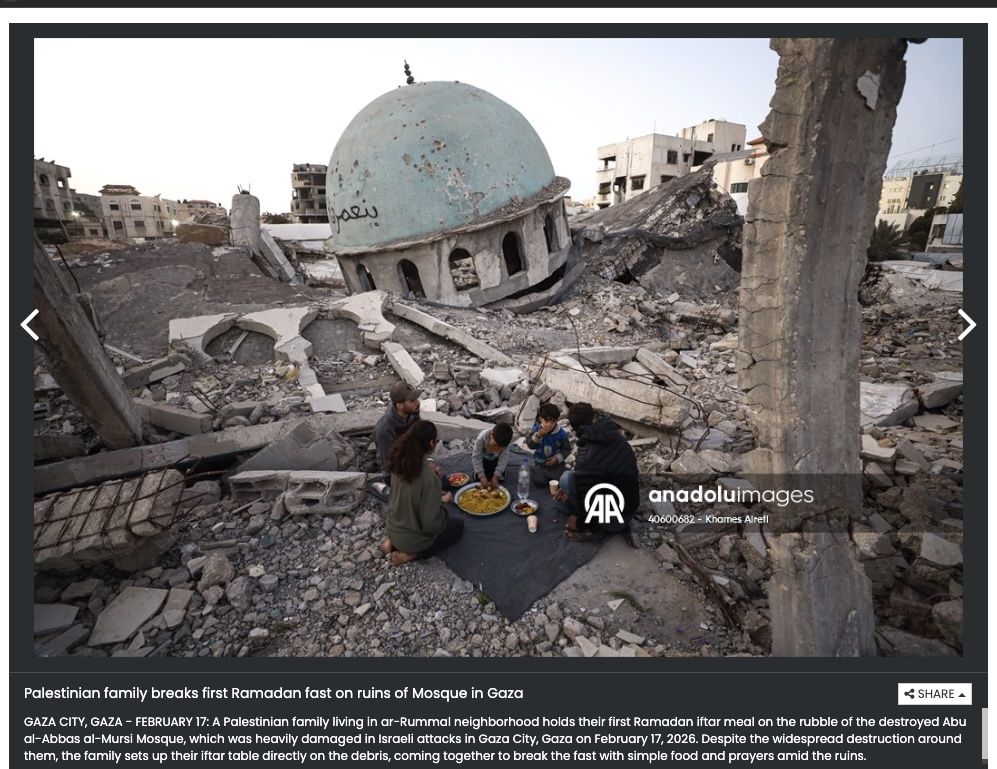
The Visual Grammar of Ramadan in Gaza
Ramadan imagery from Gaza frequently exhibits the same structural elements:
- Communal meals positioned within visible destruction
- Religious architecture incorporated prominently into frame
- Dense subject clustering to increase emotional intensity
- Elevated or carefully selected camera angles
- Rubble used as foreground framing
- Color contrast between food and grey debris
Individually, none of these elements proves staging.
Collectively – and repeatedly – they indicate deliberate compositional design.
The aesthetic juxtaposition is clear: devotion set against devastation.
The effect is narratively efficient. One frame communicates both piety and loss.
Case Study: The February 18 Alrefi Photograph
An image credited to Khames Alrefi (Anadolu Agency, February 18, 2026, Al-Rummal neighborhood, Gaza City) depicts a Palestinian family seated on a mat amid rubble, with the collapsed dome of the El Abbas Mosque dominating the background.
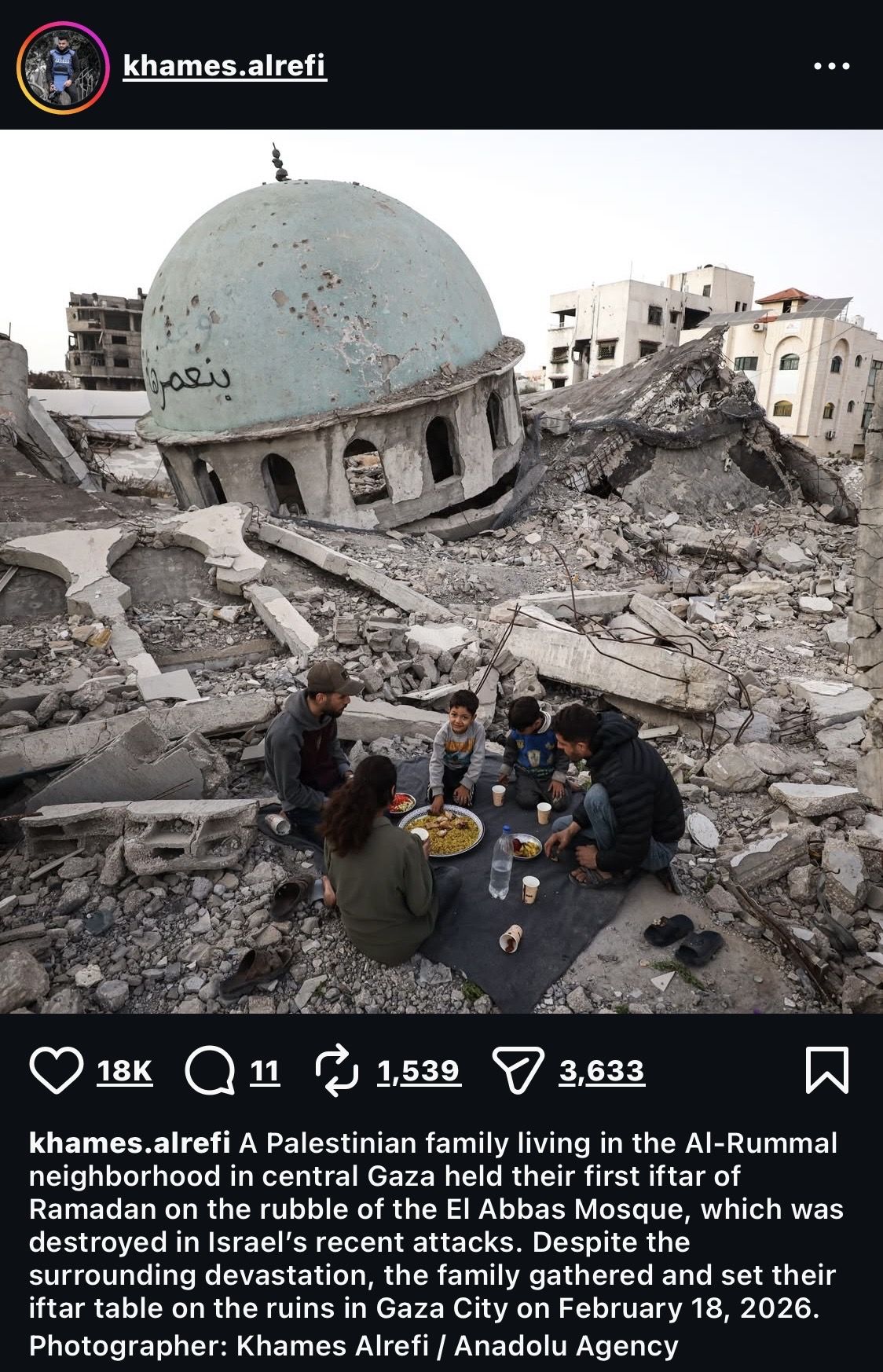
A compositional breakdown reveals the following:
Camera Position
The camera is positioned at an elevated mid-distance, capturing:
- The entire family group
- The damaged mosque dome
- Surrounding destruction
This alignment requires intentional framing distance and spatial planning.
Subject Orientation
All participants remain visible to the camera. Faces are unobstructed. Children occupy the central axis of the image. No subject blocks another.
The arrangement maximizes visual clarity.
Symbolic Layering
The shattered mosque dome occupies the upper half of the frame. Arabic calligraphy remains legible. The structure leans at an angle, reinforcing visual instability.
The religious symbol functions as a compositional anchor, not an incidental background.
Environmental Placement
The family is seated directly amid fractured concrete rather than in adjacent cleared areas. Rubble encircles the mat. The debris field remains visually intact.
The setting intensifies the contrast between sacred observance and destruction.
Object Visibility
Plates are evenly distributed. Cups remain upright and visible. A centrally placed water bottle stands vertically. The food’s color contrasts sharply with the surrounding grey rubble, increasing readability.
Depth Structure
The mosque dome creates vertical dominance. The seated family forms horizontal grounding. Secondary background structures remain visible but subordinate.
The frame achieves visual balance between ruin and ritual.
Recurrence and Environment
The Alrefi image is not anomalous.
Across Ramadan cycles, similar patterns appear:
- Meals positioned within high-visibility destruction zones
- Religious structures integrated into the background
- Dense clustering to amplify emotional scale
- Elevated perspectives compressing spatial depth
When such gatherings repeatedly occur in visually dramatic destruction corridors rather than neutral or cleared spaces, the question of intentional arrangement becomes relevant.
In a territory where press access and movement operate within structural constraints, spontaneity cannot simply be assumed. Production conditions matter.
The Distribution Chain
The pathway of these images follows a consistent sequence:
- Captured within Hamas-controlled territory
- Distributed via regional agencies (often Anadolu)
- Acquired by international wire services
- Published globally without inquiry into staging conditions
- Amplified by major broadcasters
- Integrated into language framing that escalates political interpretation
By the time the image reaches global audiences, the circumstances of its production are no longer visible. The visual remains; the production context does not.
Each stage of transfer increases institutional legitimacy. Each stage reduces scrutiny of how the image was composed.
From Gaza to Sky News: Broadcast Amplification
The process does not end with wire services.
Images credited to Gaza-based photographers are subsequently amplified by major broadcasters. In one recent example, Sky News circulated Ramadan banquet imagery featuring long tables placed between collapsed buildings, decorative string lights suspended across debris corridors, and dense communal seating framed by destruction.
The compositional characteristics mirror those identified earlier:
- Symmetrical table placement within cleared corridors
- Decorative lighting enhancing contrast
- Tight cropping that excludes broader environmental context
- Emphasis on “life amid ruins” as visual shorthand
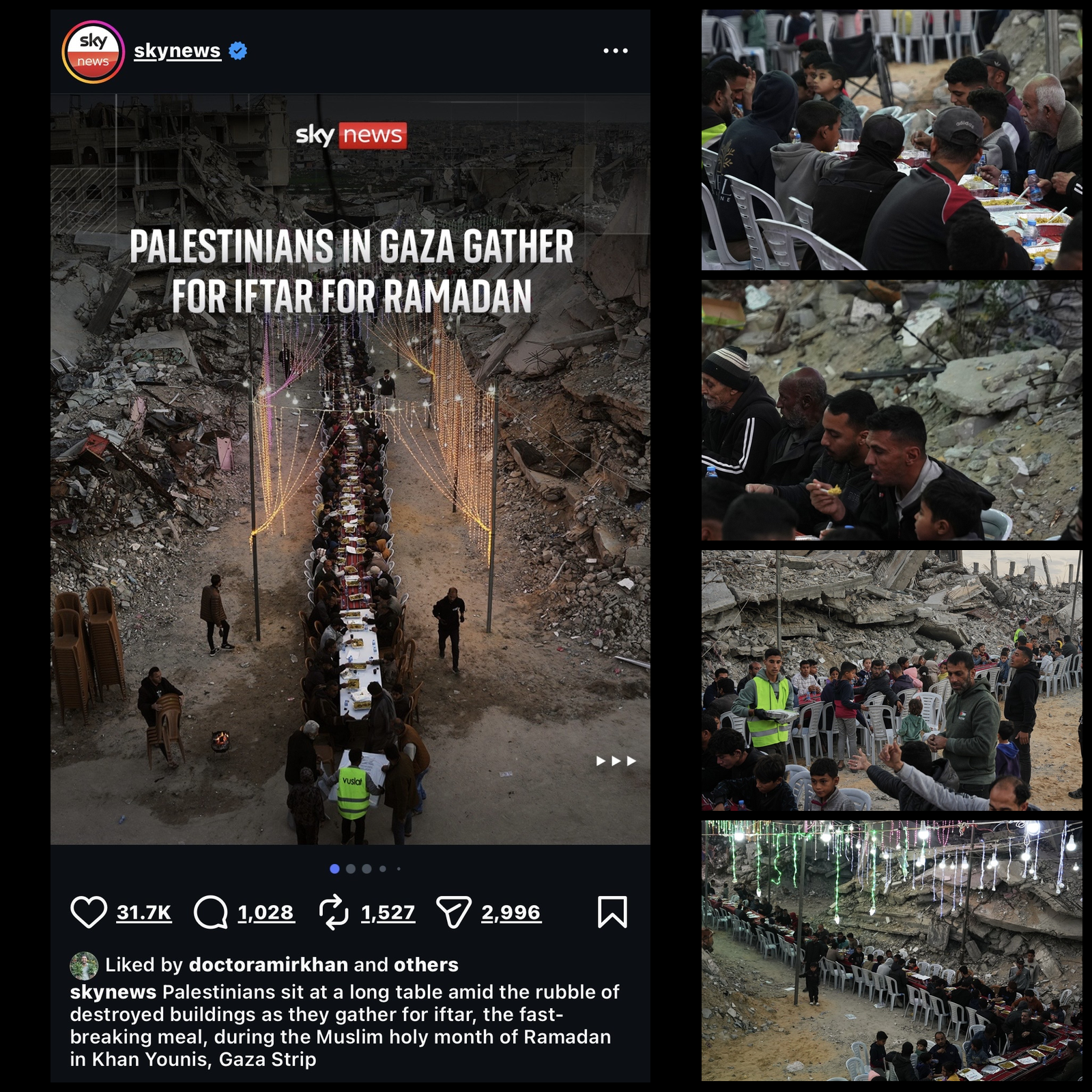
Captioning typically describes Palestinians gathering “amid the rubble.” The language is observational. The image performs the emotional function.
Absent from the broadcast presentation is an examination of how the scene was arranged, why that location was selected, or whether alternative settings were available.
The distribution chain – photographer → regional agency → wire service → broadcaster – converts a locally arranged scene into global documentary evidence.
Image and Language
When Ramadan imagery is paired with escalatory political language, the symbolic power of the frame increases.
Sacred ritual carries moral weight. Positioned within visible destruction, it reinforces narrative conclusions without requiring textual argument.
The image operates as moral evidence.
The production architecture disappears beneath symbolism.
Civilian Presence and Visual Economy
This analysis does not dispute the legitimacy of Ramadan observance.
It examines the visual mechanics surrounding its repeated presentation.
When civilians are consistently photographed within high-impact destruction zones, they function within a visual economy that prioritizes symbolic intensity. In such cases, compositional impact becomes central.
The repetition across years suggests continuity of method rather than isolated documentation.
Integrity of Production
Modern conflicts are mediated overwhelmingly through images. Questions of authenticity, therefore, extend beyond digital manipulation.
Synthetic imagery can fabricate events.
Physical staging can shape perception.
In both cases, verification of production context becomes essential.
When religious observance is repeatedly framed within curated destruction and globally syndicated without examination of how scenes were arranged, journalism risks transmitting narrative rather than interrogating it.
In image-driven conflicts, the integrity of production conditions matters as much as the integrity of pixels.
Liked this article? Follow HonestReporting on Twitter, Facebook, Instagram and TikTok to see even more posts and videos debunking news bias and smears, as well as other content explaining what’s really going on in Israel and the region. Get updates direct to your phone. Join our WhatsApp and Telegram channels!