Key Takeaways:
- Sky News’ Dominic Waghorn is reporting from Iran, but his reporting omits that the Iranian regime grants access to the country and, therefore, his ability to report is heavily monitored.
- Waghorn’s Iran reporting is presented as an inside look at Iran during war, but the picture he paints portrays Israel and the U.S. as aggressors, intentionally targeting civilians rather than the regime.
- By failing to disclose these constraints, the reporting amplifies regime-approved narratives while presenting them as independent journalism.
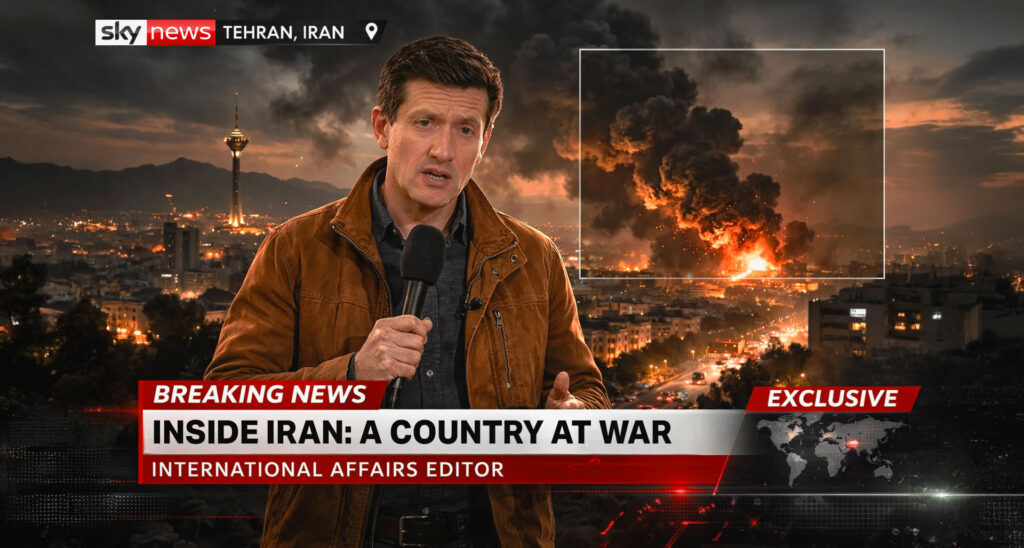
Sky News has joined CNN as one of the few Western outlets permitted to report from inside Iran. The result? Coverage that increasingly mirrors regime messaging rather than challenges it.
When Sky News correspondent Dominic Waghorn entered Iran this week, his reporting immediately struck a familiar tone: controlled access, carefully framed visuals, and little acknowledgment of the conditions under which he is operating.
This should surprise no one. Iran ranks among the worst countries in the world for press freedom. The regime tightly controls all media activity, dictating who can enter, what they can film, and whom they can interview.
At the same time, ordinary Iranians remain cut off. Internet access has been severely restricted under a widespread blackout. Even VPN access is unreliable. Waghorn himself posted on his X account that “international internet” remained down, which raises an obvious question: how is his team able to report and transmit content when millions of Iranians cannot?
Yet viewers are given no transparency. Sky News does not disclose the restrictions placed on its reporting, nor the regime’s role in facilitating access.
That omission matters.
Because access in Iran is never neutral. It is conditional.
Dominic Waghorn won’t tell you that he is in Iran with the regime’s express permission. Sky News won’t add a disclaimer.
He says he’s seen even bigger airstrikes, “big industrial areas obliterated, twisted metal, charred metal.” But he’s chosen to report from a scene where there… https://t.co/pK01PNoQJH
— HonestReporting (@HonestReporting) March 17, 2026
That’s why there were no international media in Iran at the beginning of 2026, when innocent civilians were being attacked and massacred on the streets for protesting the brutal and oppressive regime. Why is it only now that Waghorn and Sky News have been allowed in? What message are they trying to send to viewers in the West?
Even before entering Iran, concerns had surfaced. Days earlier, Waghorn attended an “Iran National Day” event at the Iranian Embassy in London alongside other journalists. While he framed this as routine, the optics are difficult to ignore: access journalism that risks crossing into accommodation.
Just to be clear AGAIN yes journalists myself among them were at the Iran National Day event at the Iranian Embassy including ITV, CNN et al as they are every year. To commit journalism. I’m now in Tehran doing the same.
— Dominic Waghorn (@DominicWaghorn) March 15, 2026
When Waghorn entered Iran, he was quick to show footage of damage from Israeli and American airstrikes. But the footage itself is carefully selected to tell the story the regime wants the world to know. In one location, he notes how residents in one location told him that a “security organization” was targeted. He does not explore what that means — or its likely connection to the Islamic Revolutionary Guard Corps (IRGC). Nor does he examine why such facilities are embedded within civilian areas.
Sky’s @DominicWaghorn visits the site of an airstrike in east Tehran.
Iran’s authorities say 40 people were killed.
? https://t.co/nE3uXEcXb2 pic.twitter.com/EQOHrmas73
— Sky News (@SkyNews) March 18, 2026
Instead, the focus remains on surrounding damage, reinforcing the impression of indiscriminate attacks.
The same applies to references to “industrial sites” struck in air raids. Missing is the critical context: these sites are often linked to IRGC infrastructure, missile production, or military logistics — legitimate targets under the laws of armed conflict.
Under regime supervision, such context is not easily reported. What is permitted is imagery that suggests civilian victimhood.
View this post on Instagram
The aim is to present Israel and the U.S. as targeting civilians who live under the “daily threat of being attacked from the air.” But the only people who live under threat of being deliberately targeted are those members of the regime itself.
Although there have certainly and unfortunately been civilian deaths in Iran, they are neither the target of the Israelis nor the Americans. Waghorn’s carefully curated reporting, however, fabricates the story that Israel and the U.S. are unjustifiably and imprecisely conducting airstrikes across Iran.
At one point, he observes that life continues as normal in a market despite nearby anti-aircraft fire. The more obvious explanation – that civilian areas are not the intended targets – goes unexamined.
The limitations of this reporting become even clearer in Waghorn’s interview with Iran’s deputy foreign minister, Saeed Khatibzadeh.
Given a platform to denounce Israel and the United States for “rogue behavior” and acting “illegally” and “recklessly,” Khatibzadeh’s claims are presented with little meaningful challenge. The result is not scrutiny, but amplification.
In a media environment tightly controlled by the regime, such interviews are not access. They are messaging opportunities.
Sky’s @DominicWaghorn is among one of the only international journalists currently allowed into Iran.
He witnesses the impact of the war on the ground, as it continues to escalate.
➡️ https://t.co/3VPt4ffYMB pic.twitter.com/jwYFA7ggKy
— Sky News (@SkyNews) March 16, 2026
The pattern continues.
Waghorn was granted access to the funeral of Ali Larijani, a figure associated with the regime’s violent crackdown on protests earlier this year. His reporting described mourners honoring Iran’s “fallen heroes” and referenced a national “culture of resistance” — language that closely echoes official state rhetoric.
This is not simply observation. It reflects the subtle but powerful influence of operating within a controlled narrative environment.
Now we know why Dominic Waghorn was one of the few Western journalists allowed into Iran.
To echo Iranian regime propaganda so eloquently requires rare qualities like skilled writing and no moral backbone. https://t.co/W3aaUuS5l7
— HonestReporting (@HonestReporting) March 19, 2026
If Dominic Waghorn is among the very few Western journalists allowed into Iran, the question is unavoidable: what makes his reporting acceptable to the regime?
In Iran, access is granted selectively. And it always comes with conditions.
Failing to disclose those conditions is not a minor oversight. It is a fundamental lapse in transparency that undermines claims of independent journalism.
Because in a system where every movement is monitored and every image is curated, what is not shown can be just as important as what is.
And without that context, viewers are not seeing Iran as it is, but as the regime wants it to be seen.
Liked this article? Follow HonestReporting on Twitter, Facebook, Instagram and TikTok to see even more posts and videos debunking news bias and smears, as well as other content explaining what’s really going on in Israel and the region. Get updates direct to your phone. Join our WhatsApp and Telegram channels!
© Divuach Ne’eman R”A, 2025