Key Takeaways:
- Hamas allegedly agreed to the Board of Peace’s Gaza disarmament plan, calling for the terrorist organization to disarm, which would lead to an eventual withdrawal of the IDF. Within hours of agreeing to the deal, Hamas publicly stated that it would only disarm once the IDF withdrew.
- Major outlets amplified Hamas’s framing rather than the text of the agreement, casting Israel as the bad faith actor while ignoring which party’s compliance is actually contingent on the other’s.
- Hamas’ past conduct in ceasefire agreements displays that it historically has not been committed to adhering to any agreement.
The U.S. announced on July 30 that Hamas agreed to the Gaza disarmament plan outlined in the Board of Peace deal.
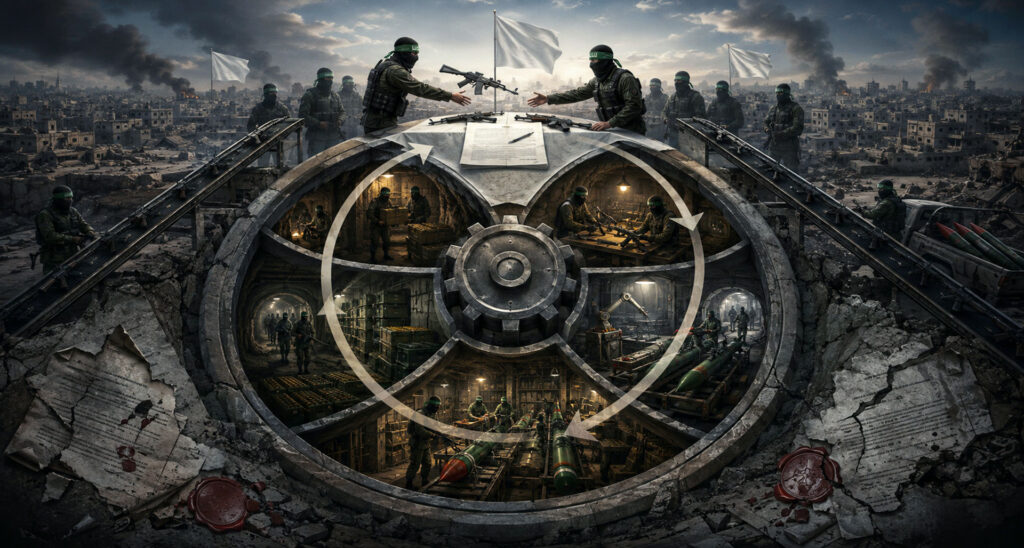
The disarmament deal calls for civilian governance and security functions in Gaza to be handed over to the National Committee for the Administration of Gaza (NCAG). Additionally, it will begin the decommission of weapons from Hamas and other terrorist organizations, which must be completed within 14 days after all parties agree to the deal. Disarmament is tied to a gradual IDF withdrawal, requiring one phase of the deal to be completed before moving on to the next stage.
As soon as the full details of the agreement were released to the public, the terrorist group was already misconstruing the terms it had just agreed to, claiming that the withdrawal of the IDF was required before the terrorist organization would hand over its weapons. Yet the agreement itself notes that disarmament must happen before withdrawal.
Nonetheless, the New York Times was quick to question “whether Israel and Hamas will comply,” despite Israel’s compliance being contingent on Hamas’.
Similarly, France24 and The Telegraph focused exclusively on Israeli strikes in the Gaza Strip after Hamas had reportedly agreed to the deal, implying that Israel was the bad faith actor – not the terrorists whose weapons storage facilities the strikes were targeting.
Hamas’ rewriting the deal’s sequencing within hours of agreeing to it gives insight into what Hamas hopes to achieve, and why Israel has been hesitant to celebrate such an achievement – until Hamas proves it will adhere to the agreement, skepticism is warranted.
Hamas is a terrorist organization bent on the destruction of Israel and the Jewish people; it is not a party that can be easily trusted to adhere to a deal. Throughout the war, Hamas consistently violated various ceasefire agreements by attacking Israeli troops, attempting to launch rockets, or refusing to return hostages. And when Hamas has fewer opportunities to commit terrorist attacks against Israelis, it has frequently turned its violence inward toward Palestinians.
In November 2025, when the UN Security Council passed Resolution 2803, approving the implementation of the 20-point Peace Plan, Hamas was the sole party to reject it.
It is thus worthwhile not only to question Hamas’ intentions but to ask whether it will even cooperate with this deal, given the terrorist organization’s lack of interest in peace in the past.
As Palestinian analyst Ahmed Fouad Alkhatib astutely notes, Hamas’ apparent willingness to disarm implies that the claim that the terrorist organization needs weapons in order to “protect” itself from Israel entirely collapses. It is this claim that has taken hold in anti-Israel protests worldwide, demonstrating that the narrative itself was used by activists to justify terrorism.
Just as soon as the news of an agreement for the next stage in the ceasefire was released, Hamas itself was rewriting the terms. This is not a one-off occasion, but emblematic of Hamas’ behavior when it comes to cooperating with international bodies and advancing any diplomatic solution. Still, as with news coverage in the past, the media is quick to blame Israel for being the bad actor while discreetly omitting the terrorist organization’s own hand in the reversal.
This next stage in the ceasefire agreement will test, once again, Hamas’ willingness to comply. Time will tell whether the press holds Hamas to the same standard, or if it defaults to blaming Israel for a deal Hamas broke first.
Liked this article? Follow HonestReporting on Twitter, Facebook, Instagram and TikTok to see even more posts and videos debunking news bias and smears, as well as other content explaining what’s really going on in Israel and the region. Get updates direct to your phone. Join our WhatsApp and Telegram channels!
© Divuach Ne’eman R”A, 2025