I spent this week scrolling through stories of Gazan children returning to school. The photos were remarkably familiar, for two different reasons.
First, the carpet of rubble that has become the visual shorthand for Gaza.
But amidst the gray, crumbled cement blocks, there’s the dissonance. Girls with their hair slicked back into neat ponytails, toting pink Minnie Mouse backpacks. Boys with freshly shorn hair carrying Sam the Fireman knapsacks. The exact ones my own kids would pick.
These kids look like any kids, which is what makes it worse. Because not one article asks what’s inside the backpack or what’s underneath the rubble.
Instead, coverage focuses on tent classrooms, destroyed schools turned into shelters, children going without notebooks or shoes because supplies now cost five times what they used to.
But no mention that the IDF has found Hamas tunnel shafts underneath school buildings. Not a word about what’s actually taught in the classrooms still standing.
Marcus Sheff, who has spent over a decade reading schoolbooks like these line by line, has a word for how something like this works: banal. School is the most ordinary thing in a child’s life, and that’s exactly where the indoctrination is taking place.
In first grade, Palestinian Authority schoolbooks (also used in Gaza) teach one letter of the Arabic alphabet with two words: hujum, attack, and shahid, martyr. The children are six and seven years old.
In fourth grade math, they’re not adding up apples and oranges. It’s martyrs from the First Intifada, plus martyrs from the Second.
By the time physics arrives, Newton’s second law is being illustrated by a child aiming a slingshot at an Israeli soldier.
UNRWA, the UN agency that ran the schools most of Gaza’s 1.3 million children have passed through, wrote its own supplementary material on top of all this. In it, an attack on a bus of Israeli civilians is called a “barbecue party.” The watchdog group that Sheff leads, IMPACT-se, has also found Palestinian Islamic education material that treats Jews as inherently dishonest and untrustworthy.
Not Israel. Jews.
Here’s the disturbing part: everyone in charge knows what these books contain. The EU set conditions for its funding of Palestinian education back in 2020: strip the content that glorifies violence, use maps that actually show Israel, and add real peace education. None of it happened, but the funding continued anyway.
But it doesn’t have to stay this way, and that’s the part that should give us hope.
The UAE rebuilt its textbooks around respect for the other, then joined the Abraham Accords. Azerbaijan, a majority Shia Muslim country, teaches coexistence and has built a close alliance with Israel.
The impression is that there’s no way out of the cycle of violence. A textbook is proof that there is.
As Marcus Sheff put it on this week’s episode of The Honest Take: “What they are taught today is who they are going to be tomorrow. Simple as that.”
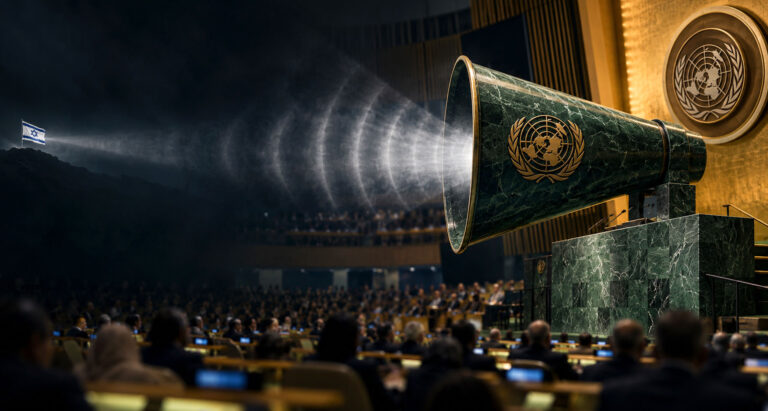
This week, the UN General Assembly is full of leaders calling for coexistence from the podium. Listening to them reminds me of a beauty pageant, where every contestant says she wants world peace. Great. But the jig is up when you realize that the mechanism is there. They have the power to force UNRWA to rewrite its curriculum, but they refuse to apply the pressure.
Peace can be taught. So can hate. Somewhere between the rubble and the backpack is the choice that decides which one a child grows up believing.
Liked this article? Follow HonestReporting on Twitter, Facebook, Instagram and TikTok to see even more posts and videos debunking news bias and smears, as well as other content explaining what’s really going on in Israel and the region. Get updates direct to your phone. Join our WhatsApp and Telegram channels!
© Divuach Ne’eman R”A, 2025