My family moved to a kibbutz on the Gaza border on October 1, 2023. When my husband or I reveal this factoid, we’re invariably met with a guffaw.
We moved with a confident sense of nonchalance. We knew it wasn’t “quiet,” but then again, nowhere is. And the prospect of a Qassam rocket felt less threatening than a terrorist stabbing you on a light rail tram in metropolitan Tel Aviv. At least you know you’ve got 15 seconds to run.
In that first week, I remember looking out the window as I prepared dinner, at the sky dyed in the pinks and purples of dusk, at the bounty of sun-hued lemons hanging from the tree, and at our neighbor’s sukkah built just beyond it. I felt content.
The next image burned into my memory is my phone screen: 6:29 a.m. and the red alert app that said Kfar Aza. I had already been groggily awake with our toddler. I leaped out of bed to close the window, yelping at my husband to close the door. Later he would tell me that in the first moments he heard my phone, he thought I’d forgotten to turn my alarm off for Saturday.
He hadn’t finished securing the door jamb by the time we started hearing “Tzeva Adom” echoing around the kibbutz. We immediately huddled over our phones, investigating what the trigger for this escalation could be. Had a senior Hamas terrorist been eliminated, or a security prisoner on hunger strike died? But there were no updates in our work chats (we both worked in news).
Within minutes, a rocket landed on a house not 100 meters away. The crash elicited a scream, the only one I would let out that day. My husband nodded to our toddler, lying wide-eyed on the bed, a reminder to calm myself.
The distraction was work. I sent out the first push alert of the day: Wave of rockets from Gaza fired at border communities. But the wave didn’t pass; it only expanded northward toward Tel Aviv.
The WhatsApp chats started to ping, work and kibbutz alike. Neighbors asking if anyone had been in touch with people from Be’eri, Kfar Aza, Mefalsim, where their friends and families lived. “Surely they’re in the safe room without reception, just like us” was the reply.
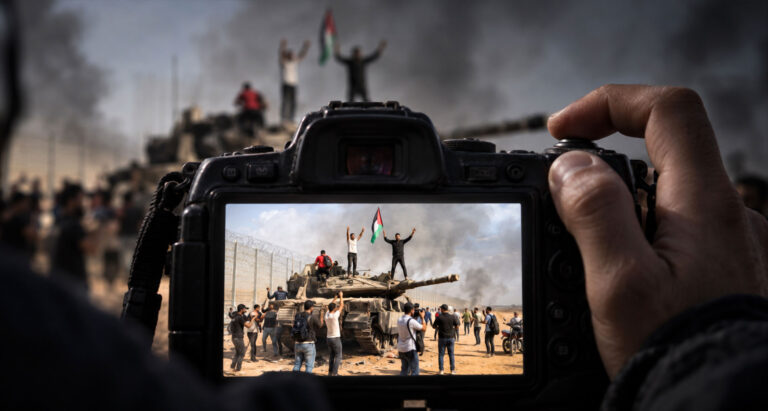
When the initial videos of paragliders landing on cliff sides came in, I thought they were fake, some sort of terrorist propaganda. Then the first photo of a pile of bodies at a bus stop in Sderot, women in their 60s and 70s who had been waiting for a coach bus likely to spend the weekend lounging in the Dead Sea. To this day, I still see the slumped outline of their bodies every time I drive past that bus stop. And when the first videos of hostages being taken back to Gaza started to circulate, again I thought it was fake. Adina Mozes sandwiched between two terrorists on a motorbike. Why would they haul a grandmother back to Gaza?
At some point the helicopters arrived, and we were surrounded by gunfire. We knew security forces were engaged with invading terrorists, but had no idea how many. 80? 200? Certainly not over 6,000. How little we all knew that day.
When we fled the kibbutz that evening, I choked on a cry as the security squad member opened the gate to let us out. “Take care of yourself,” we told him. We sped past overturned cars, a helicopter loading wounded, a media gathering spot crowded with correspondents and cameras.
We made it to my in-laws in time to see the headlines of the main broadcast. My son’s head was resting on my shoulder as I paused to admire the producers’ and graphics team’s handiwork on the opening package. I barely absorbed the map that showed terrorists had made it 30 kilometers inland to Ofakim. The stripe that read over 200 dead, dozens taken hostage. It would take days to do the full count. Days for reality to descend upon us, to realize how miraculously unscathed my family emerged from the ordeal.
We soon moved to Tel Aviv, a veritable ghost town. In the months that followed, we would change locations eight times, spending two weeks here, six weeks there. And throughout, work provided stability and insight into the world of pain around me.
Hadas Kalderon, her face etched in agony as she sat in the studio holding the posters of her daughter Sahar, 16, and son Erez, 12, taken hostage with their father. The children would be returned Thanksgiving week; their father Ofer would come home only 14 months after them. The interview I translated with Sharon Cunio’s sister, Danielle Aloni. Eight members of the Cunio-Aloni extended family were taken hostage, including three young children. I would often wake up in the middle of the night thinking of Sharon and the unimaginable double horror of being separated from one of her twin daughters for 10 days while in captivity.
We stayed focused on those stories, even as the world’s attention was quickly swept away by what was happening on the other side of the border. On October 17, when a rocket fell on Al Ahli hospital, Israel had not even launched its offensive. The immediate death toll in the hundreds rang hollow, and yet was pushed out by all the major broadcasters. Within a few hours, the IDF was able to confirm they had not launched a single airstrike at the time or in that area, and yet I was told to delete the initial tweet that said it wasn’t an IDF strike.
It was hard to breathe as I watched the war unfold onscreen throughout my workday, and simply navigated it in my personal life, not knowing when we’d get to return home. Yet in every moment of hardship, there were thoughts of the hostages and their families who had it infinitely worse.
I got to return home six months later, solidly in my third trimester. The cannons took the longest to adjust to; the spattering of gunfire was easier to ignore. The faces of the hostages met us at every turn, pictures pinned to the cash registers, posters hanging at the gate, magnets on cars. In Tel Aviv, those same faces were memorials, something you could opt into engaging with or let your eyes slide past. At home, there was no respite. It was a daily, unavoidable acknowledgment: this person was snatched, they are gone, and the effort to bring them back is ongoing. The sounds of that fight were the ambient noise to my day.
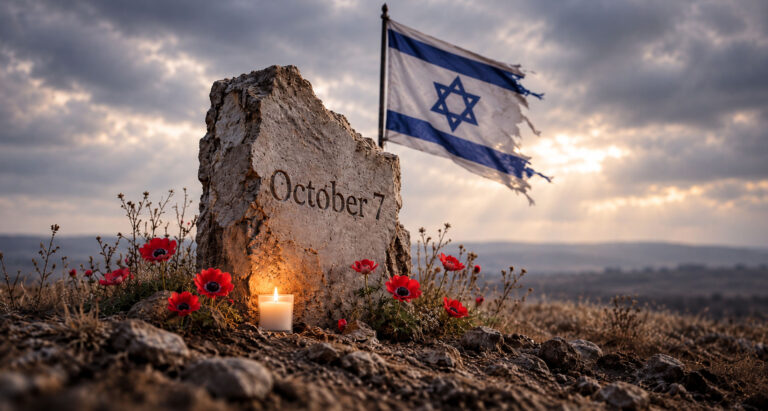
I know my experience is unexceptional. And yet, the ache pulses every time there’s mention of that Black Saturday. This week I’ve been staring out that window again, the lemon tree a few inches taller, the neighbor’s sukkah once again standing in our shared lawn. Sporadic gunfire pops in the distance. It had been notably absent for months, and its return is warily noted. I wonder how long the status quo will hold. Even though we’ll mark October 7 with no hostages in Gaza, it doesn’t feel like progress. If anything, the downward gravitational pull of the news cycle has only made the battle over Israel’s reputation feel like a quagmire.
It’s precisely the banality of living through war that gets dismissed and invalidated by the world’s media. It’s why every biased headline feels like a jab. Some days, it’s easier to plaster over the hurt and use indignation to fuel me through the day. Other times, I resign myself to feeling as though the rest of the world has closed ranks against us, and our only recourse is to turn the other cheek.
While loneliness aggravates the pain, solace comes from being seen. I joined HonestReporting shortly after the first anniversary, and it was a comfort to become part of a tribe of like-minded people who still believe in the goodness of Israel the nation, and the necessity of Israel the state. Together we take umbrage at the latest libelous headline, and then spur each other on to create change.
Rabbi Jonathan Sacks OBM drew a distinction that has stayed with me: optimism is the belief that the world is changing for the better. Hope is the belief that, together, we can make the world better. Optimism is passive. But it takes a great deal of courage to hope.
The mission to rescue the hostages was successful, but the same can’t be said yet for repairing Israel’s reputation. I don’t have much optimism these days for how soon the public’s perception will change. But hope and the belief that we have a role to play in making it better are what get me up to do this work every day.
Liked this article? Follow HonestReporting on Twitter, Facebook, Instagram and TikTok to see even more posts and videos debunking news bias and smears, as well as other content explaining what’s really going on in Israel and the region. Get updates direct to your phone. Join our WhatsApp and Telegram channels!
© Divuach Ne’eman R”A, 2025