Key Takeaways:
- “Occupied West Bank” is now standard terminology, appearing in 46.3 percent of articles across 17 outlets reporting on the West Bank.
- The term “occupied” is increasingly appearing in the first several sentences of an article and alongside the first mention of the West Bank.
- The standardization of such language shapes readers’ understanding of the territory.
The term “occupied West Bank” is increasingly being used in news articles about the disputed territory, according to research conducted by HonestReporting, with the share of articles using the phrase rising by 13.3 percentage points this year when compared to the same six-month period last year. Additionally, other rhetoric related to “occupation” rose during the same time frame by 9.4 percentage points.
The language journalists use to describe places and events is not arbitrary. It establishes the context in which readers understand a story, shaping the framework through which the people and events being reported are interpreted.
This is particularly significant when reporting on the West Bank/Judea and Samaria – the territory on the west bank of the Jordan River that Israel captured from Jordan in the 1967 Six Day War. Its status has remained a disputed territory, both within Israel and internationally, yet media coverage frequently omits the historical context that led to Israel capturing the territory in a defensive war, as well as the origins of the name West Bank.
HonestReporting.ai Labs analyzed 5,370 articles from May to October 2025 and the same months in 2026. Articles were collected from 17 international news outlets, including the BBC, CNN, The Guardian, The New York Times, NBC, and the Associated Press, to assess how frequently the term “occupied” is used in relation to the West Bank. Not only does “occupied” appear more frequently in coverage, but it is increasingly appearing toward the beginning of stories, where readers first encounter the subject.
The term “Occupied West Bank” appeared in 2,485 articles – 46.3 percent of all articles. The term was not limited to any singular outlet, but was found in every outlet in the analysis. Broader forms of the term, including “occupied,” “occupation,” and “occupying,” raised the figures to 3,348 articles, or 62.3 percent.
In comparing two six-month periods, the share of West Bank articles containing the phrase “occupied West Bank” rose from 38.9 percent between May and October 2025 to 52.2 percent between May and October 2026, while any occupation terminology rose from 57.7 percent to 67.1 percent.
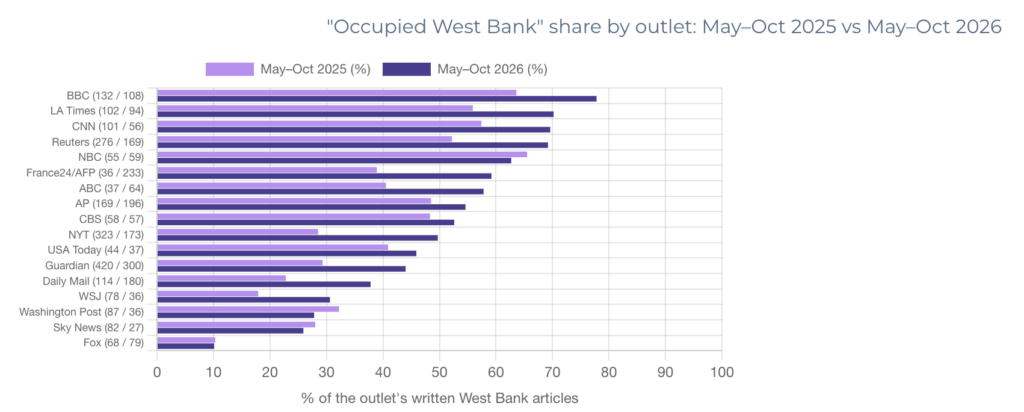
Graph based on data from HonestReporting.ai Labs.
The use of such terminology does not come from journalists quoting politicians, activists, or human rights organizations. In a sample of 60 articles from the five largest outlets, 50 used the phrase “occupied West Bank” in the journalists’ own voice, rather than as a quote or attribution. With this sample, it can be estimated that between 1,850 and 2,100 articles use the term in the outlet’s own words.
While all outlets were found to use this language, the frequency with which the term was used varied considerably by outlet. The BBC used “occupied West Bank” in 71 percent of its articles mentioning the territory, followed by CNN at 68 percent, NBC at 64 percent, the Los Angeles Times at 61 percent and Reuters at 60 percent. Fox News, by comparison, used the phrase in 12 percent of its coverage. Reuters, The New York Times, and CBS were found to more frequently write “Israeli-occupied West Bank.” By shifting the language to the outlet’s own voice, the terminology becomes part of the outlet’s own framing of the subject.
“Occupation” Language Has Moved to the Top of the Story
This shift is not only in the frequency of the term’s use, but also in where the term itself appears in an article. The term “occupation” is increasingly being introduced near the beginning of an article, rather than later in the report.
The change in language is particularly noticeable in the introduction of an article, where readers are first introduced to the subject. Between the two periods, the share of articles using occupation terminology in the first sentence rose from 8.5 percent to 15.4 percent. It had a similar increase for appearing within the first three sentences, rising from 14.9 percent to 24.2 percent. Similarly, the share of articles labeling the West Bank as “occupied” in its first mention increased from 35 percent to 46.3 percent.
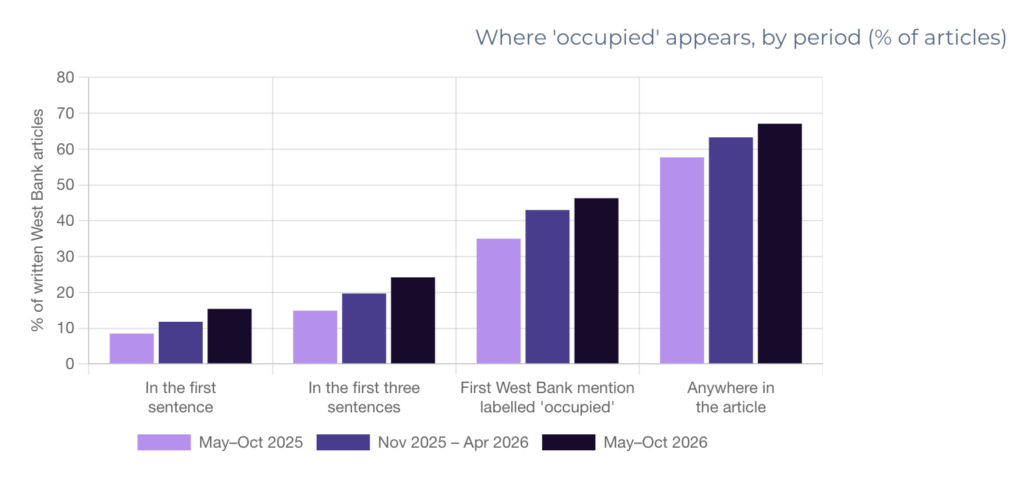
In contrast, the term appeared in headlines and summaries in only about 3 percent of articles, indicating that while it is rarely used to draw readers to click a story, once they do it is used at the top of an article to shape readers’ understanding.
Several major outlets saw particularly notable increases in the use of occupation terminology within the first three sentences. At The New York Times, the share rose from 4.6 percent to 24.3 percent; The Guardian rose from 6.2 percent to 21.7 percent; Reuters rose from 33 percent to 47.9 percent; and the BBC rose from 30.3 percent to 46.3 percent.
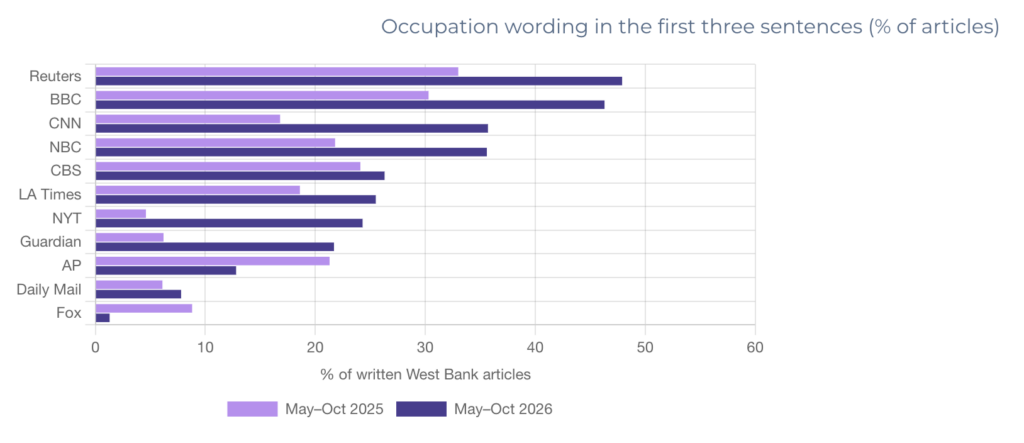
CNN illustrates this increase in usage and how the terminology can move from an occasional descriptor to the default reference. The share of articles in CNN’s own voice (without quoting or attributing) using “occupied” in the first mention rose from 32 percent in May to July 2025 to 69 percent in November 2025 to January 2026.
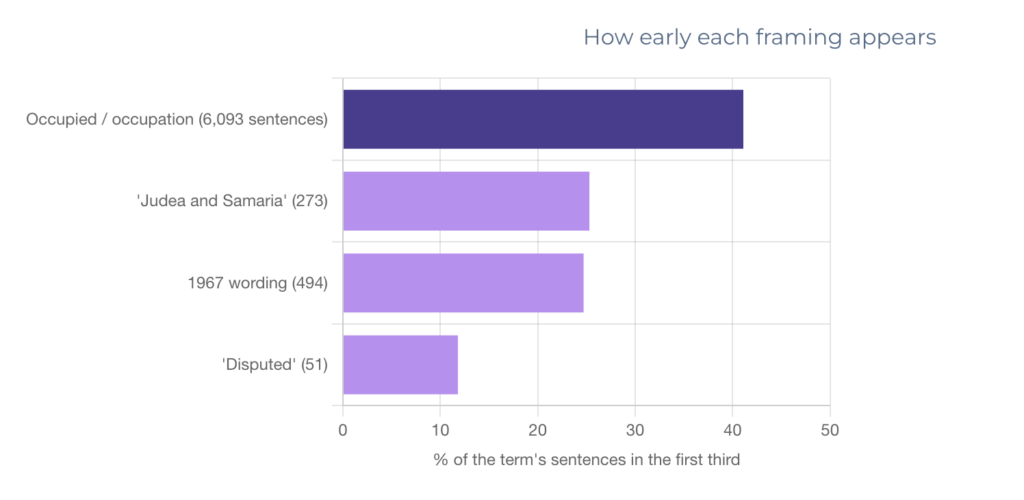
As “occupied” has increasingly become a standard descriptor, alternative descriptions of the territory remain less common. When they are used, these alternative descriptors frequently are positioned lower in an article. Forty-one percent of sentences using occupation terminology fall in the first third of an article, compared to 25 percent for “Judea and Samaria.” Phrasing that refers to 1967, when Israel captured the territory from Jordan, appears in the first third of the article 25 percent of the time, and the term “disputed” appears 12 percent of the time.
Companion Framing
Frequently, the term “occupation” is used in conjunction with other descriptors. For instance, the term “illegal” in reporting on settlements, outposts, and related issues appears in 957 articles – 18 percent of the total and 86 percent of those articles also use occupation terminology. Its share of West Bank coverage roughly doubled, from 13 percent in May-October 2025 to 26 percent in May-October 2026, peaking in August-September 2026 alongside coverage of UK, Dutch, and EU settlement sanctions.
At the same time, Israel’s official position was much less likely to appear alongside this terminology, appearing in only about one in eight of these articles.
Likewise, the term “apartheid” was found in 266 articles or 5 percent of articles about the West Bank, but 75 percent of those articles used a variety of wording referring to “occupation.” The term “Annexation” followed a similar pattern, as it was referenced in 879 articles, or 16.4 percent of the time, and accompanied by “occupation” framing 73 percent of the time. Using such language together contributes to a broader narrative about the West Bank, despite the different legal and political implications each term holds individually.
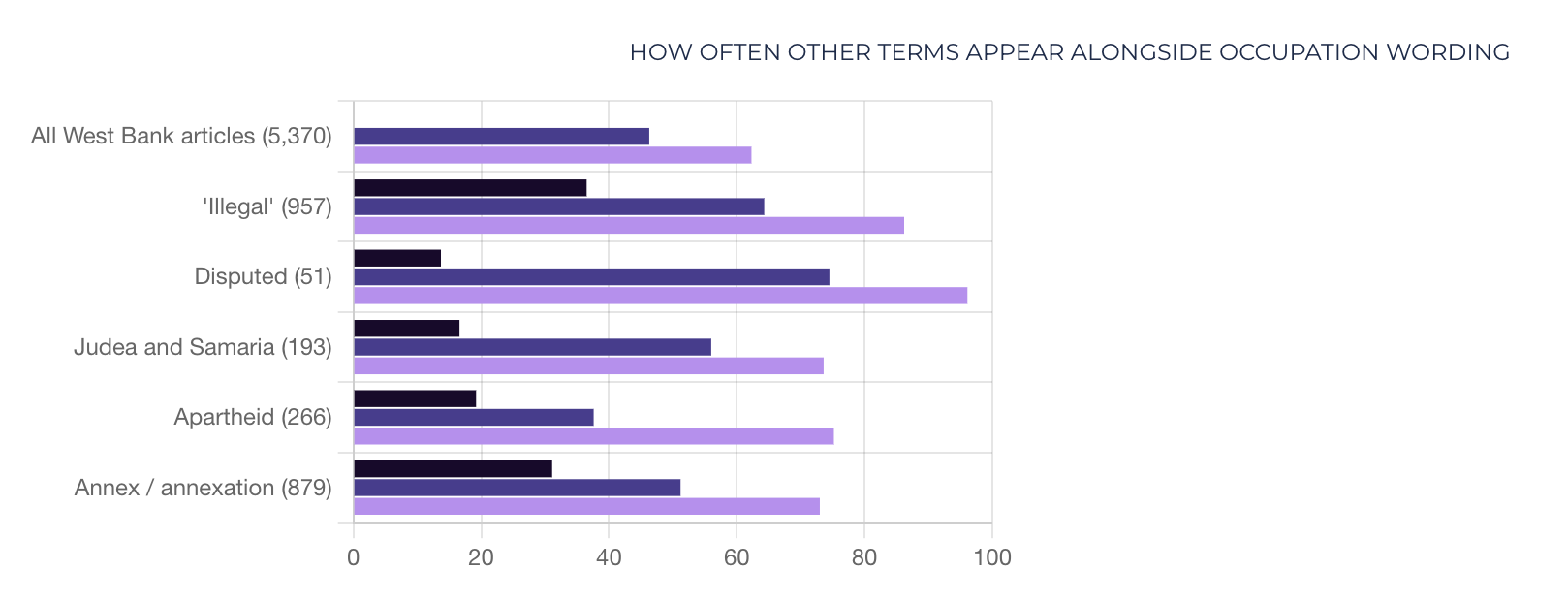
Mid purple: article also says “occupied West Bank” (%)
Lavender: any occupied/occupation wording in the article (%)
Graph based on data from HonestReporting.ai Labs.
Conclusion
There is certainly legitimate debate over the West Bank, its current status, and its future. But when journalists adopt a particular legal characterization as the standard description of the territory, rather than attributing the position to an organization or providing the context around it, readers are presented with an interpretation as fact.
Ultimately, “occupied” has become the normalized and standard term in international media, shaping not only how the West Bank is described but the context through which readers understand the events unfolding in the territory.
Liked this article? Follow HonestReporting on Twitter, Facebook, Instagram and TikTok to see even more posts and videos debunking news bias and smears, as well as other content explaining what’s really going on in Israel and the region. Get updates direct to your phone. Join our WhatsApp and Telegram channels!
© Divuach Ne’eman R”A, 2025