Key Takeaways:
- “Visibly Jewish” invites victim-blaming, implying Jews provoke attacks by being recognizable.
- Other minorities are rarely described this way, and media guidelines for them discourage it.
- Nearly 60 percent of American Jews now hide their identity, threatening Jewish life and presence.
Few words better evoke the complex absurdity of Jewish-American existence right now than “visibly-Jewish.” It’s a phrase appearing across both social and traditional media to describe Jews who appear unmistakably to the world as, well, Jewish.
Not that — in the immortal words of Jerry Seinfeld — there is anything wrong with it.
The trouble is that “visibly Jewish” Jews now find themselves at the front lines of the historic surge of antisemitic hate that has overtaken America — and the world — since the Hamas attacks on Israel three Octobers ago.
“A visibly Jewish man was assaulted in an antisemitic incident in Northwest Washington, DC,” declared a Jerusalem Post article from July 2024. “Visibly Jewish,” read social media post after social media post when describing a young boy harassed by antisemites in France last December. “‘Most Visible Jews’ Fear Being Targets as Antisemitism Rises” explained a headline in The New York Times back in 2020 for a story about the disproportionate number of Orthodox Jews affected by then record-setting hate crime numbers.
Half a decade on, those records have long been broken.
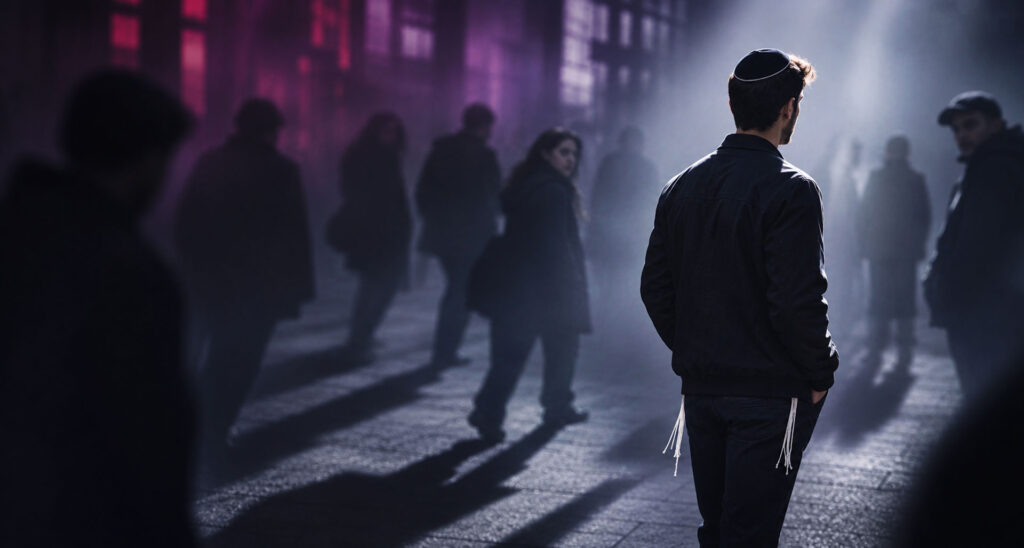
There are two main problems with the “visibly Jewish” trope, and both impact Jews in ways almost no other minority community must endure — particularly in America. The first is the most immediate: Whether wearing a kippah on their head or Magen David around their necks, “visibility” — even if used solely for descriptive purposes — can inevitably be framed as a way to blame Jews for the (often violent) hate and discrimination they’re now enduring.
That French Jewish boy berated while playing video games, his parents should have known better than to leave his tefillin exposed or a kippah on his head as they waited at Charles de Gaulle Airport. Same with that assault victim in Washington, DC, who was identified as Jewish by his yarmulke – or Orthodox Jews who could not be more visible in their traditional black–and-white ensembles.
And then there’s the case of Gideon Falter, head of Britain’s Campaign Against Antisemitism. During a pro-Palestinian march in London in April 2024, Falter – who was wearing a kippah – was stopped by the Metropolitan Police for what one officer described as appearing “openly Jewish.” Rather than consider his safety amid a crowd of anti-Israel agitators, Falter’s appearance, the police alleged, was “antagonizing” toward the protesters – and they threatened to arrest him if he refused to be escorted from the area.
Falter – who was not part of any organized counter-protest that day – later demanded an apology for the slight. Instead, London police doubled down on the insults, insisting that those “opposed to the protest” along the march’s route “must know that their presence [was] provocative.” And that provocation, it is safe to assume, was walking down the street visibly Jewish.
Jews, of course, are hardly the only minorities targeted by hate crimes and offenses; Hispanics, African-Americans and LGBTs have also seen an uptick in reported incidents. But their external appearance is rarely noted when recording assault data. LGBTs are almost never described as “visibly Gay” or “visibly transgender” even if they might be identifiable as such. And while Blacks may be easily “visible” because of their skin color, distinctive ethnic elements such as Afro or dreadlock hairstyles are rarely noted by the media. In fact, according to National Association of Black Journalists guidelines, racial descriptions are to be entirely avoided if possible precisely to prevent victim-blaming.
This is not the case with Jews.
Which brings us to the second — and more detrimental and longer-lasting — consequence of the stigma around Jewish “visibility”: The increasing decision by many Jews to lean into the flip-side and make themselves invisible. Author Dan Senor spoke on his podcast recently of “a push in many corners of [America] to drive Jews underground, to make Jews uncomfortable to the point where…Jews just need to think whether or not they need to low-key their Judaism.”
Actor Lior Raz of “Fauda” echoed Senor’s sentiments at a Jewish National Fund event in San Diego last week where he lamented American Jews who are removing mezuzot from their homes in order to downplay their Jewishness. “Sometimes you feel you can’t say anything,” said Raz of Jewish fears of public and open visibility. But concealing our Jewish identity, he made clear, “is how we lose.”
With nearly 60 percent of American Jews now saying they “hide” elements of their Jewishness to avoid being targeted by hate crimes, according to a study this summer by the Combat Antisemitism Movement, the losses are clearly mounting. So much so, added Senor on that recent podcast, that “in a world in which so many American Jews are raised without real pride in their Jewish identity and a real connection to Israel…when…they’re confronted with the sense to drive them underground, many of them will say ‘it’s just not worth it.’”
Indeed, the Washington, DC man assaulted for being visibly Jewish two years back told local media that after being repeatedly punched and kicked by a stranger accusing him of “murdering” children in Gaza, he didn’t “feel safe anymore walking around with my Jewish, religious objects.” This is the future Fauda’s Raz fears for American Jews — a future of diminished cultural presence and potential.
Judging by this man’s words, that future may have already arrived.
Liked this article? Follow HonestReporting on Twitter, Facebook, Instagram and TikTok to see even more posts and videos debunking news bias and smears, as well as other content explaining what’s really going on in Israel and the region. Get updates direct to your phone. Join our WhatsApp and Telegram channels!
© Divuach Ne’eman R”A, 2025