Key Takeaways:
-
The BBC elevates fringe antizionist Jewish voices to frame Israel as the cause of British Jews’ insecurity, despite clear data showing that a strong majority of British Jews identify as Zionist and see Israel as central to their identity and safety.
-
This selective representation amounts to tokenization, using a small subset of Jewish dissenters to legitimize harsh criticism of Israel and shield the broadcaster from accusations of bias, while marginalizing mainstream Jewish perspectives.
-
The framing distorts the nature of Jew-hate, recasting it as a reaction to Israeli policy rather than a longstanding prejudice, and subtly shifts responsibility onto Jews themselves by implying that safety depends on disavowing Israel.
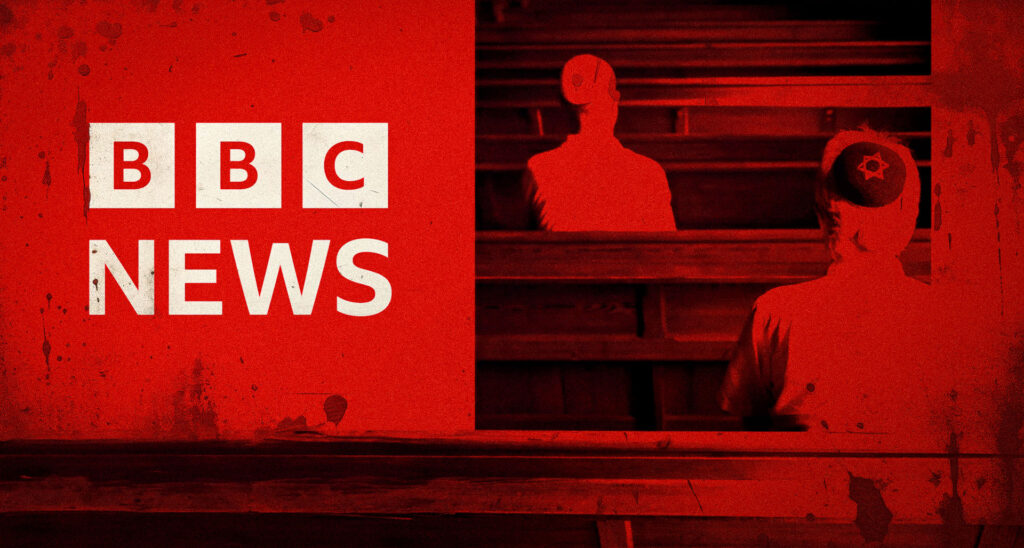
For many British Jews today, they are questioning not just their safety in the country, but their very future. This is due to the frightening rise in Jew-hate. However a recent report by the BBC profiles British Jews, one of whom argues that the actions of the state of Israel, rather than Jew-hatred itself, have left them feeling less safe in Britain. In presenting this point, the article highlights fringe voices who reject Zionism or distance themselves from Israel, presenting these perspectives as emblematic of a broader Jewish mood.
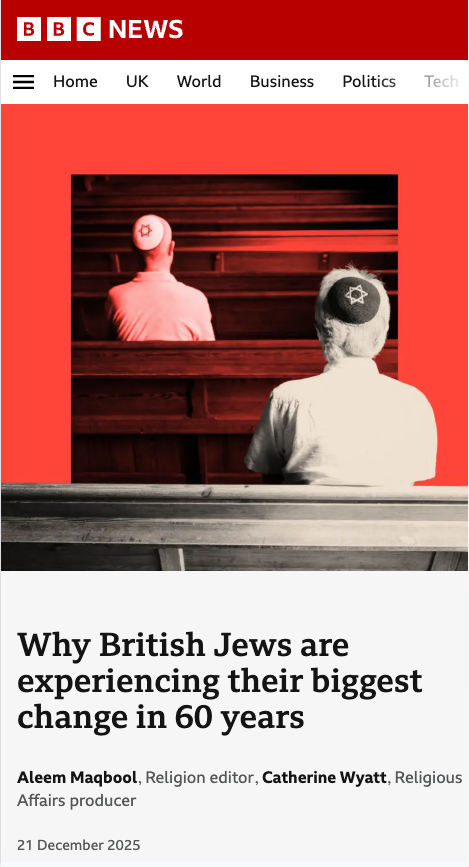
One interviewee, Tash Hyman, is quoted:
‘The bottom line for me now is that the actions of the state of Israel make me feel less safe, not more safe. It makes me less safe in the UK because of what they are doing in Gaza.’ She rejects the idea that Israel functions as a safe haven for British Jews.
A quick scan of Hyman’s social media makes it very clear where she is coming from, including retweeting Jeremy Corbyn (whose enabling of antisemitism in the UK Labour Party during his leadership ended with his expulsion from the party) and rejecting the internationally endorsed IHRA definition of antisemitism.
The fear of British Jews should not be dismissed. They are living through a period of profound anxiety, marked by rising hostility, harassment, and violence. But the BBC’s editorial decision to center antizionist Jewish voices raises a serious question about representation. Are these views reflective of British Jewry as a whole, or are they being elevated because they serve a particular narrative about Israel and Jewish safety?
Recent data suggests the latter. The largest survey of British Jews conducted since October 7, 2023, covering 4,822 respondents, found that 64 percent of British Jews identify as Zionist. Among those aged 20 to 29, that figure drops to 47 percent, with 20 percent identifying as non-Zionist and 24 percent as antizionist. This indicates a genuine generational shift, but it also makes clear that antizionism remains a minority position, even among younger Jews, and an even smaller one across the community as a whole.
Yet the BBC report places disproportionate emphasis on these minority views, implicitly presenting them as representative. In doing so, it distorts public understanding of British Jewish life and misleads audiences about how most Jews understand the relationship between Israel, identity, and safety.
Tokenization and Moral Cover
The BBC, like many media institutions, operates in a culture that is intensely critical of Israel, to the point that it is often accused of Jew-hate. Elevating antizionist Jewish voices serves a particular purpose within this context. It allows the broadcaster to air severe criticism of Israel while insulating itself from claims of bias. In essence, Jewish dissent koshers accusations of Jew-hate.
When Jewish voices are highlighted that reject the dominant Jewish collective self-perception, this is not an example of diversity. Instead, they are used to validate narratives that would otherwise be recognized as marginalizing or hostile. Jewish legitimacy becomes conditional. Jews are most acceptable when they publicly disavow other Jews.
This practice has a name. It is tokenization. And when a fringe subset of a minority group is repeatedly elevated in order to legitimize narratives directed against that group, tokenization functions as a form of racism.
The issue is not that antizionist Jews exist. They do, and their views are part of the community’s internal struggle. The problem arises when those views are treated as normal or representative, while mainstream Jewish positions are rendered suspect, parochial, or morally compromised.
Why This Matters
The BBC’s framing reinforces a deeper and more significant issue. By foregrounding antizionist Jews as representative, it encourages audiences to understand Jew-hate as a reaction to Israeli policy rather than as a long-standing and adaptive form of prejudice.
This misreads both history and Jewish experience.
Modern antizionism does not operate in a vacuum. It was deliberately shaped during the Cold War, particularly through Soviet ideological campaigns that sought to delegitimize Jewish peoplehood by severing Jews from their history, land, and collective identity. Israel was framed as an illegitimate, racist, or genocidal project, not as part of a broader critique of nationalism, but as a continuation of older anti-Jewish logics repackaged in political language. These frameworks persist today.
Where Jews were once accused of conspiring as individuals or communities, the accusation is now displaced onto the Jewish state. Where Jewish existence was framed as corrosive to society, Israel’s existence is framed as intolerable to the moral order. The structure of accusation has not changed. Only its object has.
Jewish antizionism must be understood within this context. When Jews internalise these frameworks and apply them to their own people, history, and collective identity, this is not merely dissent. It is an example of internalized anti-Jewishness, shaped by sustained external pressure and the promise that safety lies in disavowal. History suggests otherwise.
Jew-hatred long predates the state of Israel and has repeatedly attached itself to whatever form Jewish collective life takes at a given moment. Today, that form is the Jewish state. Israel functions not as the cause of Jew-hate but as its contemporary vessel. When this distinction is blurred, responsibility for hostility is subtly shifted onto Jews themselves.
By elevating Jewish antizionism as representative, the BBC unintentionally legitimizes this shift. Jew-hate is reframed as a response to Jewish behavior rather than as a prejudice directed at Jews. Jewish safety becomes something to be earned through political conformity. Distance yourself from Israel, the implication runs, and hostility will recede.
That framing does not protect Jews. It isolates them. It rewards internalized erasure and treats it as moral progress, while casting Jewish continuity, peoplehood, and self-defense as suspect. This is why the BBC’s editorial choices matter. They do not merely reflect internal Jewish debates. They shape how Jew-hate is understood, explained, and excused in the wider public sphere.
A Question of Responsibility
Public broadcasters, such as the BBC, have a responsibility not only to include minority voices, but to represent minority communities accurately. Elevating fringe positions in the name of balance does not produce clarity. It produces distortion, and it legitimizes unhealthy Jewish responses to Jew-hate in the form of internalized anti-Jewishness.
British Jews are obviously not a monolith, but they are also not represented by a minority view that rejects a core component of Jewish collective identity for most of the community. Treating antizionism as the authentic Jewish position erases how British Jews actually understand themselves and misinforms the wider public.
The issue at stake here is not disagreement over Israel. It is whether Jewish identity is allowed to exist in public discourse without passing a political test. When fringe Jews are deemed acceptable to speak for all Jews, inclusion becomes exclusion by another name.
Liked this article? Follow HonestReporting on Twitter, Facebook, Instagram and TikTok to see even more posts and videos debunking news bias and smears, as well as other content explaining what’s really going on in Israel and the region. Get updates direct to your phone. Join our WhatsApp and Telegram channels!
© Divuach Ne’eman R”A, 2025