Key Takeaways:
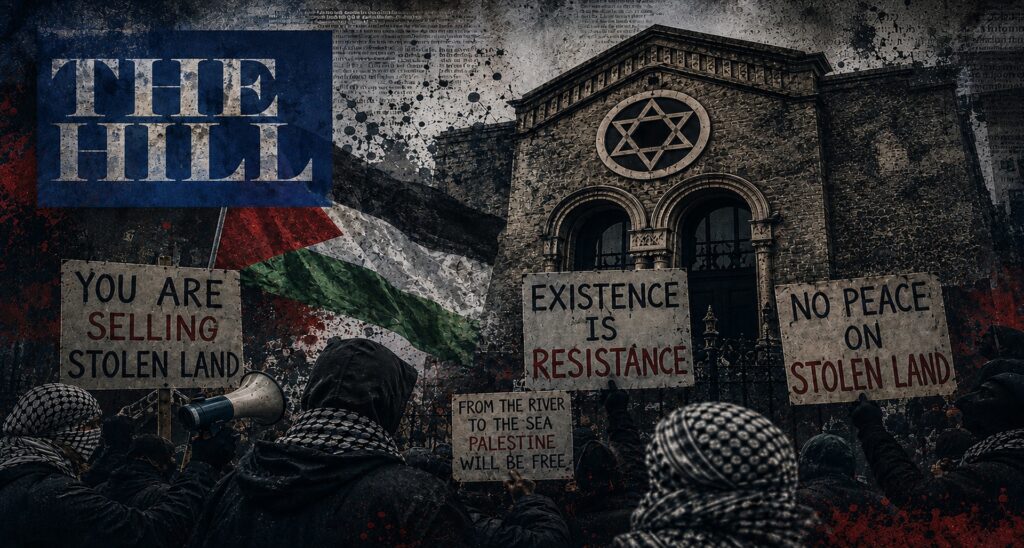
- The Hill published an opinion piece that ultimately reframes synagogues into legitimate targets, portraying the backlash against Jewish institutions as understandable because they host Israeli real estate events.
- By implying that synagogue real estate events are linked to violent land seizures and downplaying the antisemitic rhetoric frequently seen at protests, the article justifies protests outside venues of Jewish communities.
- The overwhelming majority of Jews maintain a connection to Israel. Portraying Jewish institutions that facilitate that connection as deserving of protest risks legitimizing the harassment of synagogues simply because they are Jewish spaces.
“What is a synagogue when it’s not serving as a place of worship, a house of study, or a community center?” Mark I. Pinsky asks in an opinion piece in The Hill.
The answer should be simple: a synagogue is a safe gathering place for the Jewish community. It serves not only as a place for prayer and study, but also as a venue for a range of community events, including celebrations and broader gatherings that might interest the community.

But this is not the answer Pinsky gives. Instead, he claims that a synagogue is a “shield and an implicit shill” for companies profiting off of land sales in the West Bank and Jerusalem. Yet synagogues have remained connected to the land of Israel, long before any real estate company hosted events in their halls. Hosting events that reinforce that connection isn’t a scheme to “shield” from criticism, but is rather emblematic of what a synagogue has always been to Jews globally.
Pinsky never asks the obvious follow-up: why would Jewish people want to buy property in Israel? If not for the rising antisemitism, including the protests at synagogues, perhaps the answer is as simple as the very fact that Israel is the birthplace and national homeland of the Jewish people. It is not some foreign nation with no connection to any people, and real estate sales at synagogues only further prove this very point.
Yet Pinsky treats synagogues hosting community events as something suspect, ultimately framing the “backlash” they face as an understandable “issue.”
In the past decade, the Anti-Defamation League (ADL) has noted that there have been 23 physical attacks at synagogues in the U.S. alone, contributing to the more than 80 incidents worldwide. This doesn’t include the countless protests held outside synagogues. Whether the event is for real estate or purely helping Jews make aliyah, synagogues have become focal points for harassing Jews on the basis that it is only “criticism” of Israel. Synagogues are not targeted for what they host, but for what they are: Jewish institutions with a deep connection to Israel.
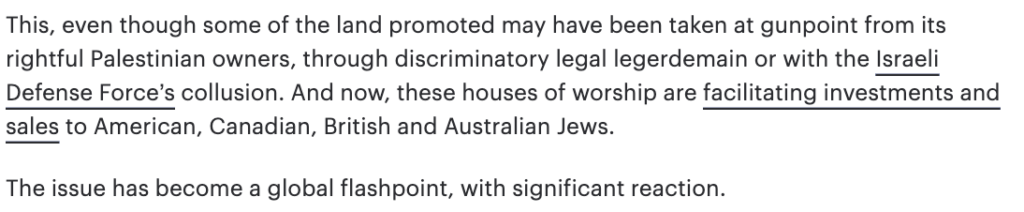
These events are not organized to advocate for or advance any political agenda. Simply, they want to help bring Jews back to their homeland. But Pinsky continues:

Writing that “not all” the land was taken at “gunpoint” implies that some of it was, as he suggests earlier in the piece. Not only does Pinsky not provide evidence for this claim, but these events held globally are not organized to drive Palestinians out of their land. Rather, his characterization is meant to encourage the reader to associate events at synagogues with violent dispossession, even when the events in question are ordinary real estate exhibitions or informational sessions – and there is nothing illegal about that.
The true purpose of these protests outside of synagogue events is further revealed by the antisemitic chants and flags supporting terrorist organizations. Pinsky writes that “occasionally” terrorist flags can be seen or antisemitic chants are heard. But such incidents have been recorded countless times worldwide, including in New York, Toronto and London.
Still, Pinsky continues that it would be wrong to largely brand this type of protest as antisemitic.

Even if antisemitic chants or terrorist paraphernalia did not accompany protests at synagogues, the very decision to protest outside an explicitly Jewish space – not a political or governmental one – indicates that Jewish institutions are legitimate targets.
It is for this same reason that Pinsky can justify New York Mayor Zohran Mamdani’s opposition to such real estate events at synagogues, for Mamdani himself was incapable of condemning such antisemitic chants at a New York synagogue event.
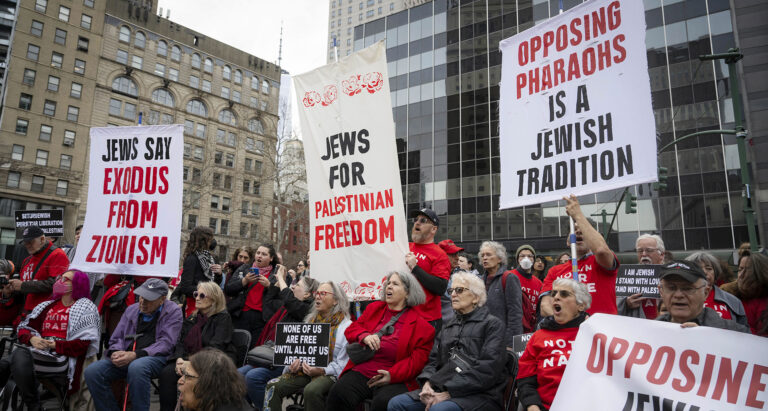
The Jewish people are inextricably tied to the land they originate from – no matter where their familial experience in exile took them. But again, Pinsky attempts to rationalize protests at synagogues by claiming that only one-third of American Jews called themselves Zionists in a recent poll. What he left out was that the same poll found that the majority of respondents view Zionism favorably and 87% “endorse Israel’s right to exist as a Jewish homeland.” It is likely due to the misconstrued meaning of the term Zionism that has decreased its usage in Jewish communities, but it has not undone their connection to Israel.
Pinsky frames being connected to Israel and supporting real estate events as sinful behavior of the Jewish people, relying on the Rabbinical Council from the radical anti-Zionist organization, Jewish Voice for Peace (JVP). Had Pinsky asked any Zionist rabbi – the vast majority of rabbis – the same question, the answer would be astoundingly different.
Pinsky isn’t interested in critiquing the Israeli government, or, even more astute, the reason driving mass aliyah to Israel. He crafts a narrative that paints the Jewish connection to Israel as shadowy and exploitative of the lives of other people, even across the world. In doing so, he ultimately justifies the ongoing antisemitic attacks at synagogues and other Jewish institutions throughout the world.
Jewish events that strengthen the connection between Diaspora communities and Israel will continue. But as long as opinion pieces like this are given a platform to portray synagogues as legitimate targets for protest, the intimidation of Jewish communities is just as likely to continue.
Liked this article? Follow HonestReporting on Twitter, Facebook, Instagram and TikTok to see even more posts and videos debunking news bias and smears, as well as other content explaining what’s really going on in Israel and the region. Get updates direct to your phone. Join our WhatsApp and Telegram channels!
© Divuach Ne’eman R”A, 2025