


Key Takeaways:
- The World Press Photo Foundation jury report for 2026 departs from its own descriptive standard in its Gaza entries, introducing causal claims and presenting contested narratives as established fact.
- Two Gaza-related finalists, Saber Nuraldin and Saher Alghorra, are accompanied by write-ups that shift from observational language to declarative framing, using imagery as “evidence” rather than representation.
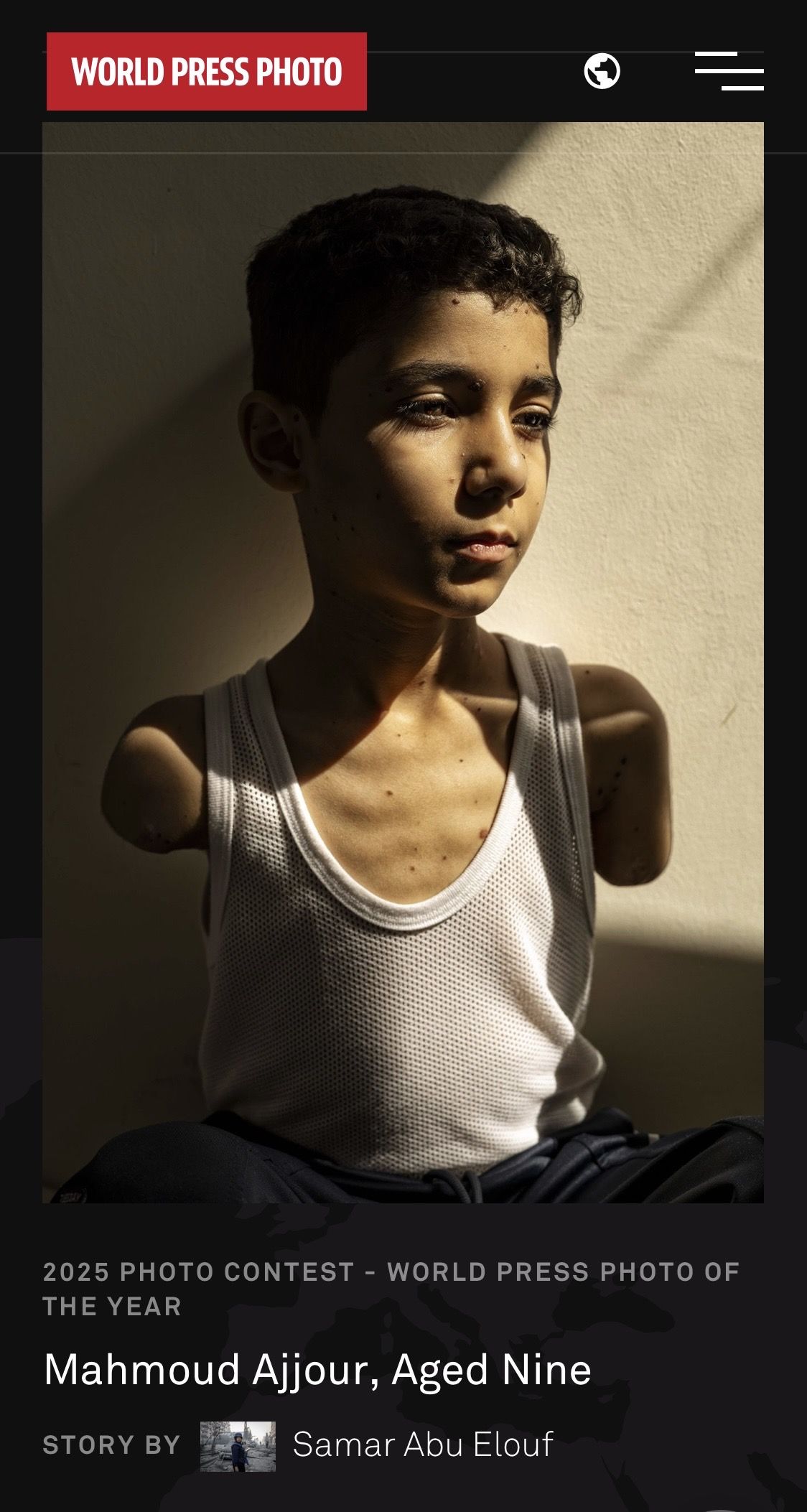
- This follows a controversial 2025 award cycle in which Gaza imagery, including the winning photograph by Samar Abu Elouf, played a central role in shaping global perceptions of the conflict, raising questions about how institutional framing assigns meaning to images.
Each year, the World Press Photo contest does more than recognize powerful images. It also plays a role in shaping how those images are understood.
The 2026 jury report, released ahead of the April 23 announcement of the winners, offers a detailed account of the finalists across regions and categories. At first glance, the language is consistent: descriptive, observational, and grounded in composition, perspective, and narrative access.
But a closer reading reveals a shift.
That shift is not simply stylistic. It reflects a deeper structural change.
When the report turns to Gaza, the tone changes. Description becomes declaration. Representation becomes assertion. And in that shift, meaning is no longer left open to the viewer; it is fixed in advance.
The Baseline: How the Jury Describes the World
Across Africa, Europe, Asia, and the Americas, the jury adheres to a clear descriptive framework.
Photographs are said to “capture,” “convey,” or “offer perspective.” Even in conflict zones such as Ukraine, Sudan, or in the United States, the language avoids direct causal claims. The emphasis remains on:
- Composition
- Emotional resonance
- Access and proximity
- The photographer’s perspective
In one European entry, the jury explicitly notes that the work “invites viewers to engage in understanding” rather than prescribing judgment. Elsewhere, images are framed as “visual records” or “entry points” into complex realities.
This is the standard: observation without imposition.
Images are presented as representations of events, not as proof of a singular narrative.
The Shift: Gaza as Declared Reality
That standard does not hold in the Gaza entries.
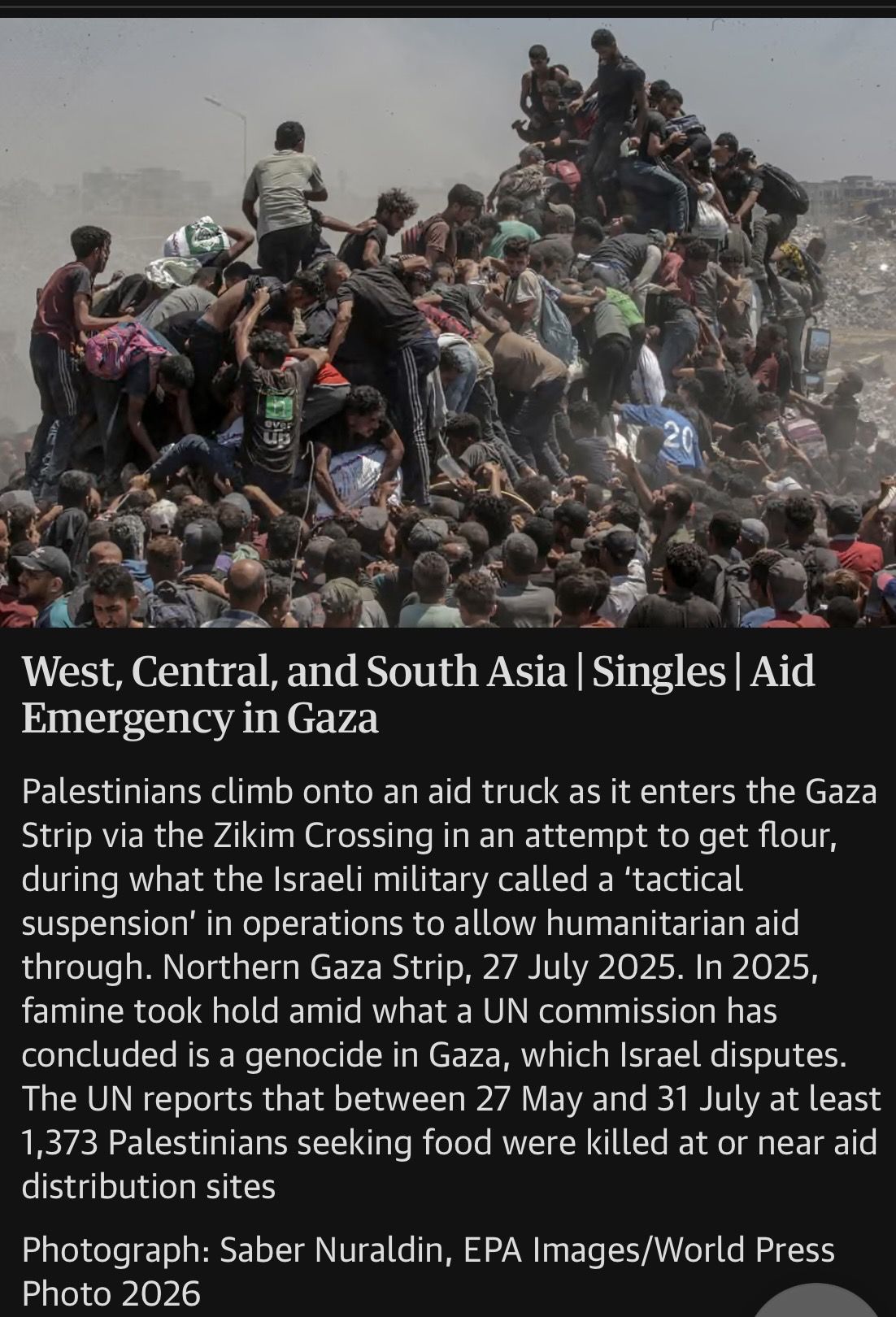
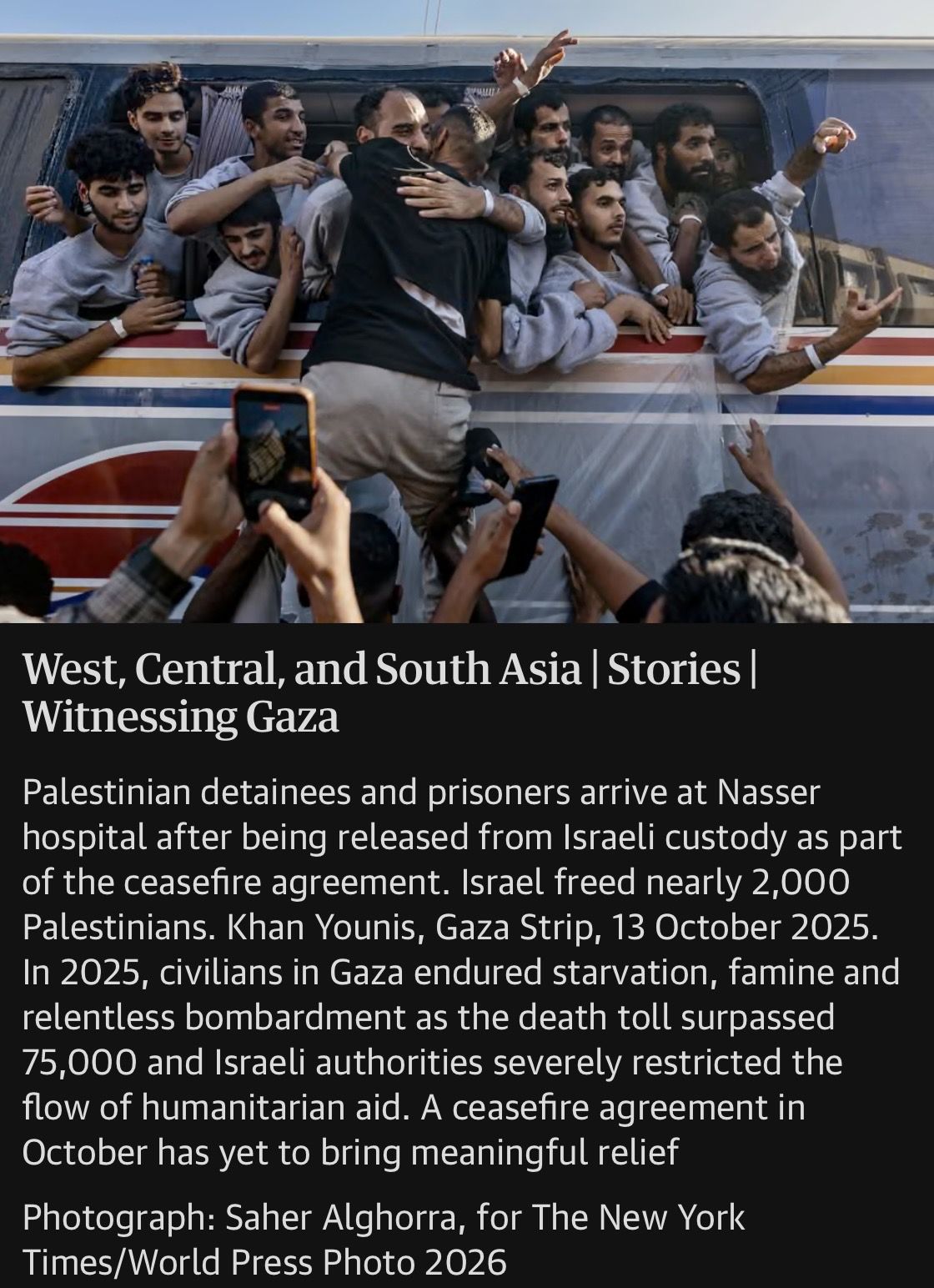
Two finalists, a single image by Saber Nuraldin and a story by Saher Alghorra, are accompanied by language that departs sharply from the rest of the report.
In Nuraldin’s entry, the jury writes that famine affecting “more than half a million Palestinians” was “the result of an Israeli blockade,” and that the image offers “visual evidence of famine.”
This moves beyond description into attribution. And attribution, in this context, functions as conclusion.
It is also certainty.
Nowhere else in the report is a political actor assigned direct causal responsibility in such terms. Nowhere else is an image explicitly framed as “evidence” of a contested claim.
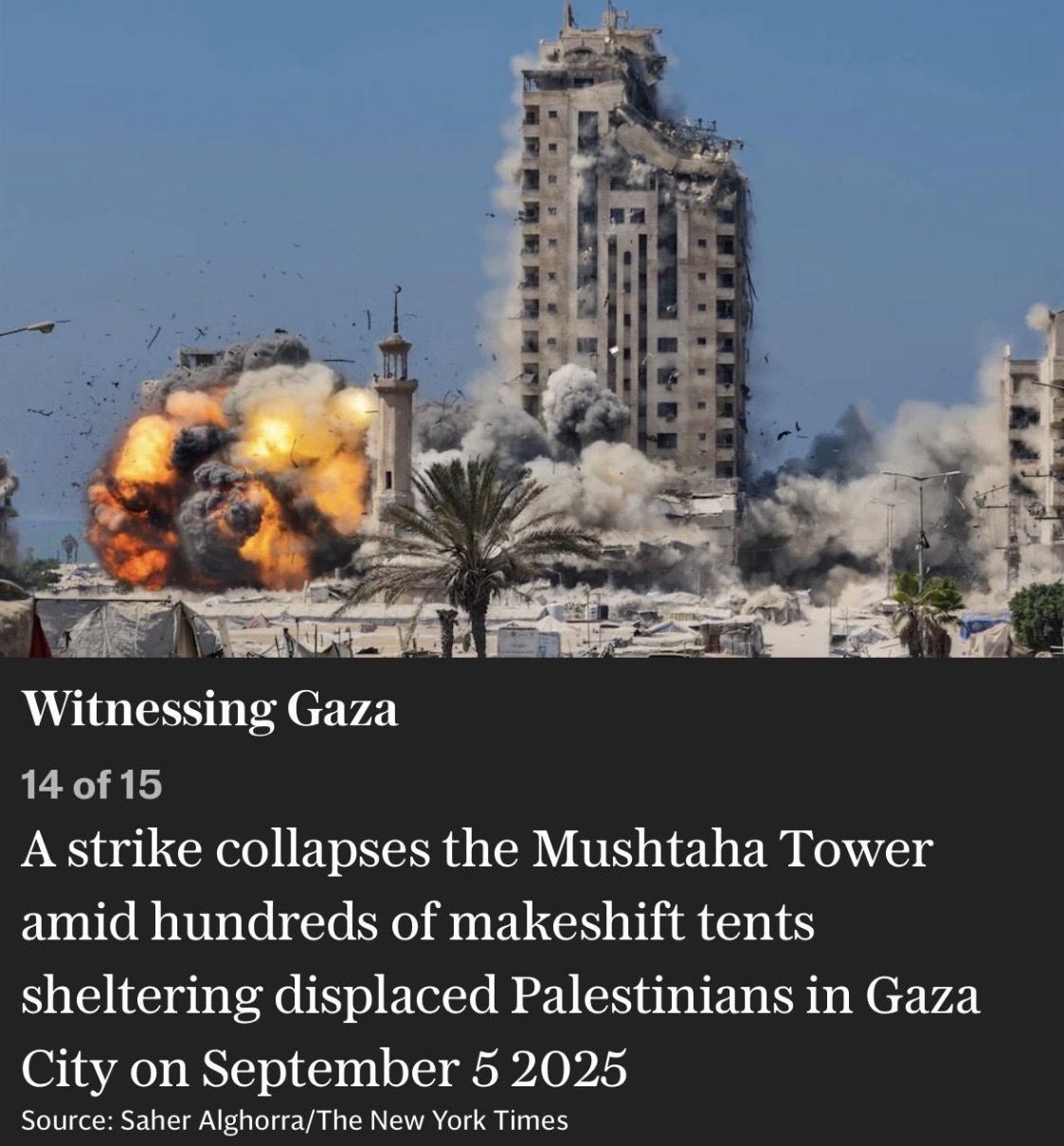
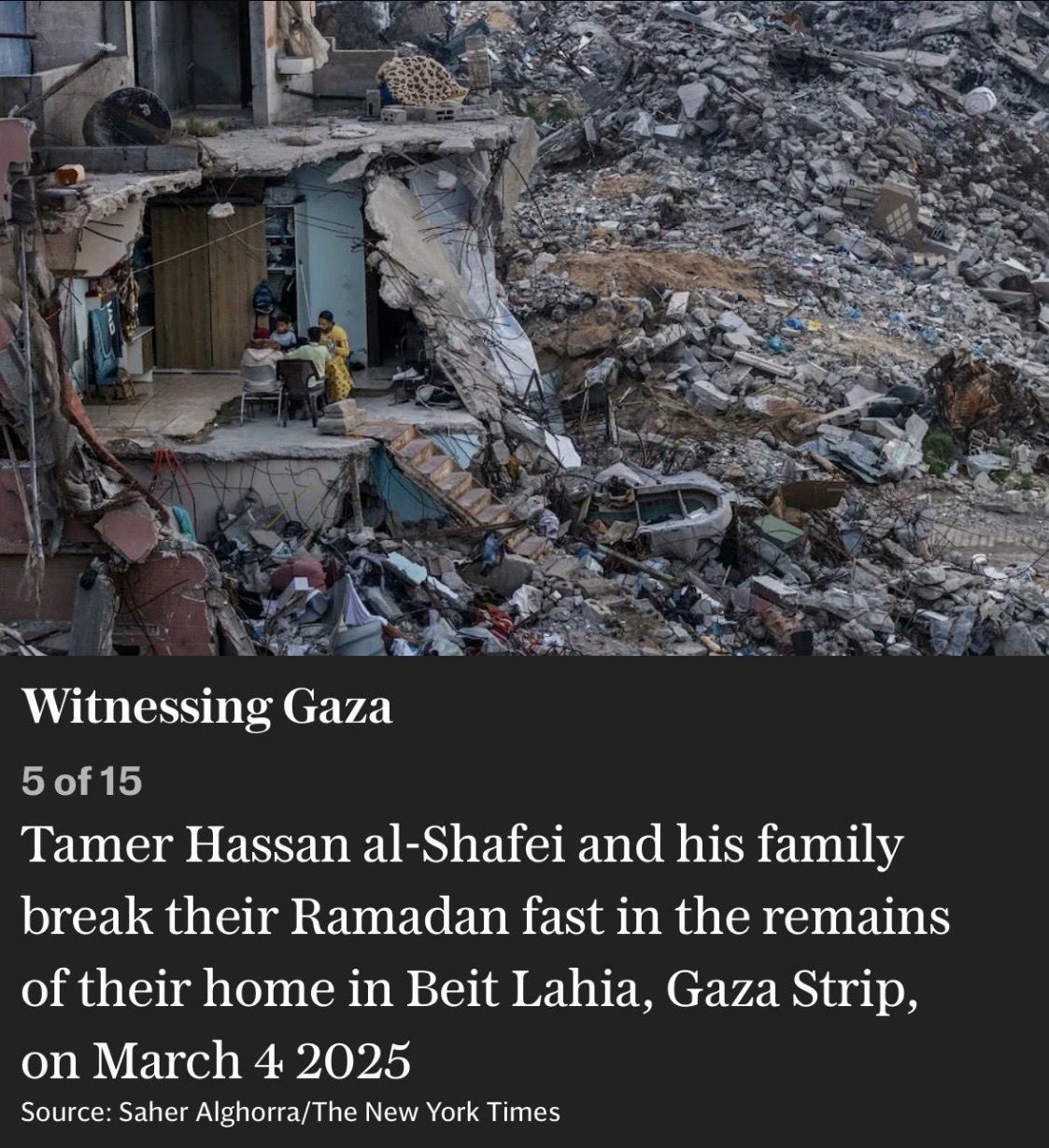
In Alghorra’s entry, the shift is less explicit but no less significant. The work is described as “bearing witness to a reality the world might otherwise not see,” supported by a sequence of images depicting death, hunger, and destruction.
Here, the mechanism is narrative accumulation. Individual scenes are combined into a coherent and unchallenged reality, reinforced by the photographer’s position as both observer and participant.
In both cases, the result is the same:
A closed narrative frame, presented without competing context.
Representation vs Evidence
This distinction matters.
In most of the report, images are treated as windows, partial, subjective, and open to interpretation. They “convey” and “suggest,” leaving space for the viewer to engage.
In the Gaza entries, images are elevated to something else:
They become evidence.
The difference is not semantic. It is structural.
An image that represents invites interpretation. An image presented as evidence demands conclusion.
By shifting from one to the other, the jury moves from describing photographs to defining reality.
The Removal of Context
Equally striking is what is not present.
In the Gaza entries, there is no reference to:
- The role of Hamas as the governing authority in Gaza
- The complexities of aid distribution
- The contested nature of famine claims during the conflict
- The broader operational context of war
The omission is not universal across the report. It is specific.
In other regions, complexity is preserved. Tensions are acknowledged. Ambiguity remains.
In Gaza, ambiguity is removed.
The narrative is fixed, and the image is positioned to support it.
A Pattern, Not an Isolated Case
The three photographers referenced in this context operate within major international media frameworks. Samar Abu Elouf’s 2025 award-winning image was published through The New York Times, while Saher Alghorra’s work also appears there. Saber Nuraldin is affiliated with EPA Images, a global news agency. This positioning places their work directly within the international media distribution system, where editorial framing extends beyond the image itself.
This shift does not exist in isolation.
In 2025, the World Press Photo of the Year was awarded to Samar Abu Elouf for an image of a severely injured child in Gaza, published by The New York Times. The photograph was widely circulated and became one of the defining images of the war.
The award drew significant attention and became a central reference point in global coverage of the war.
That cycle was widely seen as controversial, not because the image lacked impact, but because of the way such images come to represent an entire narrative.
The 2026 jury report suggests that this dynamic has not only continued but deepened.
The Institutional Role
The World Press Photo Foundation occupies a unique position in the global media ecosystem.
It does not produce news. It curates it.
But in doing so, it confers legitimacy, not only on images, but on the narratives attached to them.
The jury report is not a neutral document. It is an interpretive layer, guiding audiences on how to understand what they see.
When that layer shifts from description to declaration, the implications extend beyond the competition itself.
It shapes how images are received, shared, and remembered.
The Mechanism: Fixing Meaning in Advance
The pattern that emerges is consistent:
- Causal claims are introduced where they are otherwise absent
- Images are presented as evidence rather than representation
- Context is reduced or removed
- Ambiguity is replaced with certainty
This is not about any single photograph.
It is about how meaning is constructed.
By defining the narrative in advance, the jury report limits the range of possible interpretations. The viewer is not asked to consider what the image shows, but to accept what it proves.
Conclusion
The World Press Photo contest has long been regarded as a benchmark for visual journalism. Its selections shape not only careers, but global conversations.
That influence carries responsibility.
In the 2026 jury report, the divergence in tone between Gaza entries and the rest of the document is clear. Where most images are described, Gaza images are defined. Where others invite interpretation, these assert conclusion.
When description becomes declaration, the image no longer speaks for itself.
Its meaning has already been decided.
And once meaning is fixed, interpretation no longer follows the image; it follows the frame.
We await the announcement of the contest’s winners on April 23 with interest.
Liked this article? Follow HonestReporting on Twitter, Facebook, Instagram and TikTok to see even more posts and videos debunking news bias and smears, as well as other content explaining what’s really going on in Israel and the region. Get updates direct to your phone. Join our WhatsApp and Telegram channels!