Key Takeaways:
- The Forward frames Mahmoud Khalil as a reassuring voice, while downplaying his record of extremist rhetoric.
- Khalil’s most controversial claims go largely unchallenged, allowing him to redefine his own narrative.
- By prioritizing access over scrutiny, the interview legitimizes views it should be interrogating.
During Passover, The Forward has found a new liberating figure for the Jewish people: Mahmoud Khalil.
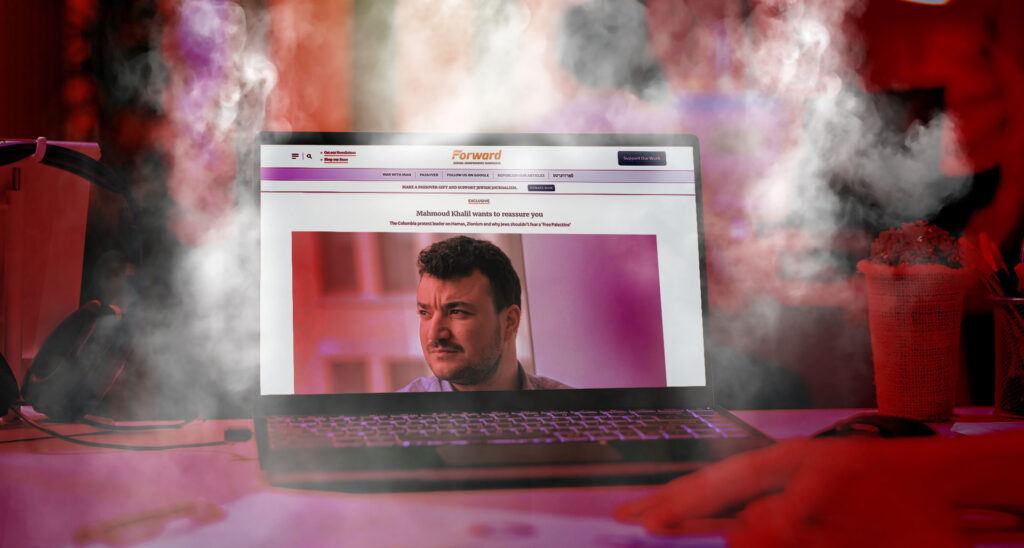
In an April 7 puff piece, headlined “Mahmoud Khalil wants to reassure you”, the missionary tone is clear from the outset. The subheader goes even further: “The Columbia protest leader on Hamas, Zionism and why Jews shouldn’t fear a ‘free Palestine.’”
A new Moses, preparing to calm down the skeptical Israelites about a new version of their Promised Land.
But Mahmoud Khalil is not simply an activist with a mission caught in a misunderstanding. As the leader of CUAD (Columbia University Apartheid Divest), Khalil has backed calls for violence and the destruction of Western civilization.
He has already been exposed as a figure whose record includes antisemitic rhetoric and positions far more extreme than the measured persona presented in the interview. That context should have been central. Instead, it is softened, sidelined, and in places effectively laundered.
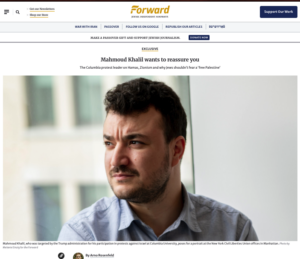
The choice of platform also matters. The Forward is not a fringe outlet. It is a prominent, left-leaning Jewish publication that often takes a critical stance toward Israel and shapes discourse within segments of the Jewish community. Even within that editorial posture, the decision to soften rather than scrutinize a figure like Khalil goes beyond critique and into normalization. It signals to readers that his views fall within the bounds of acceptable debate in the Jewish world.
Indeed, the interview acknowledges criticism of Khalil, who was detained by federal agents at Columbia university last March during campus demonstrations against Israel. But the interview quickly lets Khalil pivot to his preferred narrative. Readers are told he “sought to reassure American Jews,” and he is given wide space to do exactly that.
“The Jewish people are part of the land and they should remain that way,” Khalil says. “I want to liberate everyone.”
With appreciation to Mr. Khalil’s narcissistic need to liberate the Jewish people, it is difficult to reconcile that sentiment with his repeated denial of Jewish self-determination and his record of inflammatory rhetoric. But his star-struck interviewer, Arno Rosenfeld, didn’t seem to grasp the contradiction.
Throughout the piece, Khalil is allowed to define the terms of the debate. “Rejecting the self-determination of the Jewish people on the Palestinian land in itself is not antisemitism,” he says. That assertion sits at the core of the controversy surrounding him. Yet it is not meaningfully challenged.
Instead, the article goes further, describing Khalil as advocating “a remarkably pragmatic direction for the movement.” It even slips from reporting into quiet rehabilitation, casting him as “a poor poster child for the protest movement’s excesses” – a phrase that also sanitizes a movement which, in practice, has openly embraced chants to “globalize the intifada.” What is being framed as mere “excess” is, in reality, the movement’s defining rhetoric.
These claims also contradict the article’s own reporting. Khalil “goes beyond accusing Israel of genocide,” has said Israel’s goal is to “kill all the Palestinians,” questioned whether Hamas militants sought to kill Israeli civilians on October 7, and is “sympathetic to support for Hamas among Palestinians.”
The contradictions are visible. They are simply not interrogated. And the readers are left to wonder if they hallucinated what’s in front of their eyes.
Who is Mahmoud Khalil? A deep dive into one of Columbia’s most controversial student leaders—and his shocking ties to pro-terror activism. ? pic.twitter.com/8pVAusQeoq
— HonestReporting (@HonestReporting) March 15, 2025
It important to remember that since his detention, Khalil has not retreated from public life. On the contrary, he has become a more visible figure, speaking at events and continuing to be vocal around the campus protests he helped lead. At the same time, U.S. authorities have sought to deport him, underscoring how seriously his activities are being viewed at the federal level. That broader context makes the interview’s soft framing all the more difficult to justify.
And sadly, this is not an isolated case. The interview is part of a broader media pattern in which figures like Khalil are reframed as complex, even pragmatic voices, rather than scrutinized for the substance of their positions. The New York Times, as well as NPR, both profiled him recently as a victimized hero. The more such profiles appear, the more the boundaries of acceptable rhetoric shift.
This is because Khalil is a wolf in sheep’s clothing, and he has no qualms about showing his teeth. He refused to condemn terrorism. Yet The Forward — and other media — just gloss over it. And the mere fact they gave Khalil a platform suggests that biased editors thought he deserved it.
The effect is cumulative. Khalil is presented as thoughtful, measured, conciliatory. The teeth edges are dulled.
To be clear, interviews with controversial figures are not inherently problematic. Journalism should engage difficult voices. But that engagement requires context and challenge. It requires confronting contradictions, not smoothing them over.
Here, that standard is not met. When a publication like The Forward provides a platform without sufficient scrutiny, it does more than report. It legitimizes.
The result is a profile that allowed Khalil to imprison the truth, rather than “liberate everyone.”
Liked this article? Follow HonestReporting on Twitter, Facebook, Instagram and TikTok to see even more posts and videos debunking news bias and smears, as well as other content explaining what’s really going on in Israel and the region. Get updates direct to your phone. Join our WhatsApp and Telegram channels!
© Divuach Ne’eman R”A, 2025
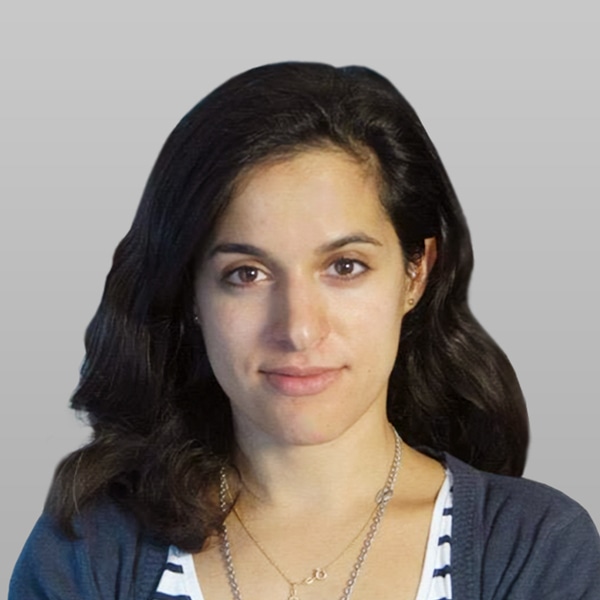
Dr. Rinat Harash
Rinat Harash, Ph.D, is a veteran news media professional, with 15 years of experience as a Reuters journalist, video editor and producer covering Israel and the Palestinian territories. She is also the author of “Apollo, Dionysus and the Übermensch at Sinai: An Attempt at a Nietzschean Analysis,” a pioneering study that fuses Jewish thought with the field of aesthetics.