Key Takeaways:
- A submunition from a Hezbollah rocket exploded, killing one teenager and injuring several others in northern Israel.
- Hezbollah uses cluster munitions to increase the probability of civilian casualties.
- Major outlets did not attribute responsibility to Hezbollah in the headline or ignored the story altogether, removing the terrorist group from accountability.
One teenager was killed this week and 24 others injured by an explosion during a high school hiking trip in northern Israel. That is the human consequence behind a story that, at first glance, could easily be mistaken for a tragic accident involving unexploded ordnance.
That leading headline is found in CNN, Reuters, and AP.
Yet every single headline failed to identify the source of the munition: Hezbollah. Other major international outlets have failed to cover the story at all.
Almost immediately following the explosion, the IDF announced that it believed the explosion was from a submunition from a Hezbollah rocket.
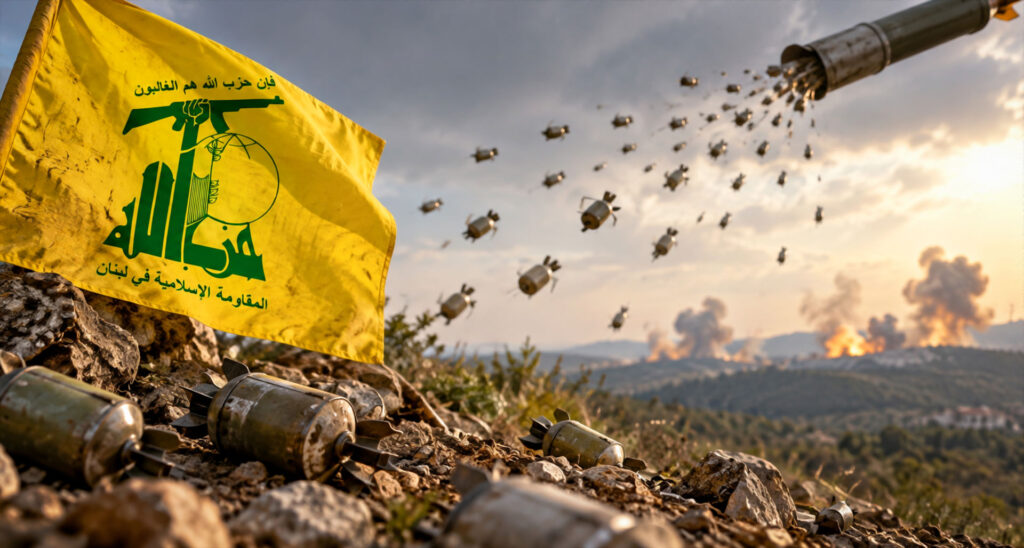
Hezbollah has been known to use Grad rockets with a short range of 15-20 kilometers, often containing dozens of BRB1-type submunitions. Unlike a conventional rocket that explodes when it reaches its target, cluster munitions are designed to release numerous smaller submunitions over a wide area. A single rocket can therefore scatter dozens of explosives across the ground, dramatically increasing the area and the number of people impacted by a single attack.
The increased area that can be targeted is exactly the purpose of Hezbollah using cluster munitions, as it increases the likelihood of more casualties. When used indiscriminately as Hezbollah does, such an attack is considered a war crime.
A preliminary investigation of the incident in the north suggested that the munition was launched at Israel between mid-March and early April 2026. Hezbollah’s use of cluster munitions on March 4 and again on March 15, 2026, resulted in a rare condemnation of the terrorist group by Human Rights Watch. The IDF reported approximately 50 submunition impacts from March 4 alone, all of which were around civilian homes.
While Lebanon is a signatory to the 2008 Convention on Cluster Munitions, the treaty does not formally bind Hezbollah as a non-state terrorist organization. Being that Hezbollah’s mission is the destruction of Israel, the terrorist organization has little incentive to abide by international agreements designed to protect Israeli civilians. However, it is still bound by international humanitarian law, including the obligation to distinguish between civilian and military targets – a distinction that Hezbollah has repeatedly failed to make as it seeks maximum casualties.
The danger of these weapons becomes revealed again when months after the initial attack, their explosive power remains deadly.
The Iranian regime similarly used cluster munitions repeatedly as it struck civilian locations in Israel. At the time, CNN made the false moral equivalence between the regime and Israel for its use of munitions against Hezbollah in the 2006 Lebanon War. The piece went without mentioning that Israel was not indiscriminately targeting civilians – which is the reason both the Iranian regime and Hezbollah use these munitions. Yet now, when these munitions have taken more civilian lives, CNN fails to give the terrorist group any deserved scrutiny.
The weapon that took a teenager’s life and left several others injured was planted several months earlier. Hezbollah’s responsibility for the casualties is no less substantial because of the time it took for the consequences to emerge. While the unexploded cluster munitions scattered across northern Israel should make the threat Hezbollah poses to civilians all the more clear, the failure of major outlets to name the terrorist group responsible only further obscures that threat. When the perpetrator disappears from the headlines, so does accountability.
Liked this article? Follow HonestReporting on Twitter, Facebook, Instagram and TikTok to see even more posts and videos debunking news bias and smears, as well as other content explaining what’s really going on in Israel and the region. Get updates direct to your phone. Join our WhatsApp and Telegram channels!
© Divuach Ne’eman R”A, 2025