Key Takeaways
This week, Israel and the Jewish world commemorated Yom HaShoah, where we remember a simple fact: six million Jews were murdered because they were Jews. Not as part of a general tragedy. Not as victims among many. But as a people marked for destruction. That matters because it is precisely what is now being stripped away.
From Remembrance to Inversion
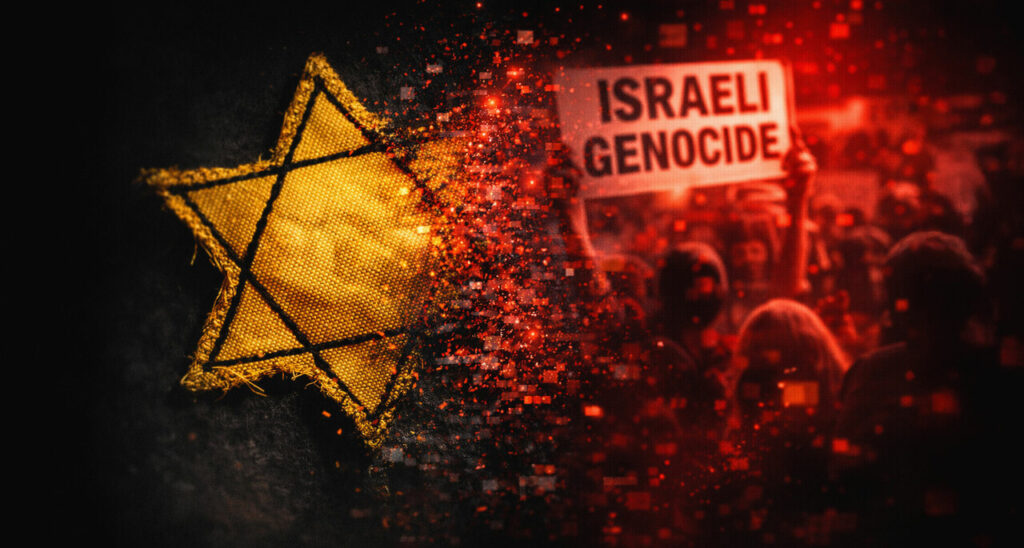
One of the most striking features of contemporary discourse is the increasing normalization of what scholars have termed “Holocaust inversion.” The claim, repeated across activist spaces, campuses, and increasingly within mainstream political language, is that Israel behaves like Nazi Germany, and that Jews, once the victims of genocide, have become its perpetrators.
This is often framed as moral outrage, as though invoking the Holocaust elevates the seriousness of criticism. But in reality, it performs a far more corrosive function. It takes the most extreme example of anti-Jewish destruction in history and turns it into a tool for indicting Jews themselves.
The Holocaust is no longer treated as a historical reality that demands precision and understanding. It is transformed into a rhetorical device, detached from its context and redeployed for contemporary political ends. In that transformation, the Holocaust is not only distorted. It is inverted, from a history that demands responsibility toward Jews into a tool for accusing them.
The Soviet Origins of the Lie
This phenomenon did not emerge in a vacuum. Its roots can be traced with particular clarity to the anti-Zionist campaigns of the Soviet Union during the Cold War. Following the break in relations with Israel, Soviet propaganda increasingly sought to reframe Zionism not simply as a political ideology, but as a form of fascism.
By the 1960s and 1970s, particularly after the Six-Day War, this framing intensified dramatically. Soviet publications and state-sponsored materials routinely depicted Israeli leaders in Nazi uniforms and equated Zionism with Hitlerism. The culmination of this effort was the 1975 United Nations General Assembly Resolution 3379, which embedded this ideological framing within international institutions. The logic was clear: if Zionism could be cast as Nazism, then Jewish self-determination, and the Jewish people themselves, could be stripped of legitimacy and morality.
That framework did not disappear. It migrated. Today, Holocaust inversion is no longer confined to state propaganda. It has been absorbed into mainstream discourse, where it is often presented as moral critique rather than ideological distortion.
This can be seen clearly in protests following the October 7, 2023 Hamas attacks, where demonstrations in London and other Western cities repeatedly featured placards reading “Stop the Holocaust in Gaza”. These were not fringe protests. They took place in major city centers, were photographed by journalists, and circulated widely across mainstream media and social platforms.
It is also visible on university campuses across the U.S. and the UK, where student protests and encampments have included slogans such as “Gaza Holocaust” and explicit comparisons between Israeli policy and Nazi extermination. These examples have been documented by multiple outlets and monitoring groups, pointing not to isolated incidents, but to a pattern in which Holocaust language has become a normalized rhetorical tool.
This distortion now extends into the absurd, with accounts on X describing individuals in Gaza as “Palestinian Holocaust survivors,” stripping the term of all meaning and turning it into a tool of inversion.
The comparison itself collapses under even minimal scrutiny. Nazi Germany’s project was the total extermination of the Jewish people. It was ideologically explicit, systematically organized, and industrially executed. Jews were not incidental victims of a conflict. They were the target, everywhere and without exception.
By contrast, Israel is engaged in an ongoing conflict with armed groups, most notably Hamas, which explicitly calls for the destruction of Jews. Civilian casualties in war are tragic and demand serious moral consideration. But they are not evidence of a policy of extermination. The distinction is foundational. Genocide is defined by intent. To erase that distinction is not to sharpen moral critique, but to replace it with propaganda. And in doing so, it empties the Holocaust of its meaning, turning the most specific crime in history into a generic accusation.
When the Holocaust Is Turned Against the Jews
What Holocaust inversion does is not simply to misrepresent Israel. It reshapes the moral framework through which Jews are understood. It erases Jewish victimhood by suggesting that the lessons of the Holocaust have been betrayed by its victims. It demonizes Jews by placing them in the role of history’s ultimate perpetrators. And it inverts moral responsibility, recasting those who explicitly target Jews as victims, while portraying Jews as aggressors.
This inversion is not merely offensive. It follows a long-established pattern in which Jews are cast as uniquely malevolent, uniquely powerful, and uniquely deserving of condemnation.
This is made possible by a broader trend: the de-Jewification of the Holocaust. In much contemporary discourse, the Holocaust is presented as a universal lesson about intolerance, stripped of its specificity as a campaign against Jews. This abstraction creates the conditions under which the Holocaust can be detached from its historical reality and repurposed. Once it is no longer anchored in the experience of the Jewish people, it becomes available as a moral symbol that can be applied to any situation, including those involving Jews themselves.
On Yom HaShoah, this matters because memory is not passive. The Holocaust did not begin with gas chambers. It began with narratives. With the construction of Jews as a problem, as outsiders, as a people whose identity could be defined by others. Holocaust inversion follows that same pattern. It imposes a narrative onto Jews that is not grounded in reality, but in ideological need.
The purpose of remembrance is not only to honor those who were murdered, but to preserve the integrity of what happened to them. That demands precision. The Holocaust was a targeted attempt to destroy the Jewish people. Comparing Israel to Nazi Germany is not moral critique. It is a collapse of moral reasoning. It is distortion.
And when the Holocaust is used against Jews, it stops being remembrance. It becomes something else. A weapon once again turned on the Jews.
Liked this article? Follow HonestReporting on Twitter, Facebook, Instagram and TikTok to see even more posts and videos debunking news bias and smears, as well as other content explaining what’s really going on in Israel and the region. Get updates direct to your phone. Join our WhatsApp and Telegram channels!
© Divuach Ne’eman R”A, 2025