Key Takeaways:
-
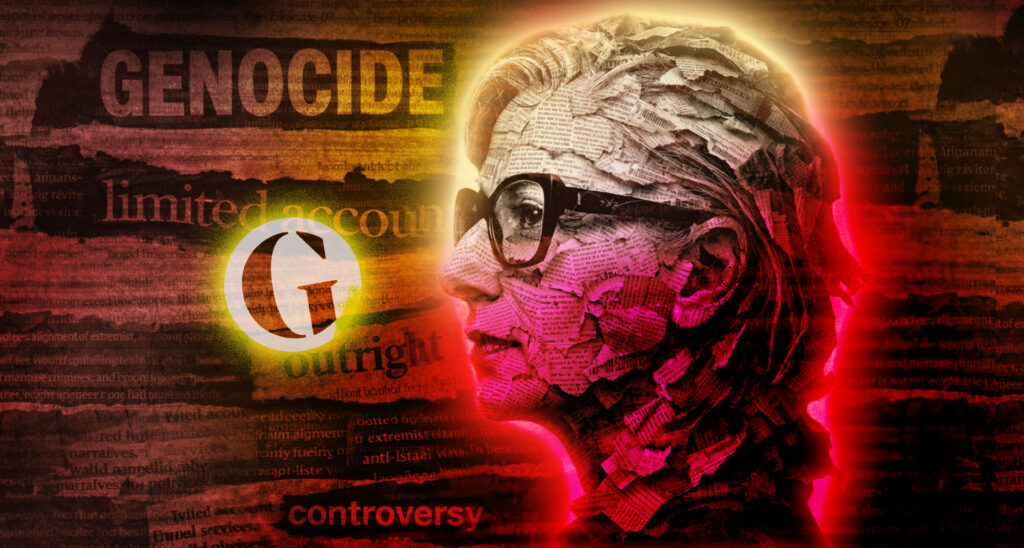
On Holocaust Remembrance Day, The Guardian platformed Francesca Albanese, a UN official who has accused Israel of “genocide.”
-
Julian Borger’s interview reads as outright fawning, portraying Albanese as a “rock star” while ignoring her most controversial record and promoting her new book.
-
Instead of reporting on the surge in antisemitism and threats facing Jewish communities, The Guardian has helped fuel the flames.
On Yom HaShoah, Israel’s Holocaust Remembrance Day, when the word “genocide” carries its heaviest historical weight, The Guardian chose to publish a sympathetic interview with a United Nations official who repeatedly accuses Israel of exactly that.
Why did the newspaper make this choice? Better ask its World Affairs correspondent Julian Borger, who travelled all the way to Geneva to interview Francesca Albanese, the UN Special Rapporteur on the “Occupied Palestinian Territories.” He described her as a”rockstar” in a puff piece that doubles as a promotion for her new book.
1/
The @Guardian just ran a fawning profile of UN rapporteur Francesca Albanese – they even call her a “rockstar.”In the opening scene, a Geneva café supposedly lines up for selfies. It reads like fan fiction, not journalism.
And it only gets worse. ? pic.twitter.com/QLI3hx2UAv
— HonestReporting (@HonestReporting) April 14, 2026
There is no better word to describe the interview than fawning. It is an embarrassment to journalism. And here is why.
First, it’s Borger’s lack of any ability to doubt or critique a person whom he clearly admires. He describes how he met Albanese in a Geneva cafe and how people approached her to voice their support. Apparently, Mr. Borger takes a crowd of selfie-seekers as evidence of credibility – a curious standard for journalism.
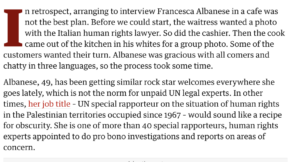
Second, Borger gushes that Albanese is the first person with “UN” in her title to accuse Israel of genocide, instead of critiquing the hypocritical global body precisely for giving her a platform, or mentioning that it is the same UN whose human rights council includes members like China and Cuba.
Third, the piece presents Albanese as a victim, who has been persecuted and sanctioned for speaking up against Israel. But where is the context? Where is any mention of her support for terrorism or her use of antisemitic tropes on global platforms? None of it appears. The result is a piece that treats criticism of such rhetoric as the problem, rather than the rhetoric itself.
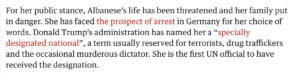
Fourth, Borger nonchalantly compares Gaza, “the genocide of the 21st century,” to Bosnia and Rwanda, where thousands were murdered in systematic, industrial-scale atrocities. The historical weight of that comparison is immense. Yet there is no mention that the recent war in Gaza began with Hamas’ October 7 attack, an assault driven by openly genocidal intent against Israelis and Jews.
Fifth, Albanese’s track record of antisemitic speech is ignored completely. All that’s mentioned is that some officials “regret that she has mixed the language of the dispassionate lawyer with the passionate rhetoric of a political campaigner.” Clearly, Borger is very passionate about defending his hero.
What he doesn’t mention is that Albanese has only recently referred to the Jewish state as a “common enemy” tied to financial power and control, echoing classic antisemitic tropes about Jewish influence, and appeared on platforms alongside Hamas figures, raising serious concerns about judgment and normalization of extremist actors.
Related Reading: Albanese’s Latest Remarks Expose a Pattern the UN and the Media Can No Longer Ignore
The conclusion is clear: Borger and The Guardian invert victimhood and justice. The murdered Jews, the hostages, and Israeli families under fire are sidelined. Gaza is presented without context, Hamas conveniently absent, and Francesca Albanese elevated, even afforded a neatly placed plug for her book at the article’s end.
What is also clear is that Mr. Borger is not a journalist. He would be better off considering a career change as a book agent.
And on Holocaust Remembrance Day, The Guardian chose a Geneva café and an antisemite over the UK’s threatened Jewish community – even as 2025 has become one of the deadliest years for Jews in decades.
Liked this article? Follow HonestReporting on Twitter, Facebook, Instagram and TikTok to see even more posts and videos debunking news bias and smears, as well as other content explaining what’s really going on in Israel and the region. Get updates direct to your phone. Join our WhatsApp and Telegram channels!
© Divuach Ne’eman R”A, 2025