Key Takeaways:
- Hezbollah’s founding ideology, public statements, and terrorist actions have been clear in their objective of the destruction of Israel. The BBC has warped this reality and downplayed the extent to which Hezbollah is responsible for the war.
- Hezbollah operates as a state within a state in Lebanon, sustained by Iranian support, and its military and political activity contributes to repeated escalation and regional instability.
- Western media coverage has frequently omitted Hezbollah’s responsibility in the conflict, resulting in a distorted understanding of Israel’s operations against the terrorist organization.
Hezbollah needs no convincing of its goal: the elimination of the State of Israel. Since its formation, the terrorist organization has been committed not only to Israel’s destruction, but to targeting Jews worldwide through deadly terrorism.
Even Hezbollah’s 1988 Open Letter makes this explicit, declaring that Israel “must be fought until the hated ones get what they deserve.”
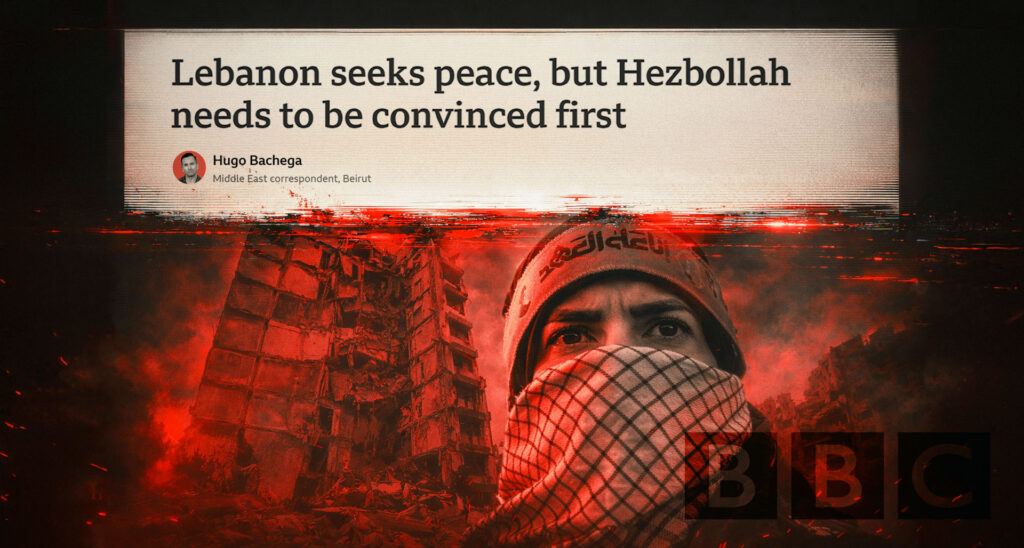
Yet the BBC distorts this reality in its article, “Lebanon seeks peace, but Hezbollah needs to be convinced first.” If the headline alone downplays the threat, the article doubles down on this gross misrepresentation.
Hezbollah has not only sought the destruction of the State of Israel, but it has also wreaked havoc on Lebanon itself, repeatedly dragging the country into war and overtaking towns with its terrorist grip.
Founded in the aftermath of the Iranian revolution by members of the Iranian Revolutionary Guard Corps, Hezbollah has remained closely aligned with the Iranian regime ever since. It is for this very reason that the entire structure of Hezbollah has been labeled a terrorist organization, rather than distinguishing between political and military wings.
This, however, is how the BBC decided to present this grim reality:
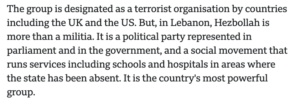
Hezbollah has become a state within a state, shaping Lebanese politics, society, and the economy, while steadily eroding the country’s own institutions.
Hezbollah’s hybrid model was not designed to compensate for the gaps in Lebanese governance, but to deliberately exploit them. Its standing as the “country’s most powerful group” is a direct result of this exploitation. Nonetheless, as its roots trace back to the Iranian regime, each sector of Hezbollah – whether military, political, or social – operates as an extension of its broader terrorist network.
But for the BBC, this pattern is recast in far softer terms:
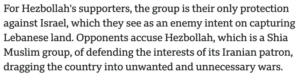
As Iran’s most significant proxy, Hezbollah received around $1 billion from its state sponsor in 2025 alone to fund its campaign against Israel . Describing it as “dragging the country into unwanted and unnecessary wars” is not an accusation from its opponents, but a reflection of reality – one the BBC chooses to obscure.
The repeated calls for Hezbollah to adhere to the ceasefire by disarming and moving north beyond the Litani River have been ignored, resulting in renewed Israeli operations. It is abundantly clear that Hezbollah does not offer Lebanon “protection against Israel,” but instead invites conflict in the land. Israel’s actions, by contrast, are defensive, aimed at securing its northern border against further terrorist attacks.
And as Israel and Lebanon enter a historic round of direct talks – the first since 1993 – Hezbollah has sought to undermine them, calling for a cancellation of the “futile” discussions. This is no surprise, considering any form of peace between the two countries would ultimately weaken Hezbollah.
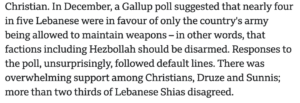
The BBC does acknowledge a recent Gallup poll showing that nearly four in five Lebanese support restricting weapons to the national army, meaning a clear majority favor Hezbollah’s disarmament. Opposition came largely from Shiite Muslims, the sect from which Hezbollah draws its core support. Yet the BBC’s own reporting – and Western media more broadly – still downplays what Lebanese civilians are saying plainly: they want Hezbollah disarmed.
The BBC states that “armed resistance” (known to anyone but the BBC as terrorism) is “key in Hezbollah’s raison d’être”:
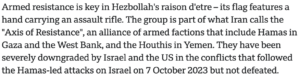
In adopting the language of “resistance,” the BBC effectively echoes the framing used by the Iranian regime and its terrorist network, allowing terrorist actors to define their actions on their own terms.
Unlike Hezbollah’s indiscriminate rocket fire, Israeli airstrikes are precise and conducted in accordance with international law, with extensive measures taken to protect civilians, including evacuation warnings.
On April 8, the IDF conducted such airstrikes and later reported that 250 Hezbollah operatives were killed, including several top commanders. The BBC’s reporting of this day, however, simply states that 300 people were killed, with no indication of how many of them were terrorists.
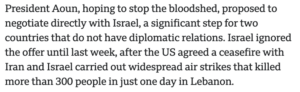
The omissions in the breakdown of combatant deaths in the Israel-Hamas war have now been repeated in subsequent reports covering Israel’s northern front. Meanwhile, this story later notes that “more than 2,000 people have been killed in Lebanon, Lebanon’s health ministry says, without distinguishing combatants from civilians” — phrasing strikingly similar to that used by Hamas’ Ministry of Health in Gaza. Yet, as of April 9, Israel stated that the number of killed Hezbollah operatives stood at more than 1,400, challenging the implication that Israel is purposefully targeting civilians.
This narrative reversal builds on a broader distortion of responsibility for the renewed fighting. While the BBC will take any opportunity to blame Israel for ceasefire violations, at no point does it acknowledge that Hezbollah has consistently violated the ceasefire, most notably through its refusal to disarm and through its continued weapons smuggling. Hezbollah commanders themselves have admitted as much, including in an interview with NPR. Why, then, does the BBC fail to do the same?
This isn’t the exclusive, @NPR.
When a Hezbollah commander admits to your reporter that the group:
❌ Never disarmed after the Nov. 2024 ceasefire with Israel
❌ Deceived the Lebanese Army with irrelevant weapons handovers
❌ Rearmed after the ceasefire
❌ Continues smuggling… pic.twitter.com/ab7BLdU1PG— HonestReporting (@HonestReporting) April 13, 2026
The beginning of direct talks is a historic opportunity for Lebanon and Israel – two neighbors without diplomatic relations, long shaped by anti-normalization policies that have helped prolong conflict across the region.
Lebanese and Israelis alike are weary of war and open to a path toward peace. But a third actor remains committed to an ideology of annihilation, determined to derail any such progress.
Despite the BBC’s reluctance to state the obvious, Hezbollah’s raison d’être is the destruction of the Jewish state, and no amount of convincing will change the organization’s direction. It is embedded in its foundation and will stop at nothing to complete this objective.
When cause and effect are reversed, Hezbollah’s aims are not exposed but softened, recast for Western audiences as a form of “resistance.” In the process, a terrorist movement is romanticized, and the civilians caught in the middle are erased.
Liked this article? Follow HonestReporting on Twitter, Facebook, Instagram and TikTok to see even more posts and videos debunking news bias and smears, as well as other content explaining what’s really going on in Israel and the region. Get updates direct to your phone. Join our WhatsApp and Telegram channels!
© Divuach Ne’eman R”A, 2025