Key takeaways
- Before the Gaza Humanitarian Foundation started operating in May 2025, substantial food entered Gaza, but Hamas seized much of it, diverted large quantities to fighters, and sold the remainder on the black market at prices ordinary Gazans could not afford. None of this appeared in wire service imagery.
- Gaza-based photographers reinforced a global famine narrative by exaggerating scarcity and omitting visual evidence of parallel food supplies, producing images that aligned with a political storyline rather than a complete reality.
- When GHF delivered a large-scale food shipment on May 26, 2025, the same photographers minimized the operation through tight, context-free framing designed to make significant aid appear small and preserve the pre-existing famine narrative.
The Gaza Humanitarian Foundation & Gaza’s Scripted Famine
Throughout much of this year, international audiences have been inundated with famine imagery from Gaza. Children clutching empty pots. Families gathered around bare tables. Market shelves stripped clean. These photographs—distributed by AP, Reuters and AFP—helped cement a global narrative that Gazan civilians were facing starvation. The images were emotional and compelling. But they reflected only one narrow version of reality.
What the cameras never showed was the extensive diversion of food inside Gaza before the arrival of the Gaza Humanitarian Foundation, a U.S.-backed aid initiative that operated from May until last month. Before this, shipments entering the territory were routinely intercepted by Hamas operatives, diverted to fighters, stored in private depots, or resold at prices civilians could not afford. This was a major driver of the shortages Gazans faced. Yet no images of this activity ever surfaced. Gaza-based photographers operate under Hamas authority and photograph only what can be safely shown.
That visual narrative met its first serious challenge when GHF entered Gaza with a massive, meticulously organized humanitarian delivery. The operation was too large to ignore. Photographers who had spent months documenting famine scenes had to show up. Total silence was no longer an option.
But a faithful depiction of the scale would have undermined months of carefully cultivated imagery. The famine narrative had become central to global coverage, and the arrival of large-scale aid created a direct collision between fact and established visual messaging.
Related Reading: Manufacturing Victimhood: How Hamas Manipulates Global Sympathy
Photographers quickly adapted. Instead of capturing trucks, pallets, distribution lines, or the full scale of the operation, they produced tightly cropped frames that reduced a major humanitarian effort into symbolic fragments: a single hand holding a single bag; a lone person carrying a box with no surrounding context; parcels photographed to obscure quantity; isolated children instead of coordinated distribution scenes. Shadows and angles concealed volume. Scale disappeared.
Every editorial choice pointed to the same goal: show that aid arrived – but make it look insignificant. Avoid anything that could suggest abundance. Preserve the established perception that Gaza remained on the brink of famine.
Wire services published these images without hesitation. Editorial desks that had relied on famine imagery for months continued along familiar lines. When photographs reinforce an expected storyline, they are almost never questioned. The GHF coverage displayed that dynamic in full.
The effect was unmistakable. Famine imagery was amplified. Abundance was minimized. Hamas’ diversion of food was excluded entirely. The public received a selective visual narrative that supported a political interpretation rather than a complete record of events. In a controlled environment, images presented as neutral evidence are often an edited, curated version of reality. The famine narrative was powerful, but when food finally arrived in quantity, the cameras found ways to make it look small.
May 27: The Visual Anatomy of a Manufactured Storyline
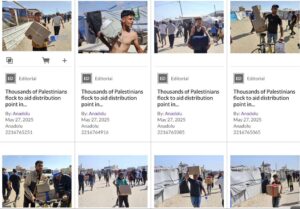
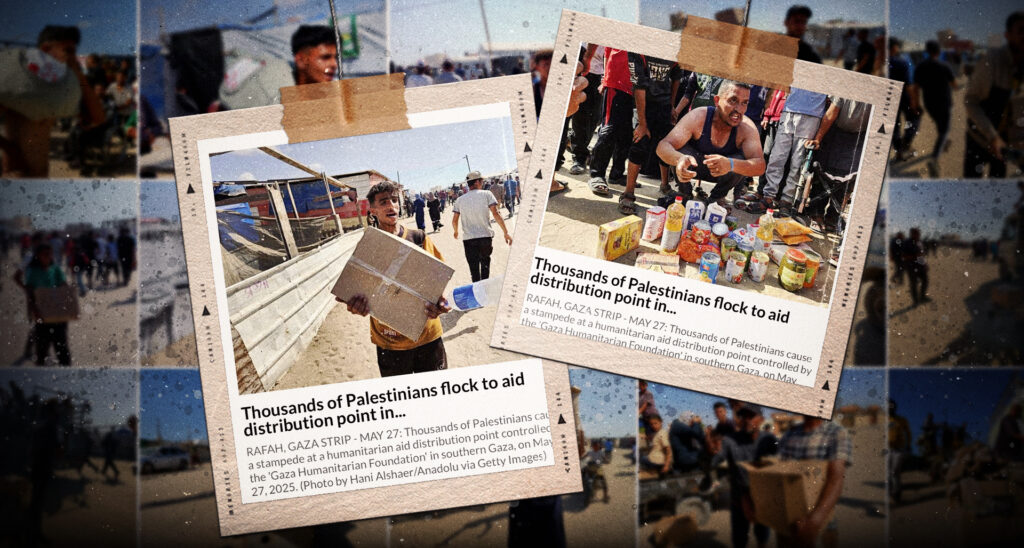
The day after the GHF delivery began, photographers reverted to their established approach. The May 27 images show a striking reluctance to reveal the sheer quantities of aid being distributed.
Instead of documenting unloading zones, distribution lines, or the volume of supplies, the images focus on isolated individuals carrying a single parcel or holding a lone bottle of oil. The same tight, emotional framing that had been used for months to promote a famine narrative was now used to downplay the significance of the GHF operation.
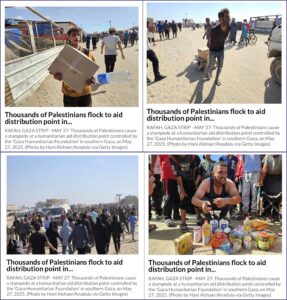
This one-day snapshot exposes how narratives are maintained. The famine storyline had been built so aggressively that any image showing abundance threatened the visual architecture supporting it. The May 27 photographs reveal not only what was shown, but what was deliberately left out.
How Hamas Helped Manipulate Famine Imagery to Shape Global Perception
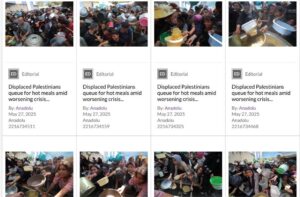
Throughout the war, international audiences saw a steady stream of crowded food-distribution scenes: women and children pressed forward with empty pots; alleys filled with bodies; hands reaching toward a single ladle. These images became some of the most widely circulated photographs of the conflict, forming the emotional backbone of the global famine narrative.
But these images were the product of highly controlled photographic choices. The framing was so tight that almost all the surrounding context disappeared. Angles exaggerated scarcity. Women and children—the most sympathetic subjects—dominated nearly every frame.
These scenes were photographed in Hamas-controlled areas and aligned with its preferred messaging. Photographers had freedom to magnify desperation because the imagery supported Hamas’ political goals. Larger quantities of food were cropped out. Lines were shot from angles that made them appear endless. Pots of food were photographed in ways that concealed volume.
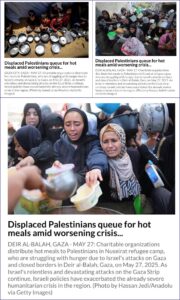
This marks a slight contrast to the May 27 GHF photographs. When documenting a distribution that Hamas did not control, photographers worked in the opposite direction – minimizing scale rather than exaggerating scarcity. Gone were sweeping frames and dramatic crowds. Instead, images became small, flat, and fragmentary.
The difference is revealing. Famine imagery in Gaza was not simply documentation. It was a constructed narrative built through selective access and deliberate framing. The comparison with the May 27 images makes the manipulation unmistakable.
Inside Israel on October 7: The Photographers Behind Gaza’s Imagery
These questions become more urgent when examining the photographers behind the imagery. One of the most significant figures is Hani Alshaer, a Gaza-based photographer whose work has been central to Anadolu’s output for Getty and AP. His images appear at hospitals, funerals and hostage exchanges. His access is extraordinary, and the agencies that publish his work have never explained it.
On October 7, Alshaer was not in Gaza at all. He was inside Israel. His photographs captured Hamas terrorists on the Israeli side of the barrier in the opening moments of the attack – armed fighters moving through Israeli territory and seizing military positions while civilians and soldiers were being murdered and abducted. His presence raises serious concerns about coordination, access, and the ethics of photographing a massacre.
He was not alone. Another Anadolu photographer, Abed Rahim Khatib, also documented Hamas operatives during the initial assault. His presence was highlighted in HonestReporting’s earlier investigation into Gaza-based freelancers operating alongside gunmen on October 7. Two Anadolu photographers inside Israel in the opening minutes of the massacre is not a coincidence. It reflects an access pipeline that has never been scrutinized by the news agencies that depend on their imagery.
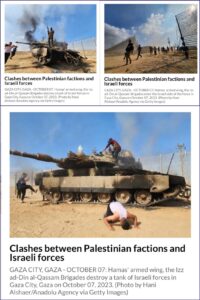
This continuity matters. The same photographers who had unprecedented access to Hamas on October 7 went on to shape the famine narrative, including later minimizing the scale of the GHF deliveries of aid. Their images form a continuous chain from the morning of the massacre to the portrayal of humanitarian conditions months later.
This is not neutral documentation. It is the work of a small group operating within a tightly controlled environment, using selective framing to shape global perception.
From October 2023 to this year, the throughline is unmistakable: the photographers with privileged access to Hamas during the massacre are the same individuals who built the famine narrative and diminished the visibility of a major humanitarian operation. When the same network of photographers shapes every stage of a story, the outcome is not an objective visual record but a curated reality.
Understanding who controls these images is essential to understanding the narrative itself.
Liked this article? Follow HonestReporting on Twitter, Facebook, Instagram and TikTok to see even more posts and videos debunking news bias and smears, as well as other content explaining what’s really going on in Israel and the region. Get updates direct to your phone. Join our WhatsApp and Telegram channels!
© Divuach Ne’eman R”A, 2025