KEY TAKEAWAYS:
- Photojournalism comes with its own unique sets of ethical standards, which were challenged by photographers that entered Israel during the October 7 Massacre.
- There is public interest in documenting atrocities, but photojournalists must also respect the victims, a responsibility that may not have been met by some on October 7.
- Taking photographs of children, wounded people, and staged scenes is against the codes of several organizations, but editors may be ignoring them.
On September 4, 1997, a broken film-processing machine took me out of Ben Yehuda Street.
I had been waiting for negatives at a photographic shop in central Jerusalem. The machine broke down. Processing would take longer than expected, so I left.
Then I heard the helicopters.
Living in Israel, you learn to recognize the signs. I went back to the street I had just left and found the aftermath of a suicide bombing. Had I waited a few more minutes for my negatives, I could have been caught in it.
I was severely shaken. I was also a photographer, and amid the scene of wounded people and human remains, I was confronted with the decision of where to point my camera. Even in those circumstances, I knew there were pictures I would not take.
On another occasion, after another suicide attack in Jerusalem, the American CEO of an advocacy organization I worked for told me to go to the hospital and photograph the injured and their families. I flatly refused. I understood why an advocacy organization wanted those pictures. I also knew that the people in that hospital were living through something I was not prepared to intrude upon for an assignment.
These were personal decisions, made in circumstances where a camera gave me the ability to record more than I believed I should. A photographer needs to know when to take a picture and, in my opinion more importantly, when not to.
As the third anniversary of October 7 approaches, I find myself returning to that responsibility while examining photographs made during the attack and throughout the war in Gaza.
October 7 Massacre Photo Ethics
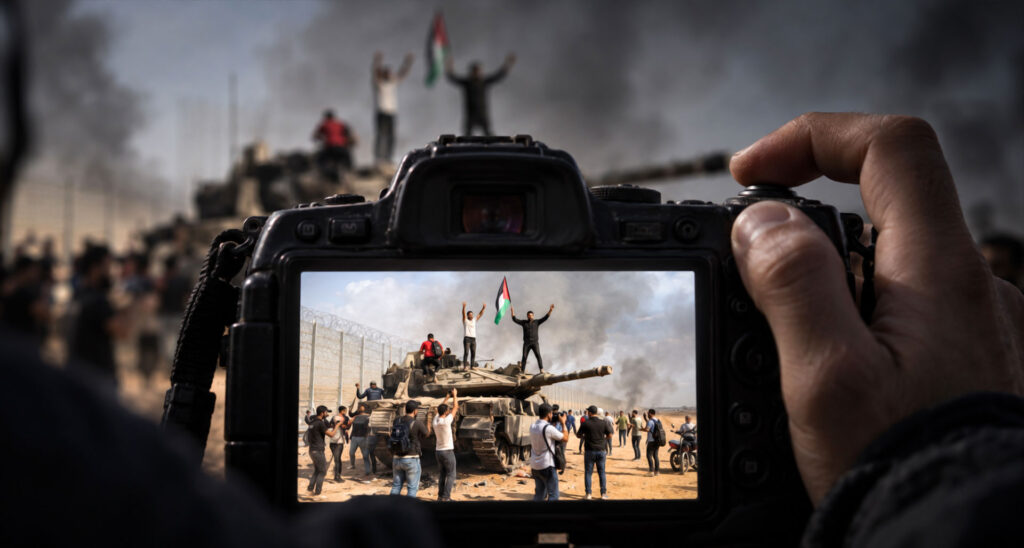
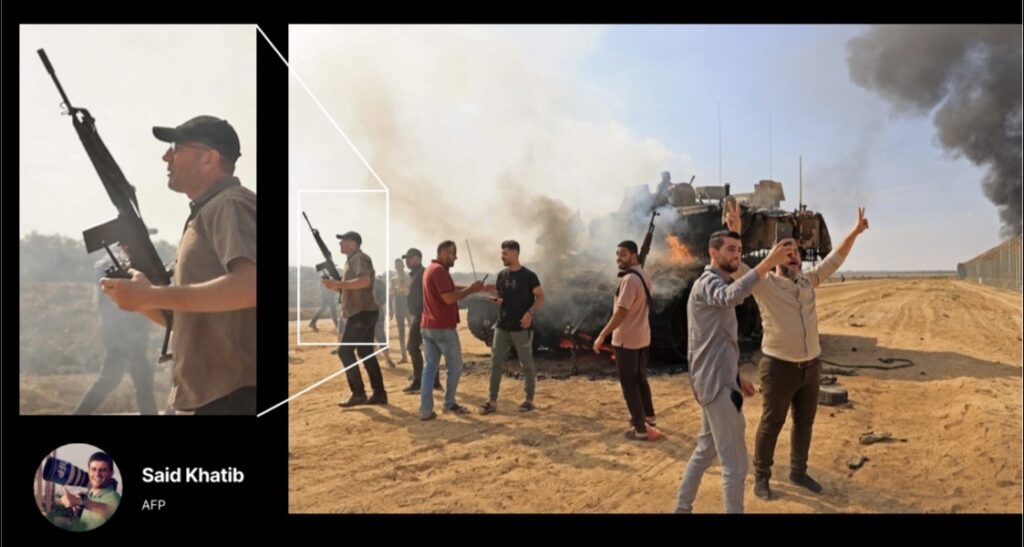
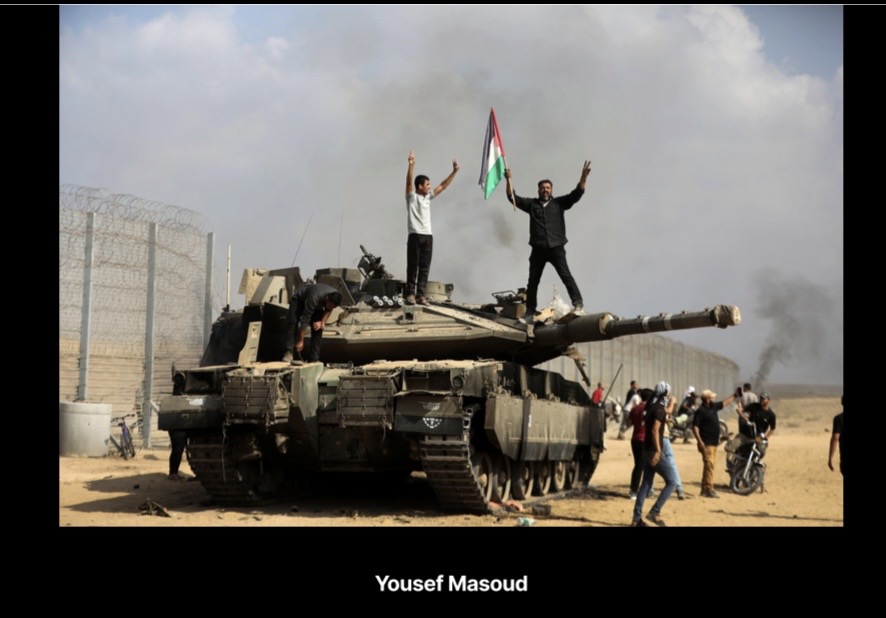
Look at the sequence from the border: a bulldozer breaking through the fence, people crossing, men celebrating on an Israeli tank. The tank appears from several angles, with photographers working around the same scene.
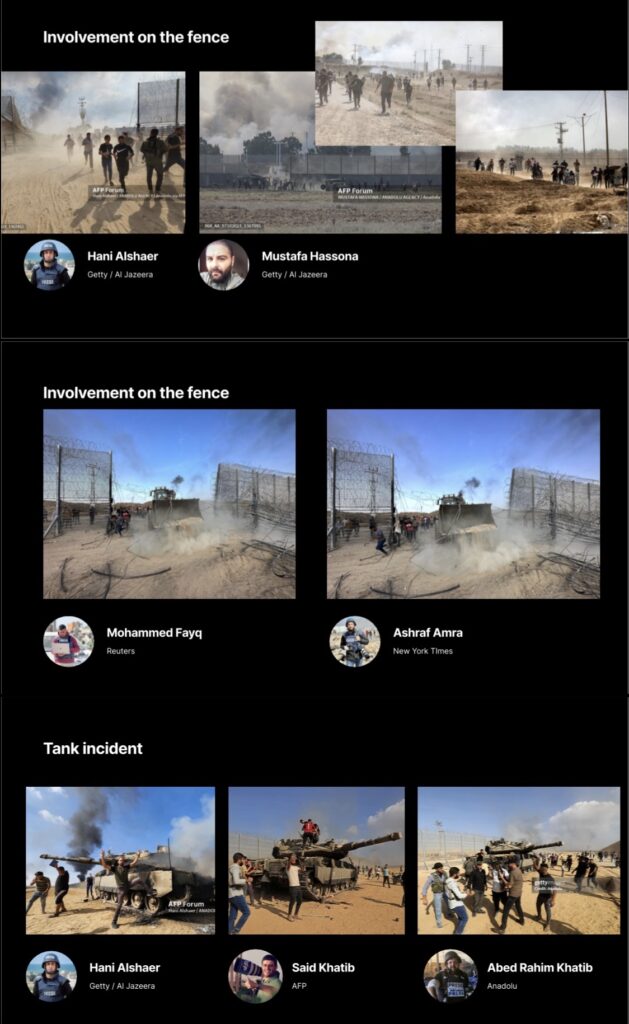
As a photographer, I look at where each camera was positioned and what was happening within sight of it. I want to reconstruct how the photographers moved through the scene, what access they had and how they behaved towards the people around them. HonestReporting’s original investigation into the October 7 photographs documented images of the tank, incursions and abductions distributed by international agencies. Those pictures are also a record of where photographers were able to work.
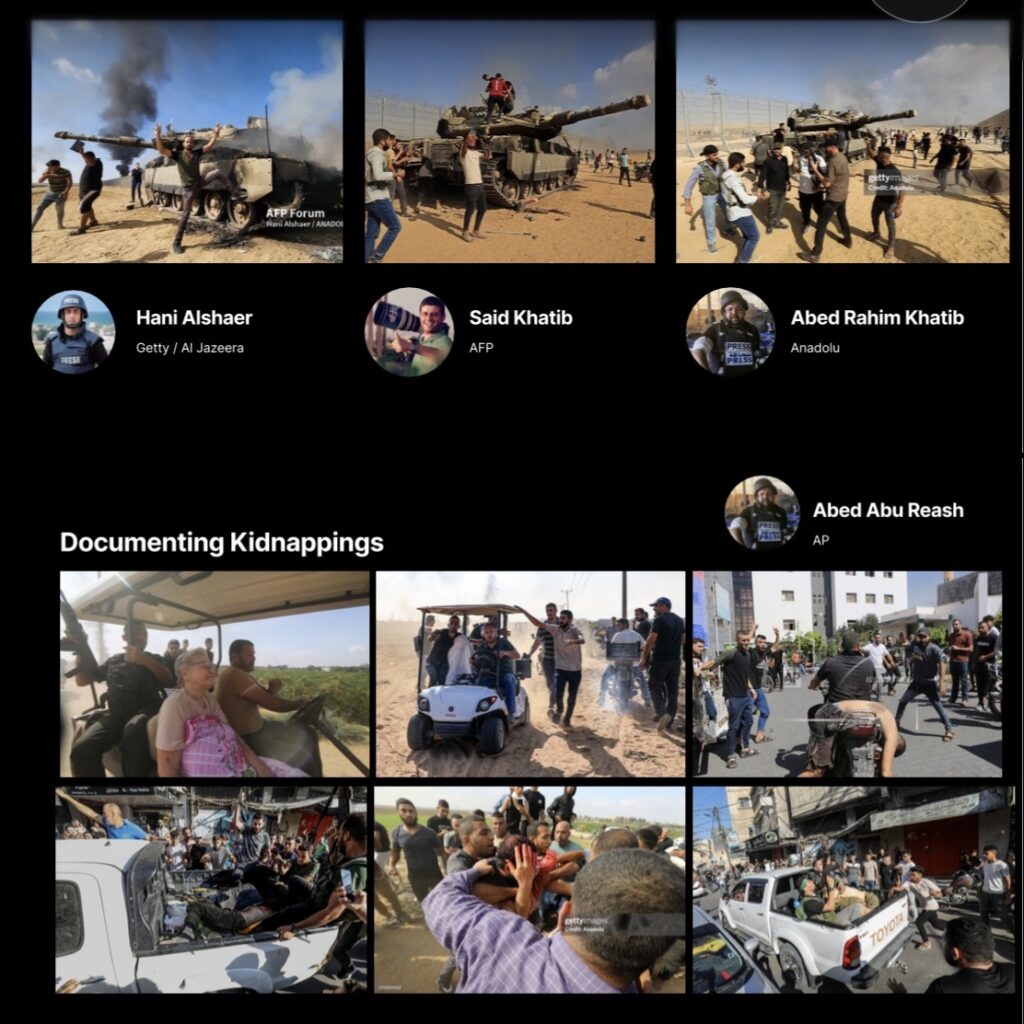
I have worked in embedded situations. You understand that access comes with conditions. You also retain responsibility for your own behavior. Who brought you there, what they allow you to see and what they expect from your presence are questions you cannot leave at the picture desk. The word “embedded” does not establish what arrangements existed on October 7. Those arrangements need to be established individually. But the photographs give editors ample reason to ask.
In the Associated Press photograph credited to Ali Mahmud, armed men ride in a pickup carrying the body of Shani Louk, a young German-Israeli woman murdered during the attack. Mahmud photographed the pickup from close range. The sequence contains more than one view of the vehicle and its occupants. I want to know how that encounter unfolded. Did he speak to the armed men? Did they address him or respond to his camera? What happened before and after these frames? What did the Associated Press picture desk establish about his access before distributing the photographs?
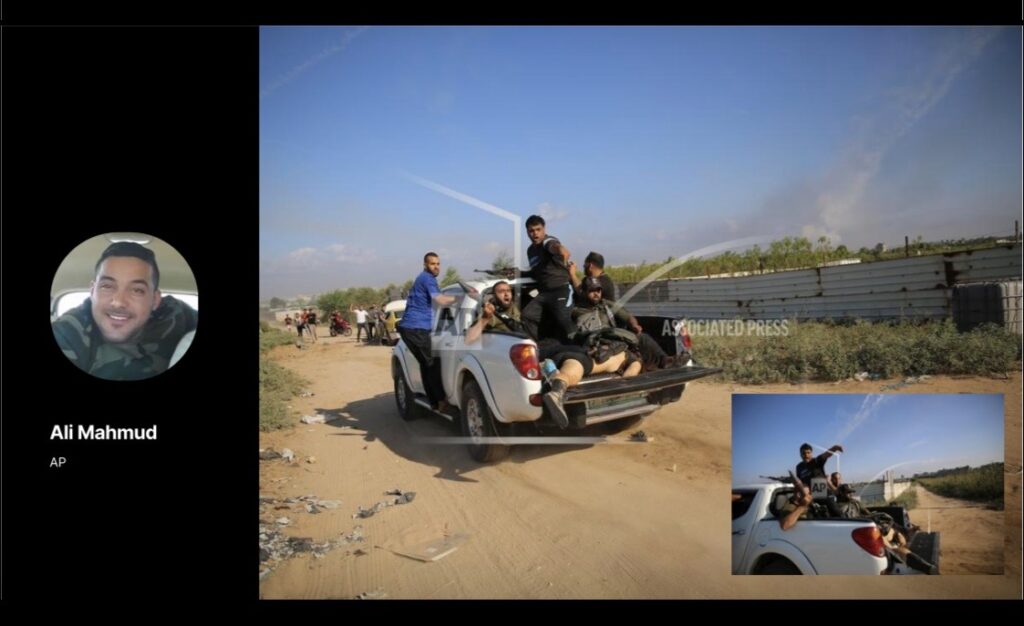
The public interest in documenting an atrocity is substantial. Photographs can preserve evidence that perpetrators and their defenders would prefer to disappear. Louk’s father, Nissim, defended the photograph’s historical importance, and his view deserves to be represented. Its importance does not exempt the photographer’s conduct from scrutiny. Nor does it settle how an editor should present the victim. Taking the photograph, preserving it, and publishing it are decisions with different consequences.
In some cases, the evidence extends beyond a photographer’s role. HonestReporting’s investigation into Mohammed Fayq Abu Mostafa and Ashraf Amra’s October 7 broadcast reported Abu Mostafa encouraging others to cross into Israel, with Amra responding affirmatively. Encouraging people to enter the scene you are covering crosses a professional boundary. The National Press Photographers Association’s ethics code expressly prohibits photographers from intentionally contributing to or influencing events. It also requires respect for subjects’ dignity and particular consideration for vulnerable people. These obligations begin while the camera is still in your hands.
They also apply to what you decide to withhold. In my examination of Motaz Azaiza’s podcast interview, I discussed his account of recording Israeli captives and withholding material because people shown could be identified by Israel. His stated reason makes that a question of photojournalistic ethics. Whose interests did withholding serve? What evidence remained unseen? Was an editor told that the material existed?
Photographing The Vulnerable
When I refused the hospital assignment, I was protecting injured people and families from an intrusion I could not justify. Azaiza’s account requires us to examine whom his decision protected, and why. The same scrutiny belongs in our examination of photographs of Palestinian children, patients, and bereaved families.
A child’s distress may make a powerful photograph. The photographer still has responsibilities towards that child. What was explained? Was a parent or guardian consulted? Was the child willing? Was someone directing the scene or asking the child to repeat an action for the cameras? A finished photograph may not answer those questions. The person who made it should be able to.
UNICEF’s guidance puts the individual child’s best interests ahead even of advocacy for children’s rights. It calls for permission from the child and guardian for interviews and filming, and where possible for documentary photographs, without coercion. That standard is particularly relevant when a child’s image is being used to advance a cause. The cause does not relieve the adults involved of their responsibility towards the child.
A hospital presents another set of obligations. Patients may be frightened, in pain or unable to make a meaningful decision about being photographed. Permission to enter a ward cannot, by itself, answer whether a particular patient should be exposed to an international audience.
In Israel, the Medical Association’s ethical guidance places strict conditions on photographing medical procedures and requires patients to understand that refusing photography will not affect their treatment. Those are medical ethics provisions, but they identify the vulnerability a photographer encounters at the bedside.
My own experience in Israel taught me to respect those boundaries. I will not pretend that every photographer makes the same decisions, or that every hospital photograph is an intrusion. A patient can choose to tell their story. There can be compelling reasons to document what has happened to them.
The obligation is to make that judgment seriously, with the person’s welfare in mind. An injured child does not become available for unrestricted photography because the resulting image might persuade someone.
Picture editors carry responsibility too. Associated Press rules prohibit staging and require captions to disclose posing, including posing arranged by third parties. Readers are entitled to understand how the scene in front of them came about.
Editors should ask who arranged access, who directed the subject, what restrictions applied and what the photographer chose not to transmit. An accurate caption and an unaltered file are essential. They cannot account for every ethical decision made before a photograph arrives.
Deciding When to Photograph
I remember the broken processing machine, the helicopters, and the return to Ben Yehuda Street. I remember the hospital assignment I refused. The decisions were mine, and I remain responsible for them.
The photographers whose pictures shaped the world’s understanding of October 7 and Gaza should be expected to explain their decisions too. So should the editors who published their work.
I knew why I put my camera down. They should be able to explain why they kept theirs raised, and when they chose to lower it.
Liked this article? Follow HonestReporting on Twitter, Facebook, Instagram and TikTok to see even more posts and videos debunking news bias and smears, as well as other content explaining what’s really going on in Israel and the region. Get updates direct to your phone. Join our WhatsApp and Telegram channels!
© Divuach Ne’eman R”A, 2025