Key Takeaways:
- Mehdi Hasan’s claim on X that Hitler worked with Zionists relies on a distorted reading of the Haavara Agreement, a limited and coercive arrangement aimed at facilitating Jewish escape from Nazi Germany – not ideological cooperation.
- The Zionist movement did not “deal” with the Nazi Party. Zionists, like all Jews, were persecuted by the Nazis and viewed Nazism as an existential threat to the Jewish people.
- When Holocaust-distorting narratives spread on social media, they obscure historical reality and legitimize antisemitic tropes under the guise of political critique.
As the years pass since the Holocaust, distorted narratives continue to grow larger and more entrenched. This is not accidental, but the result of bad-faith actors exploiting Jewish suffering for their own political benefit. As social media continues to advance, the danger of this exploitation only increases, as narratives can take on a life of their own – no matter how far removed they are from reality and history.
The problem becomes more severe as online influencers make baseless claims that are then uncritically re-shared en masse by their followers. Mehdi Hasan, Editor-in-Chief and CEO of Zeteo News, offered a clear example of this when he told his nearly two million followers on X that while Hitler hated Jews, he was nevertheless supportive of Zionism and even worked hand in hand with Zionists.
Hitler hated Jews and Judaism. But like the white supremacist far right today, he was happy to do deals with Zionists.https://t.co/5ib3f6j1uP https://t.co/4MxZos6GE5
— Mehdi Hasan (@mehdirhasan) December 30, 2025
This isn’t the first time Hasan has blatantly distorted historical facts, making it unsurprising that he appears to have done little – if any – research into the Haavara Agreement he cited.
It is an established historical fact that Hitler and the Nazi Party made no distinctions in their hatred of Jews. Religious or secular, Zionist or anti-Zionist, Jews living under Nazi rule were subjected to brutal persecution from the very outset of Hitler’s rise to power in 1933.
Historical Background
The Nazi regime sought to isolate Jews from every aspect of public, economic, and civic life. Accordingly, it explored any measures it believed could accelerate their removal from German society, through exclusion, dispossession, and forced emigration.
Hitler’s appointment as Chancellor in January 1933 initiated the Nazi Party to begin brainstorming the various “solutions” to the so-called “Jewish question.” From that moment on, a wave of explicitly antisemitic legislation was enacted, including a general boycott of Jewish-owned stores and businesses. The process of “Voluntary Aryanization” came into policy, whereby the Nazi government encouraged the nearly 100,000 Jewish-owned businesses to sell their business at a dramatically reduced cost.
It was against this background of economic difficulties that isolated the Jewish community that the Haavara Agreement came into place, as the Jewish community was desperate to leave what they viewed as a situation that would only continue to deteriorate.
Haavara Agreement
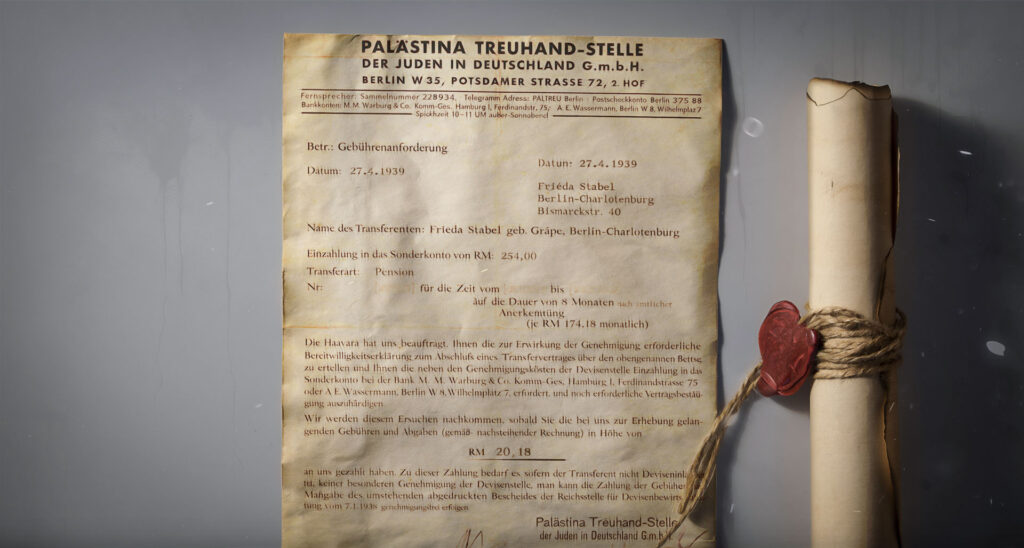
The Haavara Agreement was formalized in August 1933 between the Nazi Party and the German Zionist Federation as a way to encourage and facilitate the emigration of Jews from Germany to Mandatory Palestine. German Jews willing to emigrate were able to retain some of the value of their property in Germany by purchasing German products for the Jewish community in Mandatory Palestine. They would then be able to redeem the goods in Mandatory Palestine through the local currency.
The agreement required German Jews to put at least 1,000 pounds sterling in the bank – an amount equivalent to the cost of an immigration certificate. However, this meant that the vast majority of Jews capable of emigrating were wealthy, resulting in disagreements within the Jewish community, especially as it pertained to perceived cooperation with the Nazi regime.
Crucially, the Nazi regime retained full control over Jewish assets throughout the process and benefited economically from increased exports, underscoring that the agreement functioned within a framework of coercion and persecution. It was not partnership or ideological cooperation, but rather one step in the Nazi regime’s systematic effort to remove the Jewish people from Germany.
The agreement was ultimately dissolved in 1939 with the outbreak of World War II. During the years that it was active, around 60,000 Jewish Germans emigrated to Mandatory Palestine, ultimately saving their lives.
Jewish Immigration to Mandatory Palestine
The Nazi regime vehemently opposed any Jewish rise to power in Mandatory Palestine and feared the possibility of the creation of a Jewish state. It was for this reason that the regime did not initiate further opportunities to move the entire Jewish community to Mandatory Palestine.
How did Israel’s path to statehood really unfold?
On the anniversary of the Balfour Declaration, let’s dig into the history behind the British Mandate—a story of promises, resistance, and resilience. ? pic.twitter.com/bpID5R8lnI
— HonestReporting (@HonestReporting) November 2, 2024
Nonetheless, the Jewish community was desperate to leave Nazi-occupied territories, and from 1929 until 1939, around 250,000 Jews had immigrated to Mandatory Palestine, despite severe financial, political, and logistical obstacles. However, their immigration was further limited by the 1939 White Paper put in place by the British to limit Jewish immigration to Mandatory Palestine.
The Jewish people’s return to their historical homeland predated the enforcement of the White Paper and the Nazi regime’s rise to power, driven by their enduring connection to the Land of Israel, dating back thousands of years.
Related Reading: Israel Was Not Created Because of Holocaust, Rather Ancient Jewish Roots & Modern Determination
While Mehdi Hasan and other online influencers attempt to compress years of complex history into misleading, engagement-driven soundbites, the claim that the Zionist movement collaborated with the Nazi Party collapses under the weight of historical fact.
The reality is clear: Jews – whether Zionist or not – were systematically targeted by the Nazis, and every policy enacted by the Nazi regime served only its own interests and ideological aims, never the Jewish people.
Liked this article? Follow HonestReporting on Twitter, Facebook, Instagram and TikTok to see even more posts and videos debunking news bias and smears, as well as other content explaining what’s really going on in Israel and the region. Get updates direct to your phone. Join our WhatsApp and Telegram channels!
© Divuach Ne’eman R”A, 2025