Key Takeaways:
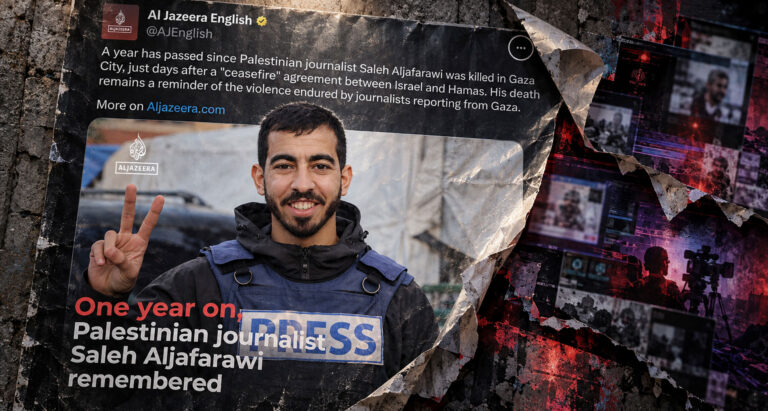
- Global headlines labeled Hezbollah-affiliated figures as “journalists,” downplaying their ties to designated terrorist media outlets.
- Media coverage cast doubt on the IDF’s claim that one was a Hezbollah operative, while failing to scrutinize his role within Hezbollah’s media apparatus.
- By ignoring affiliation and context, reporting blurred the line between journalist and participant in hostilities, shaping a misleading narrative.
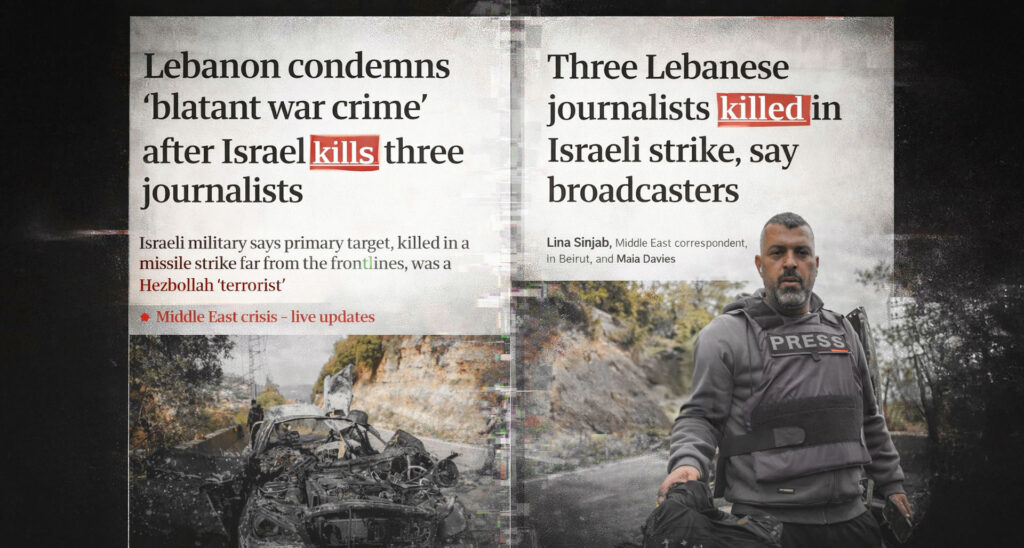
When an Israeli strike in southern Lebanon killed several individuals described as journalists this week, global media coverage followed a familiar pattern. The victims were presented as professional reporters. Their affiliations were noted, but rarely interrogated. And when the Israeli army identified one of them as a Hezbollah operative, that claim was met with skepticism.
The result was coverage that blurred a critical distinction. Global headlines were nearly identical: “Israeli strike kills journalists in southern Lebanon,” instead of “IDF targets Hezbollah operative posing as a journalist in southern Lebanon.”
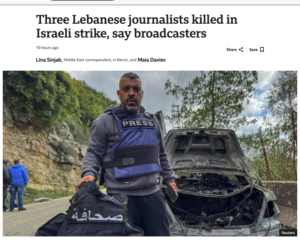
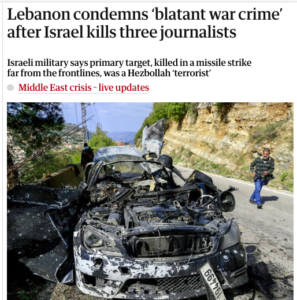
Those killed included Ali Shoeib, described as a journalist working for Al-Manar, Hezbollah’s official television network. Another was affiliated with Al Mayadeen, a Hezbollah-aligned outlet closely tied to Iran.
These are not neutral platforms.
Al-Manar is Hezbollah’s media arm. It was added to the U.S. Terrorism Exclusion List as far back as December 2004. The then Treasury Under Secretary for Terrorism and Financial Intelligence, Stuart Levey, made clear that any entity maintained by a terrorist group — whether masquerading as a charity, business, or media outlet — is as culpable as the organization itself.
At the time, it was noted that:
- An Al-Manar employee conducted pre-operational surveillance for Hezbollah under cover of his role.
- The network raised funds for Hezbollah through broadcasts and online appeals.
- It supported other terrorist organizations, including Palestinian Islamic Jihad (PIJ) and the Al Aqsa Martyrs Brigade, transferring significant funds to a PIJ-controlled charity.
Israel similarly acted against Al Mayadeen in 2024, blocking the station under emergency regulations targeting foreign outlets deemed harmful to national security. The channel has consistently echoed Hezbollah’s narrative and political alignment.
Yet much of the reporting on the strike continued to refer to the individuals simply as “journalists,” without addressing what it means to work for such outlets.
Sky’s Alex Crawford described them as “two senior correspondents” who were “very well known in Lebanon,” as if prominence alone confers legitimacy. By that standard, notoriety becomes a substitute for scrutiny.
“The two senior correspondents were very well known in Lebanon. They now reach more than 20 journalists in Lebanon who have been targeted by Israeli strikes since October 2023.” our @AlexCrawfordSky on the latest from Lebanon pic.twitter.com/IgkKaDV4QK
— Yalda Hakim (@SkyYaldaHakim) March 28, 2026
When media organizations label individuals affiliated with designated terrorist groups as journalists, they are not simply reporting facts. They are shaping perception. They confer professional legitimacy without examining whether the label meaningfully applies.
And when they cast doubt on Israeli military statements, they are not neutral arbiters. They are making editorial choices. The IDF stated that Shoeib used his journalistic cover to gather intelligence on Israeli positions. Yet this was framed as an unsubstantiated claim, rather than an assertion requiring serious scrutiny.
Associated Press, for example, reported: “Israel’s military said it had targeted Shoeib, accusing him of being a Hezbollah intelligence operative, without providing evidence.”
On social media, journalists and commentators echoed this framing. Coverage emphasized the dangers faced by reporters and the targeting of media personnel, while affiliations were treated as secondary details rather than central facts.
Others pushed back, noting a key legal point: civilians who take direct part in hostilities lose their protected status under international law.
Now here’s the important “context” Alex fails to cover.
While it is true that “disagreements with journos do not justify assassinating them” pursuant to international law, attacking a civilian taking direct part in hostilities IS permitted by #LOAC (and not “assassination”). ⤵️ https://t.co/HqGmd0fU3N pic.twitter.com/76WBNLLFXW
— Dr. Brian L. Cox (@BrianCox_RLTW) March 28, 2026
Despite claims from some outlets and organizations such as the Committee to Protect Journalists, Israel does not target journalists for doing their jobs. It targets terrorists, including those operating under the cover of a press vest.
Hezbollah is a designated terrorist organization in multiple countries. Its media apparatus is part of its broader operational and ideological infrastructure. In that context, the distinction between “journalist” and “operative” is not semantic. It is central.
The issue is not whether journalists face danger in conflict zones. They do. The issue is whether media organizations apply consistent standards when defining who qualifies as a journalist. If Hamas itself mourned those killed as credible journalists, Western media should probably revisit their definitions.
Affiliation matters. Role matters. Context matters. When these are downplayed, the result is distortion. Readers are left with a simplified narrative that obscures more than it reveals.
In this case, the question is not only who was killed. It is how they were described, and what was left unsaid.
Because in a conflict where information itself is a battlefield, words are not neutral. And neither are the labels attached to those operating within it.
Liked this article? Follow HonestReporting on Twitter, Facebook, Instagram and TikTok to see even more posts and videos debunking news bias and smears, as well as other content explaining what’s really going on in Israel and the region. Get updates direct to your phone. Join our WhatsApp and Telegram channels!
© Divuach Ne’eman R”A, 2025