


Key Takeaways:
- Reporters Without Borders (RSF) published an annual round-up that accused Israel of targeting journalists in the Gaza Strip.
- The RSF data cannot be verified as the organization did not release the names of every journalist killed by Israel. Yet, news outlets, including Haaretz, rushed to publish the findings.
- HonestReporting has found that many journalists killed in the Gaza Strip have connections to terrorist organizations, raising questions as to who the journalists on the RSF report really were.
This past week, Reporters Without Borders (RSF) released its annual round-up of journalists killed worldwide, declaring 2025 a “deadly year for journalists” driven by “hatred and impunity.”
Across global conflict zones, RSF recorded 67 journalists killed between December 1, 2024, and December 1, 2025. According to their tally, 29 of those deaths occurred in Gaza – an eye-catching 43 percent of all journalists killed “because of their profession.”
But RSF’s framing omits a crucial fact: in Gaza, many so-called “journalists” are not solely media workers at all, but documented members of terrorist organizations who operate under the guise of reporting.
Reporters Without Borders (@RSF_inter) says Israel “portrays journalists as terrorists” while describing Hamas operatives as “reporters.”
Hard to misrepresent men documented as being on Hamas’ payroll. pic.twitter.com/frITiG34hU
— HonestReporting (@HonestReporting) December 9, 2025
Urban warfare is inherently chaotic, and tragically, civilians—including journalists covering the fighting—can sometimes be caught in the crossfire. Despite this reality, Israel has consistently worked to minimize civilian harm and does not intentionally target journalists or anyone else without a lawful military purpose. But when an individual is found to be operating as part of a terrorist organization and actively participating in hostilities, they are no longer considered a civilian under the laws of armed conflict.
Over the course of the war, it has become increasingly clear that Hamas has woven its propaganda strategy directly into the media sphere. Some of the “journalists” cited by advocacy groups were, in fact, dual-role operatives. Hossam Shabat served as a sniper in Hamas’ Beit Hanoun Battalion. Anas Al-Sharif worked for Al Jazeera while simultaneously being employed by Hamas in the East Jabaliya Battalion. Yet both appear on RSF’s list of journalists “killed in the line of duty” during the Israel–Gaza war.
Their actual line of duty was not journalism, but active service within a terrorist organization.
View this post on Instagram
It is highly likely that Al-Sharif and Shabat are counted in RSF’s annual tally of journalists killed. But this cannot be independently confirmed because RSF does not actually identify by name all of those it reports to have been killed. For an organization that claims to defend access to “free and reliable information,” the lack of basic transparency in its own reporting is a striking contradiction.
Even so, major news outlets rushed to amplify the headline, asserting that Israel is responsible for nearly half of all journalist deaths worldwide. The framing spoke volumes. Haaretz led with Israel’s “attack in Gaza” as the explanation for journalists killed – recasting a defensive war launched after a brutal terror attack as an unprovoked Israeli offensive. The Irish Times and France24 likewise pushed the RSF roundup, while omitting the inconvenient fact that many of the individuals counted were terrorists masquerading as journalists.
Recommended Reading: Who Are the Killed Gazan Journalists Affiliated With Palestinian Terror Groups?
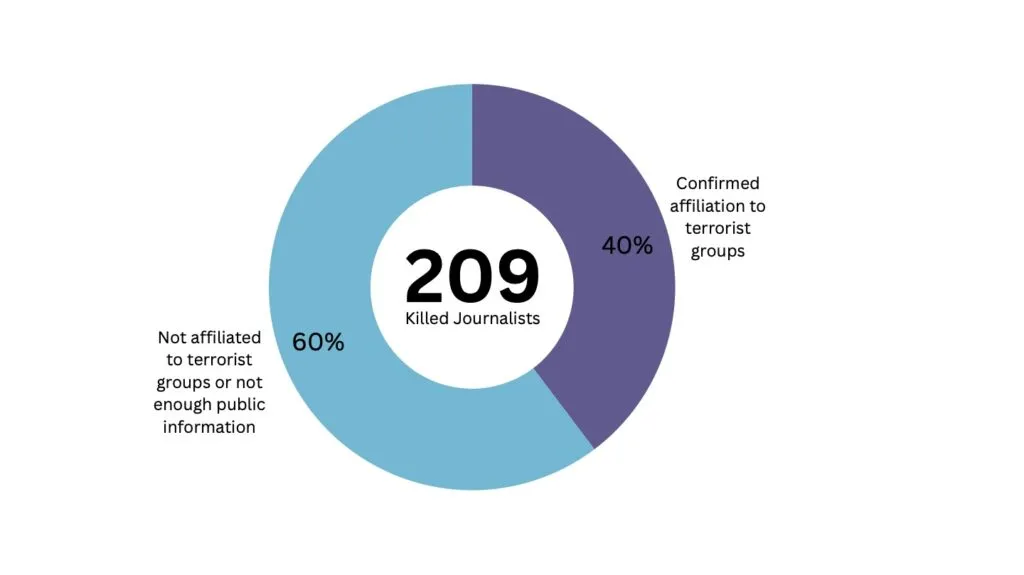
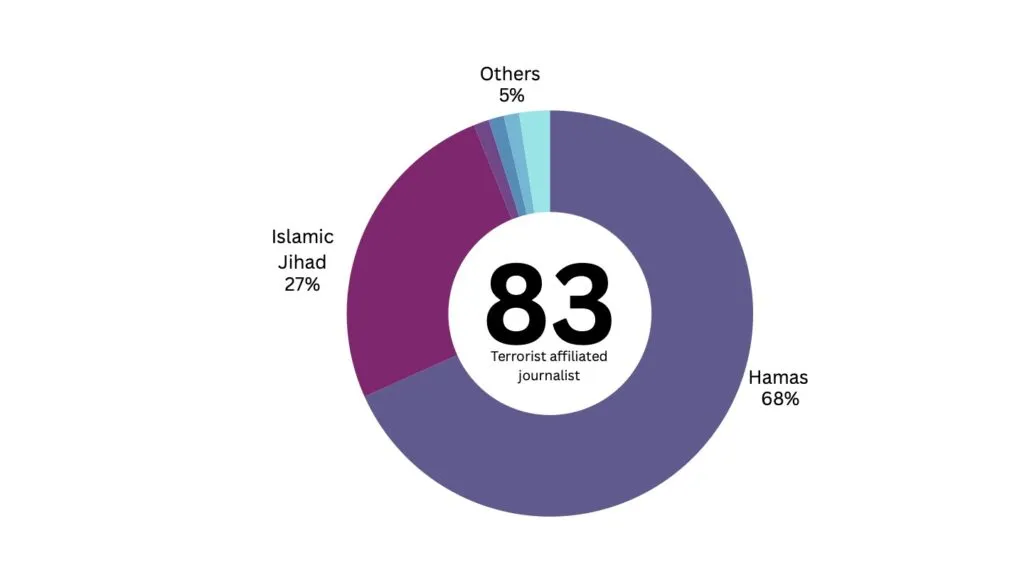
Of the 83 on the CPJ list, 56 are confirmed to be affiliated with Hamas, 21 with Islamic Jihad, and another 6 have ties to other terrorist organizations such as Hezbollah or Fatah.
Thus, even though RSF has declined to publish a list of names, the available data from organizations that do offer transparency tells a very different story. CPJ’s publicly accessible information shows that many individuals labeled as “journalists” in Gaza also had direct ties to terrorist organizations. Likewise, a study by the Meir Amit Intelligence and Terrorism Information Center examined 266 Gazan journalists killed during the war and found that 60 percent were operatives or had documented affiliations with terrorist groups. This directly contradicts the narrative advanced by RSF’s annual round-up.
RSF surely understood that releasing a report without sufficient underlying data to support its implicit claim that Israel is intentionally targeting journalists is a journalistic failure in itself. By publishing the round-up without verifiable evidence, RSF created a vacuum – one that media outlets quickly filled by framing Israel as the primary aggressor while erasing the role of terrorist organizations entirely.
If organizations devoted to protecting journalistic integrity expect others to uphold standards, they must meet those standards themselves. When transparency disappears, facts blur, and an anti-Israel narrative fills the void.
Liked this article? Follow HonestReporting on Twitter, Facebook, Instagram and TikTok to see even more posts and videos debunking news bias and smears, as well as other content explaining what’s really going on in Israel and the region. Get updates direct to your phone. Join our WhatsApp and Telegram channels!