


Key Takeaways:
- The same false narratives applied to Israel’s war against Hamas in Gaza have now been repackaged to be deployed against Israel once again, as the country is at war with Iran and Hezbollah.
- HonestReporting.ai Labs analyzed the pattern of narrative repetition, gathering more than 550 alerts that used similar phrasing in the Israel-Hamas war and Israel-Iran war.
- The recycling of familiar narratives raises significant questions surrounding accurate reporting and whether journalists make well-informed conclusions before the facts are established.
Every few months, familiar narratives resurface in the news cycle. This is no coincidence. While reporting on current events, the media often recycles established narratives, repackaging them to fit entirely different situations.
Nowhere has this been clearer than over the past two and a half years, as Israel has found itself at war on multiple fronts.
Following Hamas’ terrorist attacks on October 7, 2023, the ensuing conflict quickly became not only a military war, but a war of narratives. News outlets rapidly accused Israel of violating international law, amplifying claims from the Hamas-run Ministry of Health that Israel was deliberately targeting children or massacring civilians.
Related Reading: Fake Massacres, Skewed Stats & Misleading Claims: The 25 Lies The Media Told You About The October 7 War
These same narratives have now become a template – one that is being applied to Israel’s conflict with Iran and Hezbollah.
The Gaza Narrative Template
HonestReporting.ai Labs has found that although the subject matter may differ in the current war against Iran and Hezbollah, the framing first used during the Gaza conflict is being reused almost wholesale.
A closer analysis suggests that this is not simply organic journalism responding to unfolding events. Rather, it reflects a structured pattern – one that allows a well-established, often emotionally charged narrative to be transferred into an entirely different conflict zone.
The implications are significant. If the framing is preloaded, then the conclusions are likely predetermined as well.
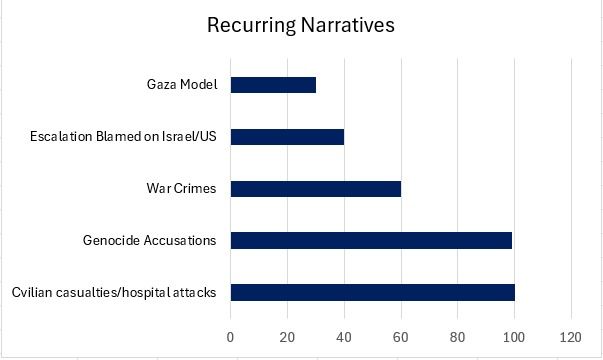
HonestReporting.ai Labs tracked the migration of disinformation narratives originally deployed during the Gaza conflict, which are now being applied to the war with Iran. This has already resulted in more than 550 alerts related specifically to Iran. These can be grouped into five dominant narrative categories:
- Civilian casualties and attacks on hospitals
- Genocide accusations
- War crimes presented as established fact
- Blame for escalation placed squarely on Israel or the United States
- The emergence of what is explicitly labeled the “Gaza model”
These themes will sound familiar to anyone who followed media coverage of the Israel-Hamas war. Their reappearance now, as Israel faces threats from Iran and Hezbollah, is hardly coincidental.
The Spread of Narratives
What is particularly concerning is not just the familiarity of these narratives, but the speed and scale at which they spread. They shape public perception almost instantly, often provoking emotional reactions before the facts on the ground are fully established.
Within days of the conflict’s escalation, identical themes—frequently using near-identical language—were already appearing in major international outlets, including ncluding The New York Times, The Guardian, and The LA Times.
This raises an important question: are journalists assessing events as they unfold, or fitting them into an already established narrative framework?
Beyond these broader themes, specific phrases illustrate just how quickly Gaza-era framing has been transplanted to Iran and Lebanon.
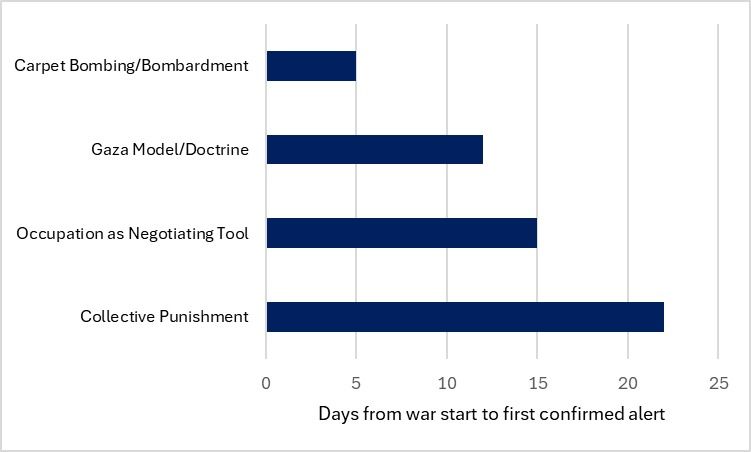
Within the first five days of the war, terms such as “carpet bombing” and “bombardment” were already in widespread use. Even before explicit comparisons to Gaza were made, such language was doing the framing work, implying indiscriminate violence as a given rather than a claim requiring verification.
This stands in contrast to the reality that the IDF has taken extensive measures to minimize civilian harm while fighting a guerrilla war. Hezbollah’s strategy of embedding operatives and infrastructure within civilian areas deliberately turns homes and neighborhoods into battlegrounds.
Soon after, the term “collective punishment” appeared across multiple outlets within a 48-hour window. Its attribution to Lebanese President Joseph Aoun elevated it from commentary to what appeared to be accepted diplomatic language.
Another recycled narrative followed shortly thereafter: the idea of Israeli “occupation as a negotiating tool.” Previously rooted in discourse surrounding Gaza and the West Bank, it was now applied to Lebanon, reframing military operations as political coercion rather than security measures.
In the process, any nuanced understanding of the threat posed by Hezbollah and the danger it presents to Israeli civilians is largely erased.
The “Gaza Model” Shortcut
Perhaps the most revealing development is the emergence of the so-called “Gaza model” or “Gaza doctrine.” Unlike individual narrative elements, this functions as a meta-narrative – one that imports an entire framework in a single phrase.
When headlines claim that Israel is applying a “Gaza model” to Lebanon, there is no need to argue specifics. The phrase itself carries built-in assumptions: displacement, attacks on civilians, and violations of international law.
The timeline is instructive. The phrase first appeared in Al Jazeera on March 13, before quickly spreading to other outlets, including The Guardian. Even UN Secretary-General António Guterres adopted similar language, demonstrating how such narratives extend beyond the media itself.
“Across the region & far beyond, civilians are enduring serious harm & living under profound insecurity. I witnessed some of these consequences firsthand during my recent visit to Lebanon. There, too, the war must stop.
The Gaza model must not be replicated in Lebanon.” pic.twitter.com/6k6vytjcvK
— UN News (@UN_News_Centre) March 25, 2026
The phrase was attributed to Israel Defense Minister Israel Katz, but in a manner that stripped away key context.
In reality, Hezbollah, like Hamas, has systematically embedded its infrastructure within civilian areas. The so-called “Gaza model” refers to dismantling terrorist infrastructure, both above and below ground, not targeting civilians, as is often implied.
By omitting this context, the narrative leaves readers with a misleading impression: that Israel is pursuing the destruction of entire communities.
When Framing Becomes Misleading Conclusions
Once a narrative framework proves effective, it becomes reusable. In an environment where website traffic and virality often take precedence, there is little incentive to build new arguments when existing ones can simply be repurposed.
But when crucial context is omitted, journalism ceases to inform. Instead, it steers audiences toward predetermined conclusions.
If the “Gaza model” can be so easily applied elsewhere, it raises a deeper question: was it ever truly about Gaza in the first place?
Liked this article? Follow HonestReporting on Twitter, Facebook, Instagram and TikTok to see even more posts and videos debunking news bias and smears, as well as other content explaining what’s really going on in Israel and the region. Get updates direct to your phone. Join our WhatsApp and Telegram channels!