Key Takeaways:
- Anti-Hamas protesters took to the streets in Gaza last week, but Hamas was quick to exercise its control, beating, interrogating, and threatening suspected organizers, using the Al-Ahli Arab Hospital as an interrogation site.
- The international media by and large did not cover the protests, instead reporting on other non-pressing issues in Gaza.
- Hamas’ violent crackdown on its own civilians is part of a documented pattern, but when the media continues to ignore it, audiences are left with a distorted picture of who is responsible for the suffering in Gaza.
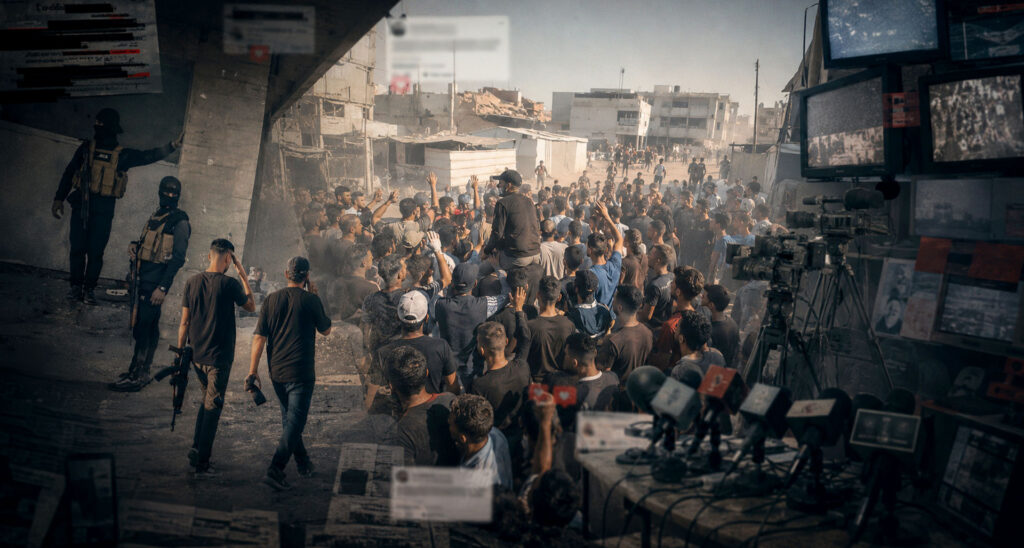
This past week saw mass anti-Hamas protests across the Gaza Strip.
Yet despite the nonstop international coverage of Gaza, these demonstrations received essentially no attention in the media. This was not an oversight.
Instead, on the day of the anti-Hamas protests in Gaza, the international media focused on stories about Gaza’s Surf Club, polluted waters, and Gazans watching the World Cup.
For the past two and a half years, much of the reporting on Gaza has centered on Israel while paying far less attention to Hamas’ responsibility for the suffering inside the Strip. When Gazans risk their lives to speak out against Hamas’ rule, those voices too often fail to break through to international audiences, leaving the world with an incomplete picture of life under Hamas.
In the days leading up to the protest, social media posts made clear that demonstrations were planned across Gaza for June 26. In response, Hamas was already beginning to beat, interrogate, and threaten anyone it suspected of involvement.
The location of some of these interrogations is telling. The Al Ahli Arab Hospital was reportedly used to interrogate suspected dissidents, underscoring how Hamas continues to exploit civilian sites for its own purposes. Yet, like the torture chambers inside Hamas-controlled hospitals, the general abuse of such civilian locations both before and after the ceasefire, remains absent from the media.
When the protests began, Hamas set up terrorists in multiple locations to violently crack down on the protesters, in an effort to project control over the Strip and deter further dissent through intimidation and fear.
The Telegraph – the only major international outlet that covered the protests – noted that protesters would be accused of collaboration with Israel. Because this crime is punishable by death, it ultimately had severe consequences on how many people were willing to take to the streets.
The contrast that day was stark. In yet another display of intimidation, the protest was followed by a Hamas funeral procession, where Hamas supporters were chanting in praise of the terror group and calling for another October 7th.
Anti-Hamas protests offer a glimpse into the reality of life under Hamas’ rule in Gaza. While opinion polls still indicate that support for Hamas remains high, those figures can only be understood against a backdrop of coercion where expressing dissent can be treated as collaboration with the enemy.
Nonetheless, Hamas’ brutality towards its own civilians is too often absent from international coverage. Last year, when large anti-Hamas protesters took to the streets, the news was similarly quiet.
When stories of Gazans opposing Hamas are ignored or marginalized, audiences are left with only part of the picture and an incomplete understanding of the forces shaping life inside Gaza. The media’s decision not to tell the story of the anti-Hamas protests is itself a story worth telling.
Liked this article? Follow HonestReporting on Twitter, Facebook, Instagram and TikTok to see even more posts and videos debunking news bias and smears, as well as other content explaining what’s really going on in Israel and the region. Get updates direct to your phone. Join our WhatsApp and Telegram channels!
© Divuach Ne’eman R”A, 2025