Key Takeaways
- Tisha B’Av reveals that the Jewish connection to Jerusalem is not a modern political claim but a two-thousand-year-old lived memory, embedded in Jewish ritual, prayer, and identity.
- Jewish tradition transforms history into collective memory, using Tisha B’Av to ensure the destruction of Jerusalem remains a lived experience rather than a forgotten historical event.
- Far from supporting colonial narratives, Tisha B’Av reflects the enduring grief of an indigenous people who never severed their connection to their ancestral homeland, even during centuries of exile.
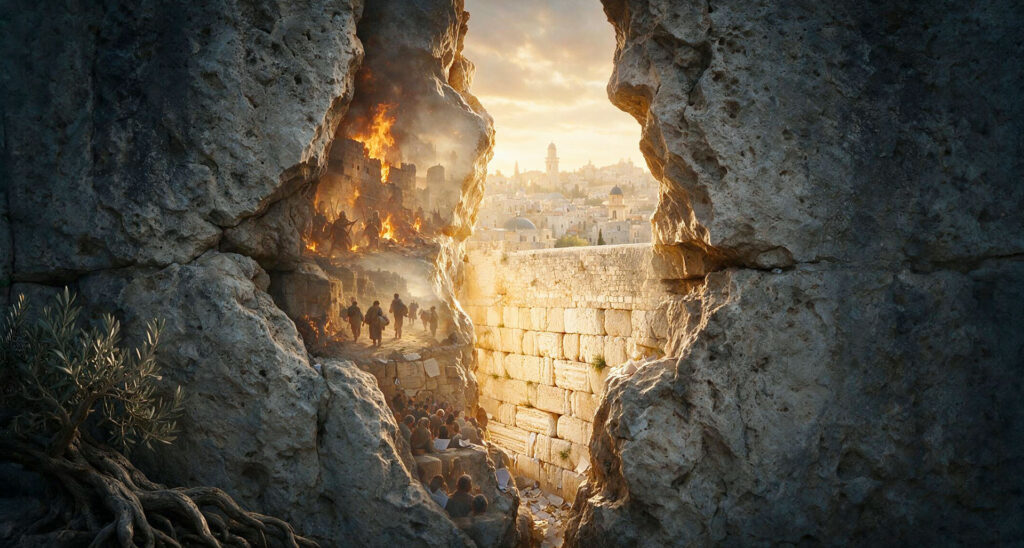
This evening, Jews around the world will sit down on the floor, the same posture the tradition gives to mourners. The lights in our synagogues will be dimmed. The ark will be draped in black. And we will listen to a single ancient poem of grief, chanted aloud. Just as we have chanted it for roughly two thousand years. The poem is Eichah, the Book of Lamentations. The day is Tisha B’Av, the ninth of Av. And it is the saddest day in the Jewish calendar.
But it is not just sadness. It is something more specific, and more revealing about who we are as a people. Tisha B’Av is the day we set aside, year after year, to remember a city: Jerusalem. To understand this fast is to understand the whole of the Jewish relationship to our indigenous homeland, because that relationship is precisely what this day exists to keep alive.
What Is Tisha B’av?
Tisha B’Av falls on the ninth day of the Hebrew month of Av, usually in July or August. It is the culmination of the Three Weeks, a mourning period that begins on the 17th of Tammuz, the date the walls of Jerusalem were breached before the Second Temple’s destruction. Those three weeks grow heavier as they go. In the final nine days, many stop eating meat and drinking wine. All of it builds towards a single twenty-five-hour fast, beginning at sundown, that strips away food, drink, washing for pleasure, leather shoes, perfume, and marital intimacy. The restrictions echo Yom Kippur. But the spirit does not. Yom Kippur is solemn, but it is hopeful, it looks towards atonement and renewal. Tisha B’Av is grief. Full stop. At least until midday, when the mourning eases slightly, because tradition holds that even the Temple’s burning continued only until noon of the following day.
A Date That Haunts the Jewish People
What makes the ninth of Av extraordinary is not simply what happened on it. It is how often catastrophe seems to have chosen it. Jewish tradition traces the date back to the Book of Numbers, when the spies sent to scout the Land of Canaan returned and ten of them gave a demoralizing report, causing the Israelites to weep and despair of ever reaching the land God had promised them. The Talmud imagines a stark response: since you wept without cause on this night, you will be given real cause to weep on this date for generations to come. Whatever we make of that theology, the historical pattern is undeniable. The First Temple, built under Solomon, fell to the Babylonians in 586 BCE on the ninth of Av. Six hundred and fifty-six years later, in 70 CE, the Second Temple fell to Rome, on the same date. Roman forces plowed over the ruins of the Temple Mount. Decades on, in 133 CE, the fortress of Beitar fell during the failed Bar Kokhba revolt, ending the last Jewish attempt to reverse our exile by force, again, on the ninth of Av. Later generations layered on more grief still: the expulsion of the Jews of England in 1290, the expulsion of the Jews of Spain in 1492, Himmler’s approval for the initiation of the “Final Solution” in 1941, and the start of mass deportations from the Warsaw Ghetto to Treblinka in 1942. The date became a magnet for our catastrophes.
How We Observe It
At the centre of the day is Eichah, Lamentations, traditionally attributed to the prophet Jeremiah, who witnessed Jerusalem’s destruction in 586 BCE and gave voice to its grief. After Eichah came the kinot, elegies composed across the centuries, widening the lens from the Temple’s destruction to the Crusades, the expulsions, and the Holocaust. The morning service strips away its usual comforts: tallit and tefillin, worn every ordinary weekday, are set aside until the afternoon, a physical signal that this is not a normal day of obligation but a day of raw, unfiltered loss. We avoid greeting one another with the usual pleasantries. We avoid most Torah study, other than the texts that deal with suffering. We sit low, on the floor or on stools, the posture of a mourner sitting shiva. Yet even here, buried inside the mourning, lies the first hint of consolation. When Tisha B’Av falls on Shabbat, its observance moves to Sunday, because public grief is never permitted to override the joy of the Sabbath. And the Shabbat that follows carries its own name: Shabbat Nachamu, the Sabbath of Comfort, opening seven weeks of consoling readings that carry us from grief towards renewal.
Memory, Not History
Rabbi Lord Jonathan Sacks drew a distinction that explains why we still fast for a building that fell almost two thousand years ago. History is someone else’s story, facts we can know without them touching who we are. Memory is different. It is our story, deliberately carried forward, handed to our children so it continues to shape our identity in the present. Tisha B’Av is built as an act of memory, not history. It does not simply inform us that Jerusalem once fell. It makes that fall present again, felt in an empty stomach, in a lowered stool, precisely so the connection to what was lost never fades into a footnote. And Rabbinic tradition insists on a specific cause for the Second Temple’s fall: not conquest alone, but “sinat chinam,” or baseless hatred, between Jews. This hatred is illustrated in the story of Kamtza and Bar Kamtza, where a chain of social slights spirals into catastrophe. The lesson is pointed. Jerusalem’s fate, and our own unity, have always been bound together.
The City We Never Forgot
All of this mourning has one address: Jerusalem. The Book of Psalms gives us the line that has become close to a national vow: “If I forget you, O Jerusalem, let my right hand forget its skill; let my tongue cling to my palate if I do not remember you, if I do not set Jerusalem above my highest joy.”
The sentiment expressed in Psalms is not recalled just once a year. Jewish practice built it into the architecture of daily life. We pray facing Jerusalem three times a day, wherever in the world we stand. At the height of a Jewish wedding, the groom shatters a glass, our happiest day, deliberately interrupted, to recall the Temple’s absence. The Passover Seder and the close of Yom Kippur both end with the same words: “Next year in Jerusalem,” repeated by Jewish families for centuries, whether they sat in Baghdad, Vilna, Casablanca, or Glasgow. This is not antiquarian sentiment. It is a relationship we refused to consider over.
And the bond was never only imagined from a distance. Even after Rome’s expulsion, Jewish communities remained inside the land itself, in the Galilee, in Tiberias, in Safed, in Hebron, producing rabbinic literature, running yeshivot, maintaining an unbroken physical Jewish presence through the centuries, reinforced by wave after wave of return. Jerusalem was our emotional and spiritual capital for two thousand years during which it was, for most of that time, not our political capital at all. That gap between spiritual centrality and political sovereignty is itself part of what Tisha B’Av memorializes. It is why the reunification of Jerusalem in 1967 landed for so many of us not as a political event, but as the resolution of an ache we had rehearsed every single summer for nineteen centuries.
An Indigenous People’s Grief
I have spent years arguing, in my work on Jewish Pride and in my book The Jews: An Indigenous People, that this persistence is not merely religious or emotional. It is anthropological. An indigenous people is a group whose collective identity began in one specific land, and it is in that land they remained rooted, physically, spiritually, or culturally, regardless of who currently holds sovereignty over it. Indigeneity is a question of origin and continuity. It is not a question of who currently governs, and it is certainly not forfeited the moment an indigenous people regains self-determination in its own land. By that standard, the Jewish case is one of the clearest examples of indigeneity anywhere in the world. Dig beneath Jerusalem and you find pottery from Davidic times and coins minted during the Bar Kokhba revolt. Hebrew, the language of our prayer and our texts even in the depths of exile, was revived as a living, spoken national language, a feat of linguistic continuity few peoples can claim. Our calendar still runs on the agricultural rhythms of the Land of Israel: Pesach as a spring harvest festival, Shavuot marking the wheat harvest, Sukkot tied to the autumn ingathering, festivals that only make full seasonal sense in that specific land, kept for millennia by Jews living in climates that matched none of it. Brit milah, the mikveh, Shabbat: a living legal and cultural system, rooted in the Torah, carried forward, not reconstructed from scratch. Tisha B’Av sits inside this same framework. It is not a memorial to an idea. It is the ritualized grief of an indigenous people mourning the loss of sovereignty in its own homeland, a homeland it never stopped calling home, and to which it eventually returned. That return is not colonialism. It is decolonization, two thousand years in the making.
From Mourning to Pride
None of this erases the grief Tisha B’Av exists to hold. The fast is real. Lamentations is bleak. The catalogue of loss attached to the ninth of Av is long, and much of it is irreversible. But the day was never designed to leave us only in that grief. Its own laws point beyond it: the “moed” status quietly persisting beneath the mourning, the afternoon that eases, the Sabbath of Comfort that follows within days, the seven weeks of consolation that carry us towards the High Holidays and the possibility of renewal. Tisha B’Av asks us to remember, specifically and physically, what we lost. And it asks this of us precisely because that memory has never curdled into resignation. For two thousand years it has instead lived alongside the belief that what was destroyed could be rebuilt, and alongside a bond to Jerusalem so unbroken that it shows up in a wedding glass, in the closing line of a Seder, in a shard of pottery beneath the Old City, and in a fast kept every summer by a people scattered across the globe.
We are an indigenous people. We never stopped being rooted in our land, even when we were forced from it. We mourn Jerusalem on the ninth of Av because we never let go of her, and we never will. That is the real subject of this fast: Not an ending, but a people who refused to let one be the last word.
Liked this article? Follow HonestReporting on Twitter, Facebook, Instagram and TikTok to see even more posts and videos debunking news bias and smears, as well as other content explaining what’s really going on in Israel and the region. Get updates direct to your phone. Join our WhatsApp and Telegram channels!
© Divuach Ne’eman R”A, 2025