All the votes in Israel’s election have now been counted. But, as we’ve said before, this is just the beginning of Israel’s democratic process.
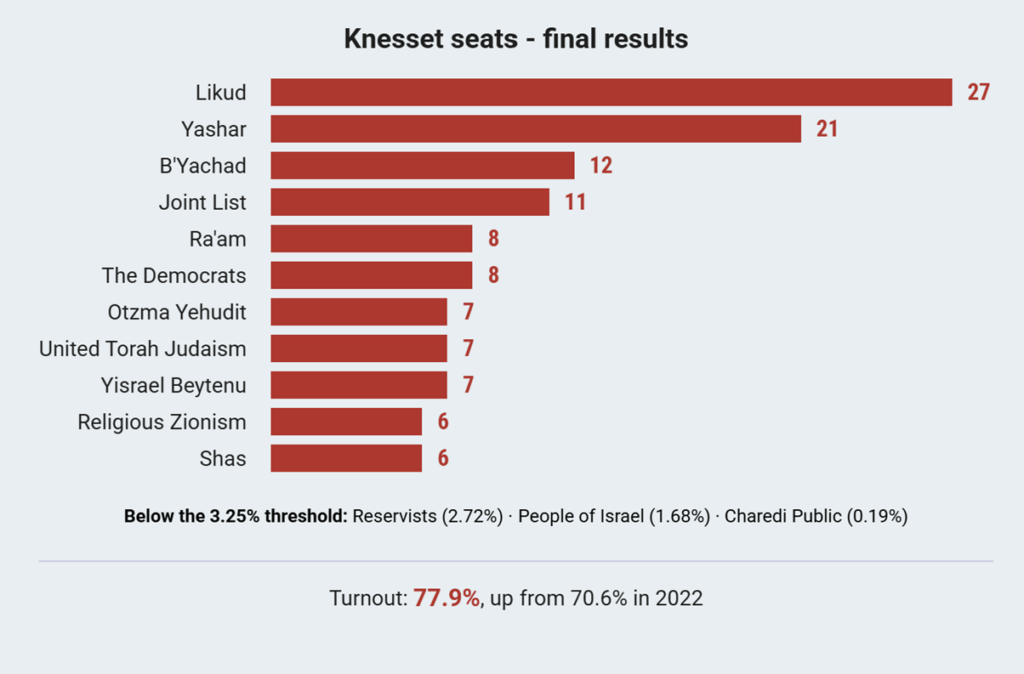
As has been true in every election since the founding of the state, no single party won enough seats to govern without forming a coalition. In fact, nobody came close. Israel’s Knesset has 120 seats, meaning 61 seats are needed to form a government. Prime Minister Netanyahu’s Likud received the most seats, with 27.
So…what now?
In the coming week, each of the parties that received enough votes to enter the Knesset will meet with President Herzog and make their recommendation on who should form the next government. Based on those recommendations, President Herzog will give one member of the Knesset the “mandate” to form a government. In all likelihood, the mandate will be given either to Prime Minister Netanyahu or to Yashar head Gadi Eisenkot.
Whoever receives the mandate will have 28 days to negotiate with the other parties in an effort to bring enough parties in to reach a 61-seat majority and form a government. If no coalition is formed within 28 days, the individual with the mandate can request a 14-day extension or return the mandate to the President. If, after 28 days, plus a 14-day extension, no government is formed, the mandate returns to the President. At that time, it is likely someone else will be given the opportunity to form a government. If the second candidate fails, there is a 21-day window in which 61 Members of Knesset can petition the President to nominate someone. If, after all those avenues have been exhausted, there is no government, new elections would be called. Nobody said this process was simple or easy to understand.
Neither bloc of parties, the “pro-Bibi bloc” (53 seats) nor the “Anti-Bibi Change bloc” (48 seats) received a majority. The Arab-majority parties, which are not clearly aligned with either bloc, received an unprecedented 19 seats. There are many potential outcomes in the next couple of months. Below are just five of the most likely possibilities, in no particular order.
1. Center-Right Unity Government
In this scenario, the two largest parties, Likud and Yashar, would agree to govern together with their leaders, Benjamin Netanyahu and Gadi Eisenkot, rotating as Prime Minister. The coalition would include Yisrael Beytenu and B’Yachad, yielding a coalition of 67 seats.
While this government would represent a broad central cross-section of the country, there are challenges to bringing it together. Prime Minister Netanyahu has said he will not abandon his current coalition partners, and each of the leaders of the opposition Change bloc has vowed not to serve under or with him.
2. Right-Wing Government
In this scenario, Prime Minister Netanyahu keeps the parties in the current government together. The challenge is that those parties (Likud, Otzma Yehudit, Religious Zionism, United Torah Judaism and Shas) received only 53 seats in this election. So, the Prime Minister would have to convince someone in the Anti-Bibi Change bloc to join him. This faces the same challenge as a unity government, with the added fact that many of the Change bloc parties have also said they will not sit with the Haredi parties or with the right-wing parties led by Itamar Ben Gvir and Bezalel Smotrich.
3. Center-Left and Arab Parties Government
In this scenario, Gadi Eisenkot would lead a government including Yisrael Beytenu, B’Yachad, the left-wing Democrats and the Arab-majority Ra’am and Joint List, a combination of Hadash, Ta’al and Balad. Together these parties won 67 seats.
There are several challenges to forming this government. First, after October 7, several parties in the Change bloc said they will not sit in a coalition with Ra’am or the Joint List. Second, some, if not all, elements of the Joint List have expressed a consistent unwillingness to sit in a government under Zionist parties. Third, Gadi Eisenkot has listed four principles for any member of Knesset to sit in his government. Two of them: recognition that Israel is a Jewish and democratic state, and that Hamas is a terrorist organization that must be dismantled, might be more than some of the Arab-majority parties, the ultra-nationalist Balad in particular, are willing to accept.
4. Anti-Netanyahu Change Bloc Minority Coalition
In this scenario, Eisenkot is unable to put together a coalition of 61 members of Knesset, but forms a minority government that is supported from outside the government by Ra’am, the Joint List, or both. The Joint List would not join the government and thus would not need to meet Eisenkot’s four principles, or sit in the cabinet to make decisions on war and peace, but they would vote in favor of forming the government, mostly for the purpose of removing Netanyahu from power. This type of minority government would likely be unstable and survive only a short period of time before new elections.
5. No New Government and Another Round of Elections
In this scenario, after all negotiations and potential solutions have been exhausted, no one can form a coalition. New elections would immediately be scheduled and the current government, led by Benjamin Netanyahu, would remain in office with certain limits on its powers as an “interim” government. The complicating factor here is that the new Knesset would be sworn in, and they could look to enact legislation making Netanyahu ineligible to continue as Prime Minister after the next elections. That would likely trigger legal challenges, the outcome of which is not clear.
Conclusion… for now
There are multiple potential permutations to each of these scenarios, but the bottom line is that last week’s elections were only the first step in a long and complicated process. We still don’t know who Israel’s next Prime Minister will be. A coalition may be formed in the coming few weeks, or we may need more elections to break the deadlock.
One hundred twenty members of Knesset, 11 parties and a 28-day clock: messy as it is, that is what our vibrant democracy looks like.
Liked this article? Follow HonestReporting on Twitter, Facebook, Instagram and TikTok to see even more posts and videos debunking news bias and smears, as well as other content explaining what’s really going on in Israel and the region. Get updates direct to your phone. Join our WhatsApp and Telegram channels!
© Divuach Ne’eman R”A, 2025