Key Takeaways:
- The Associated Press published a 12-image gallery by Gaza photographer Abdel Kareem Hana dominated by civilians, children, damaged buildings and people recovering possessions. The photographs documented genuine aftermath, but the captions provided virtually no information about the military targets behind the strikes.
- Contemporaneous reporting supplied operational context missing from the gallery. Reuters reported that Israel said it was targeting Hamas commanders, Nukhba operatives and military infrastructure, while witnesses reported advance evacuation warnings before at least one of the Deir al-Balah strikes.
- AP produced and curated the visual package, but other media such as The Independent made their own editorial decisions to republish it. The result gave readers an overwhelmingly civilian visual account while leaving the reported military purpose of the operations largely outside the story.
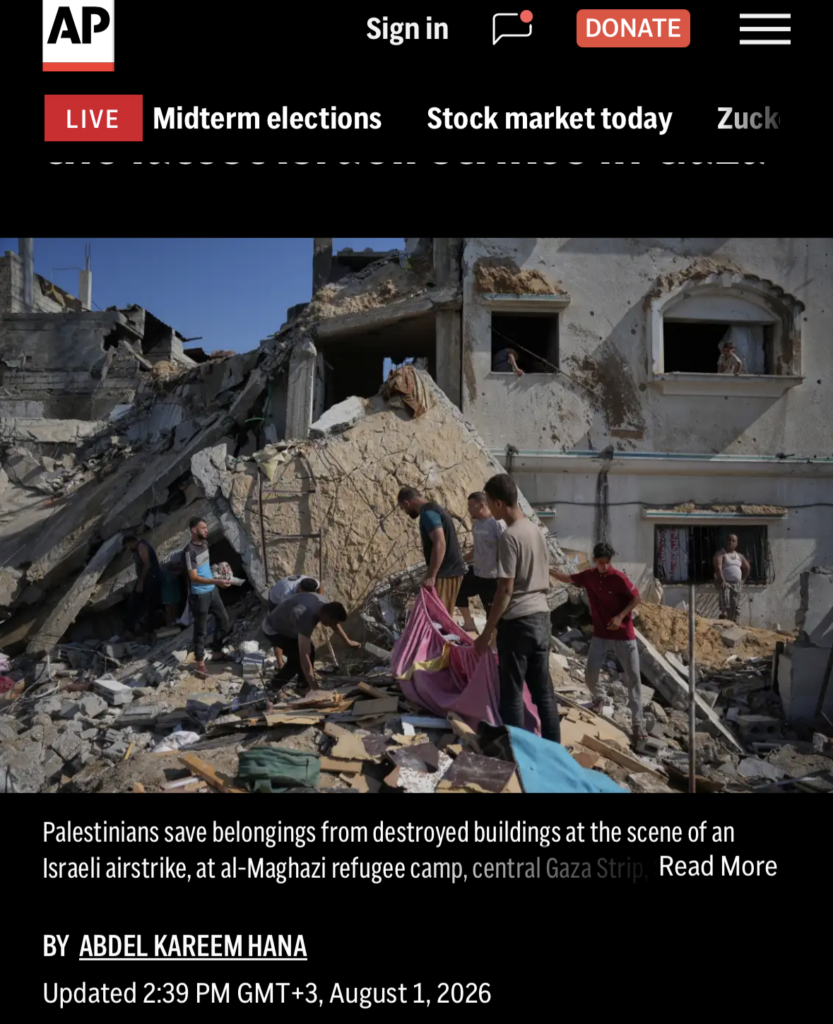
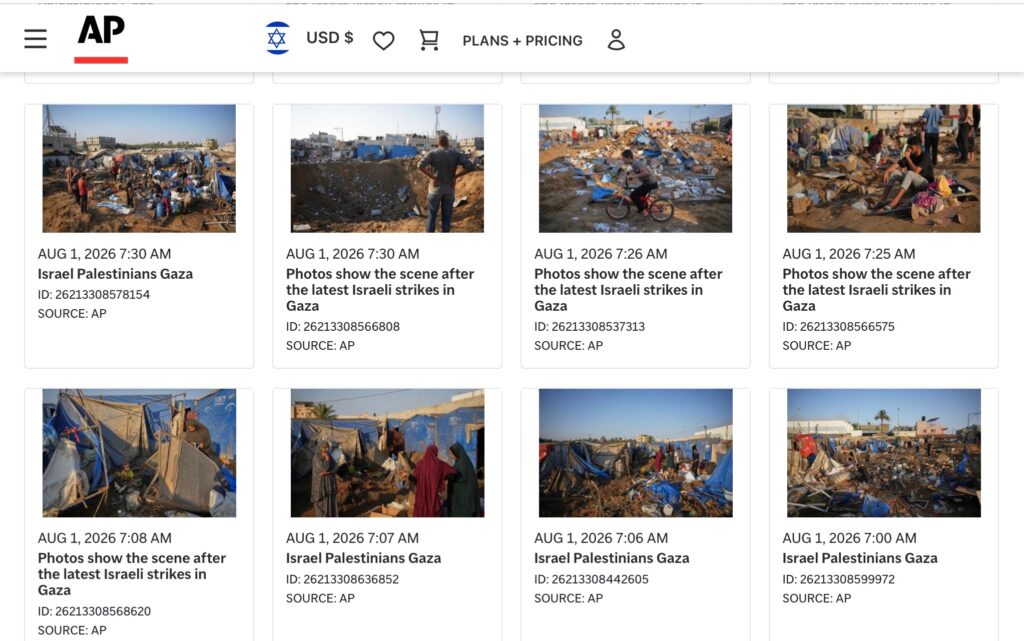
On August 1, the Associated Press published a gallery under the headline, “Photos show the scene after the latest Israeli strikes in Gaza.”
The gallery was republished by other media outlets, including The Independent.
All twelve photographs were taken by Abdel Kareem Hana, one of AP’s established photographers in Gaza. They showed Palestinians searching damaged buildings in al-Maghazi, residents inspecting destruction in Deir al-Balah and Nuseirat, children among rubble, a woman walking through a damaged area and families recovering possessions.
While the images documented genuine aftermath, they lacked the basic operational context required to explain the strikes. Individual captions repeatedly described only the “scene of an Israeli airstrike.” There were no Hamas operatives, weapons or military targets visible in the sequence, and virtually nothing explaining what Israel said it had been attacking.
Presented in isolation, the gallery leaves readers with an overwhelmingly civilian account: damaged buildings, children, families and rubble, with almost none of the contemporaneously reported information explaining why those locations were being struck.
Parallel reporting supplied some of that missing context.
What Israel Said It Was Targeting
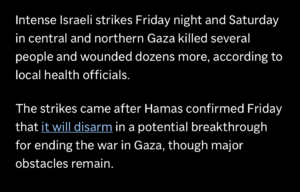
Reuters reported on August 1 that the Israeli military said an apartment strike in Deir al-Balah targeted two commanders from Hamas’ elite Nukhba force. Other strikes in Gaza City and Jabalia, the IDF said, targeted military operatives.
A separate Reuters report provided particularly relevant context for the Deir al-Balah imagery. It reported that Israel said it had struck Hamas operatives and a weapons storage site near al-Aqsa Hospital. Witnesses quoted by Reuters said an evacuation warning had been issued before the strike.
The IDF also identified Hamas commanders and operatives targeted during this broader operational period. They included Salem Jamal Abd al-Rahman Abu Labad, whom Israel identified as a Nukhba cell commander who participated in the October 7 attacks; Muhammad Abd al-Nasser Muhammad Khatib, described as a commander in Hamas’ Maghazi Battalion; and Abdallah Adnan Taha Abu al-Tayf, identified as a Nukhba operative who infiltrated Israel on October 7 and subsequently continued operating against Israeli troops. Jalal Sobieh was separately identified as a commander in Hamas’ Daraj-Tuffah Battalion.
Israeli statements also said precautions used during targeted operations included aerial surveillance and precision munitions intended to reduce civilian harm.
Not every named operative can be matched from the available evidence to a specific building appearing in Hana’s photographs. The point is narrower: substantial military context existed alongside the civilian aftermath reporting, including Israel’s identification of Hamas targets and Reuters’ reporting of an advance warning before a Deir al-Balah strike.
Almost none of it appears in the AP’s presentation.
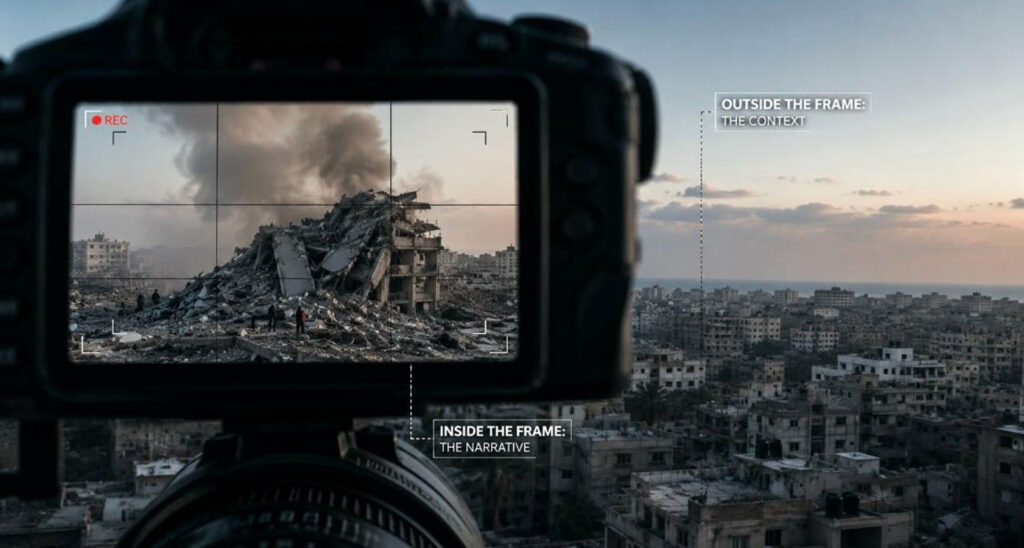
What the Frame Leaves Out
There is another element worth examining: the photographs themselves.
Hana repeatedly works at tight and medium distances. People dominate the compositions. Children are photographed against damaged buildings. Residents search through rubble and recover possessions. Human figures provide both scale and emotion.
Those choices produce powerful photographs, but they also make the overall footprint of the strikes considerably harder to assess.
A tightly framed photograph can show extraordinary detail within a damaged structure while revealing little about the surrounding buildings. It can emphasize destruction without establishing whether damage extended across an entire neighborhood or was concentrated around particular structures. Without wider or elevated views, readers have limited ability to assess the relationship between the damaged location and its surroundings.
That does not, from the photographs alone, establish that the strikes were precise, nor does it negate civilian harm. It does mean that the gallery provides little visual evidence for readers to independently assess the wider scale and concentration of the damage.
Across twelve images, that repeated framing becomes more consequential than any individual photograph.
AP’s Pictures, The Independent’s Decision
Hana is not an unknown freelancer whose photographs happened to reach a British newspaper. He is an established AP Gaza photographer whose work has appeared extensively throughout the war and formed part of the agency’s Pulitzer Prize finalist portfolio for Feature Photography.
His work frequently documents civilian life, displacement, destruction and the human consequences of the conflict. Those are legitimate subjects for photojournalism.
But Hana did not determine the final presentation alone.
AP photo editors curated the gallery from the imagery available to the agency. The Independent (and some other smaller media outlets) then chose to republish that package for its own readers.
That second decision carries its own editorial responsibility.
Wire agencies supply newsrooms with enormous quantities of photographs and reporting every day. Newspapers decide which images to publish, how to sequence them, what captions accompany them and what additional context readers require.
The Independent was therefore not simply a passive conduit for AP photography. It made an editorial choice to present the package essentially as supplied, without adding the substantial operational context being reported elsewhere at the time.
The Context That Disappeared
None of the missing information requires accepting Israeli military statements as uncontested fact. The IDF’s account could have been clearly attributed, just as casualty figures and Palestinian accounts routinely are.
Nor should images of civilian destruction disappear because Hamas operatives may have been targeted.
The journalistic issue is completeness.
Reuters readers were told that Israel said Nukhba commanders and other military operatives were being targeted. They could read that the military said a Hamas weapons storage site near al-Aqsa Hospital had been struck. They were also told that witnesses reported an evacuation warning before the Deir al-Balah strike.
Readers encountering the AP’s gallery saw something very different.
They saw the aftermath.
They saw civilians.
They saw children and rubble.
What they were given almost no opportunity to see, visually or through accompanying context, was the reported military dimension of the operation.
Conclusion
Abdel Kareem Hana documented genuine destruction following Israeli strikes in Gaza. AP selected those photographs and assembled them into a visual package. The Independent then chose to reproduce that package for its readers.
At each stage, editorial decisions determined what survived.
The final gallery concentrated overwhelmingly on civilian aftermath while leaving out contemporaneously available reporting that Israel said it was targeting Hamas commanders, Nukhba operatives and military infrastructure, as well as Reuters’ reporting that witnesses described an advance warning before one of the Deir al-Balah strikes.
The photographs did not need to be manipulated to produce an incomplete picture.
By publishing the aftermath while leaving the reported military targets largely outside the story, the AP and The Independent gave their readers the destruction without the context required to understand why the strikes took place.
Liked this article? Follow HonestReporting on Twitter, Facebook, Instagram and TikTok to see even more posts and videos debunking news bias and smears, as well as other content explaining what’s really going on in Israel and the region. Get updates direct to your phone. Join our WhatsApp and Telegram channels!
© Divuach Ne’eman R”A, 2025