Key Takeaways:
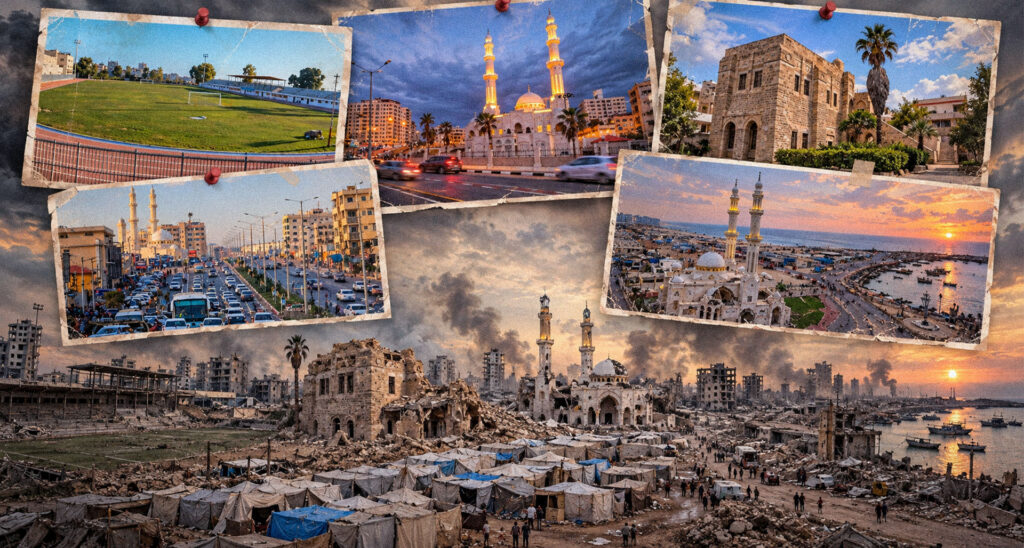
- Before-and-after photographs published by TRT World and Al Jazeera reveal the substantial infrastructure, recreational facilities, and everyday civilian life that existed in Gaza before October 7, 2023.
- Both outlets have repeatedly described Gaza as an “open-air prison,” a characterization that sits uneasily alongside the picture of prewar life now emerging from their own photographic archives.
- While the comparisons document extensive destruction, they offer little context concerning the circumstances of the war, Hamas’ military infrastructure, or the events that led to Israel’s military response.
A series of photographs published by TRT World to mark three years since the outbreak of the Gaza war has inadvertently raised some uncomfortable questions about how the international media portrayed the territory before October 7, 2023.
In TRT World’s photographic comparison, a young couple dressed in elaborate wedding clothes walks through a garden, university graduates celebrate their achievements, families enjoy the Mediterranean waterfront, and spectators fill a soccer stadium. Other photographs show modern apartment buildings, busy roads, and an urban landscape extending towards the sea.
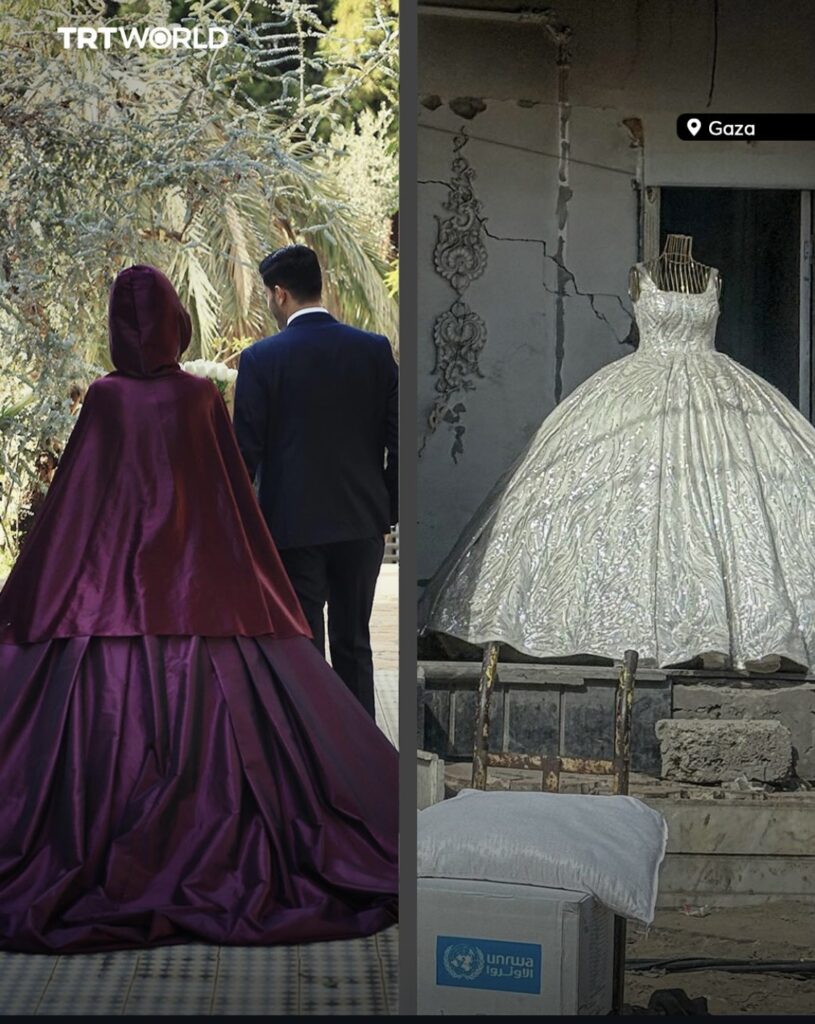
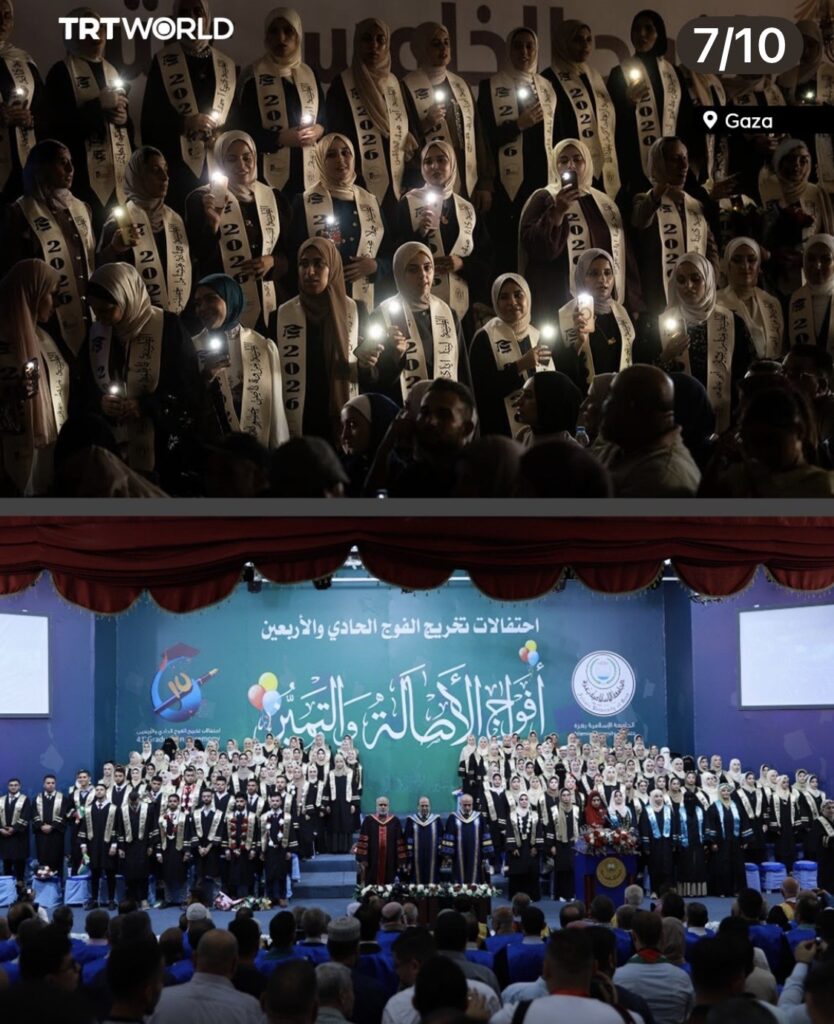
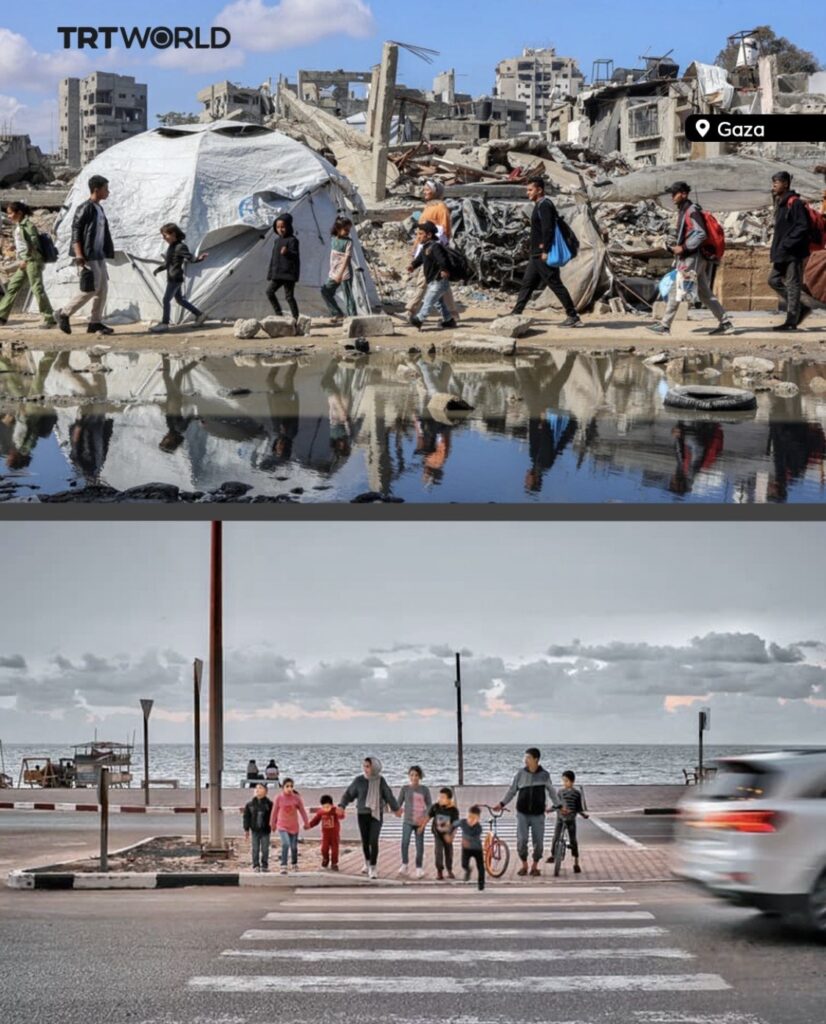
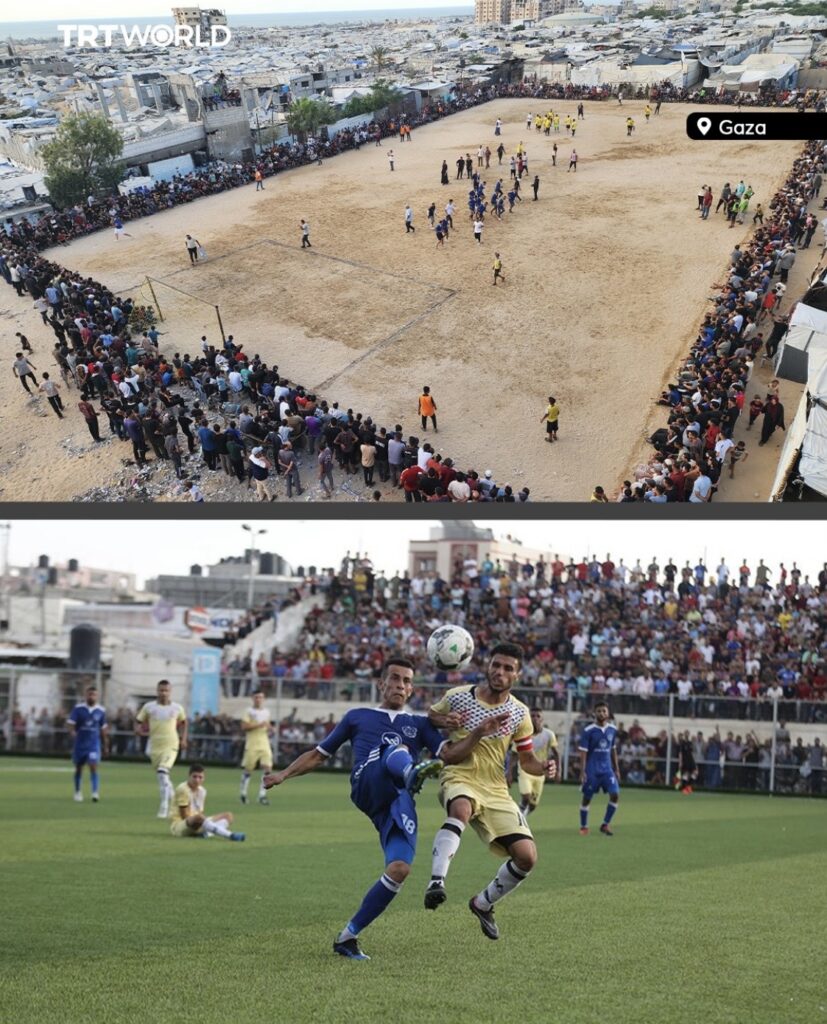
These scenes of ordinary civilian life are contrasted with photographs of devastated neighborhoods, damaged buildings, and displaced families struggling to survive among the ruins.
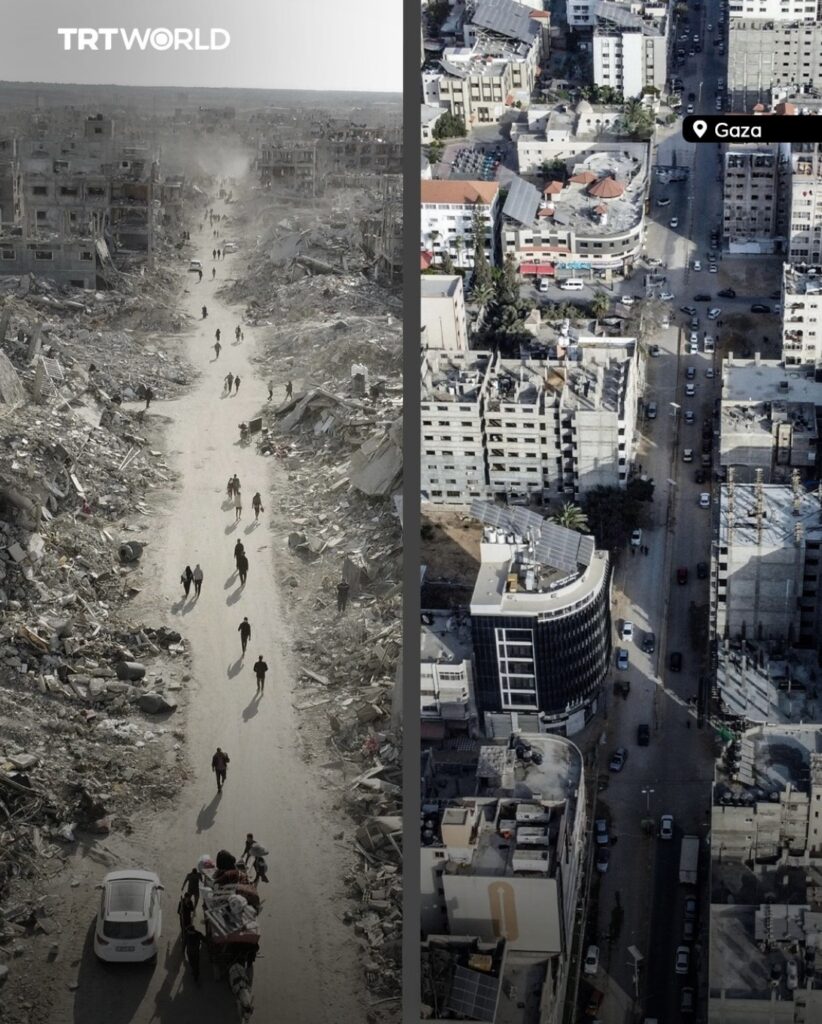
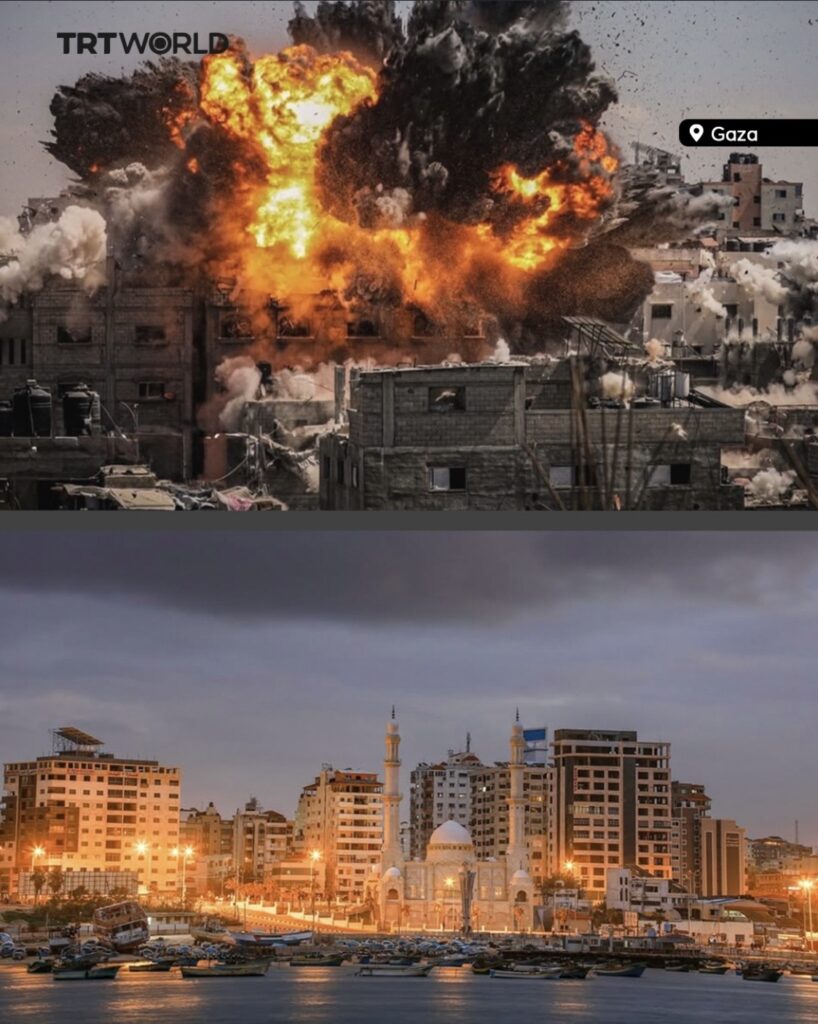
TRT World introduces the collection with the words “Three years of genocide in Gaza,” leaving little doubt about the message the outlet intends to convey.
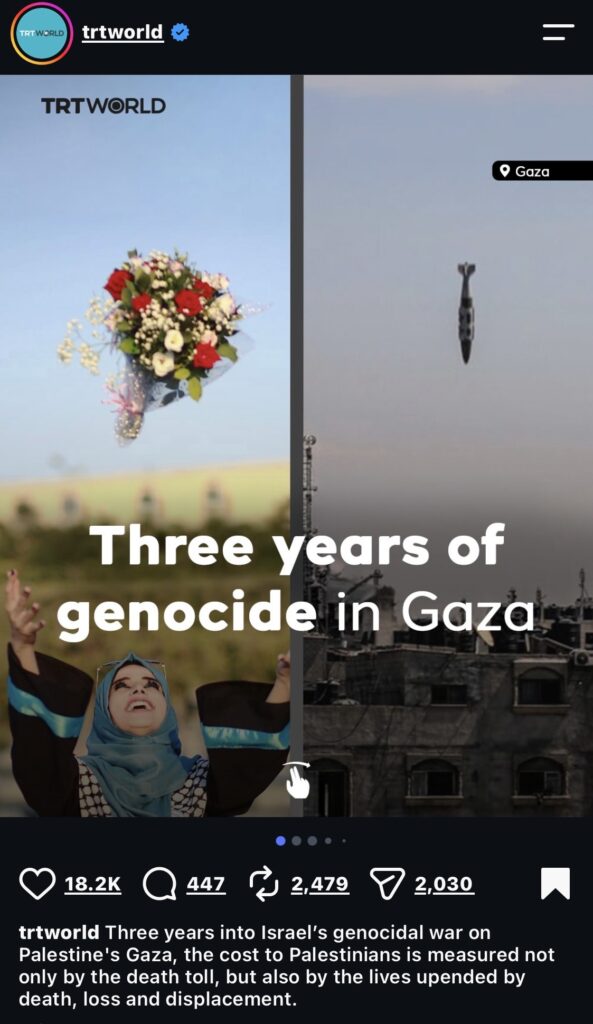
There is no disputing that the photographs of destruction are powerful or that the physical transformation of Gaza has been immense. What is particularly striking, however, is the picture of prewar Gaza that TRT World has chosen to present to its audience, especially given the outlet’s previous coverage of the territory.
For years, international audiences were encouraged to regard Gaza as a place defined almost entirely by confinement and deprivation. Now, some of the same media organizations responsible for reinforcing that impression are publishing images of a functioning urban society, complete with the institutions, amenities, and recreational spaces familiar to cities elsewhere in the region.
The Gaza in Al Jazeera’s Archives
A similar contradiction emerges from a collection published by Al Jazeera on October 9, featuring before-and-after photographs of recognizable locations across Gaza.
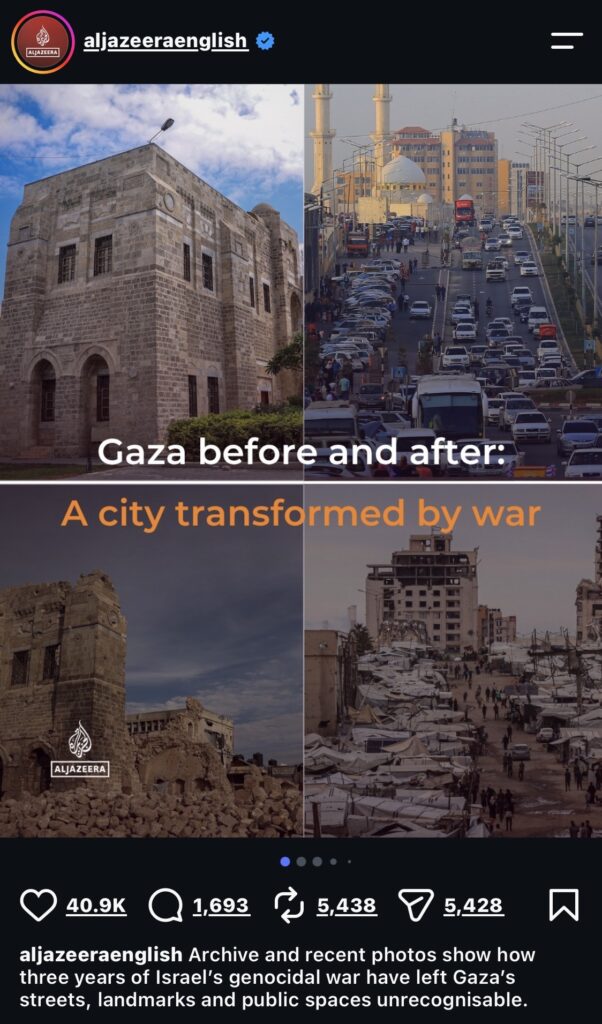
Al-Rashid Street appears as a broad, paved thoroughfare lined with substantial buildings, while Gaza’s coastal road is shown bustling with traffic and commercial activity. An aerial photograph of the port reveals landscaped public spaces, a large mosque, and roads running alongside the Mediterranean.
Elsewhere, the Islamic University of Gaza is presented as an impressive modern campus, Yarmouk Stadium boasts a maintained soccer pitch and athletics track, and the historic Qasr al-Basha stands surrounded by gardens and trees. Another photograph shows Al-Hasayna Mosque illuminated against a backdrop of apartment towers.
These are not images selected by an Israeli public relations department to challenge the international media’s portrayal of Gaza. They are Al Jazeera’s own selections, chosen to demonstrate what the territory looked like before the war.
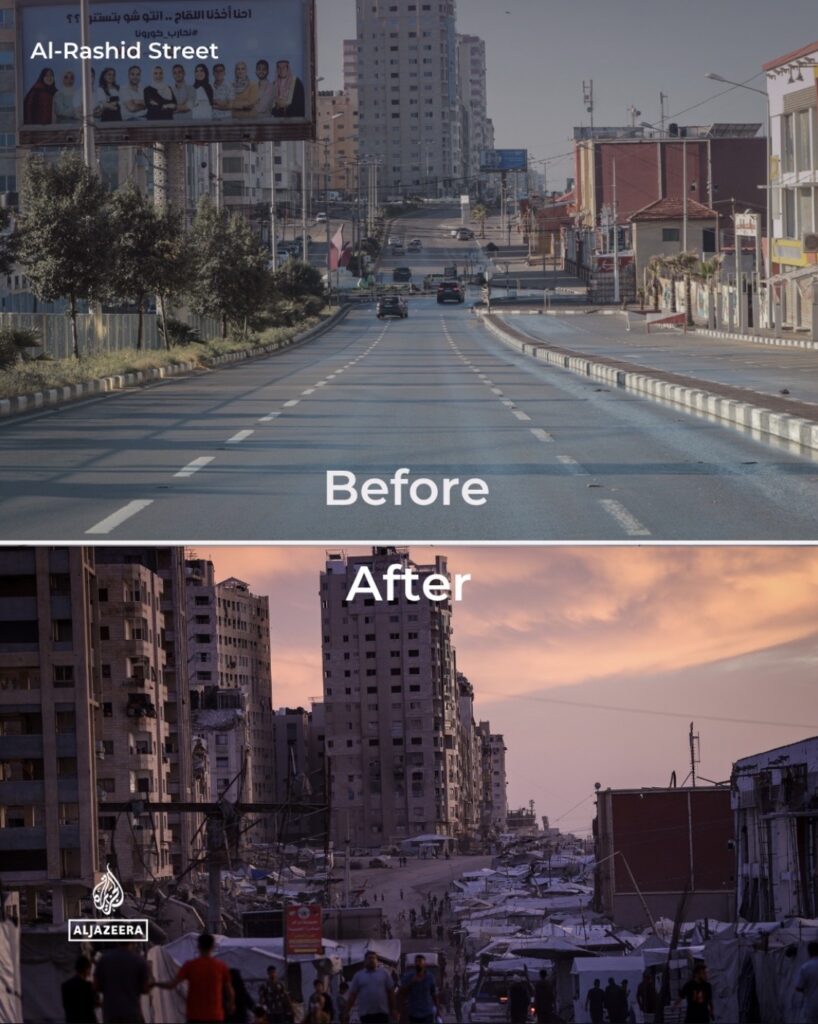
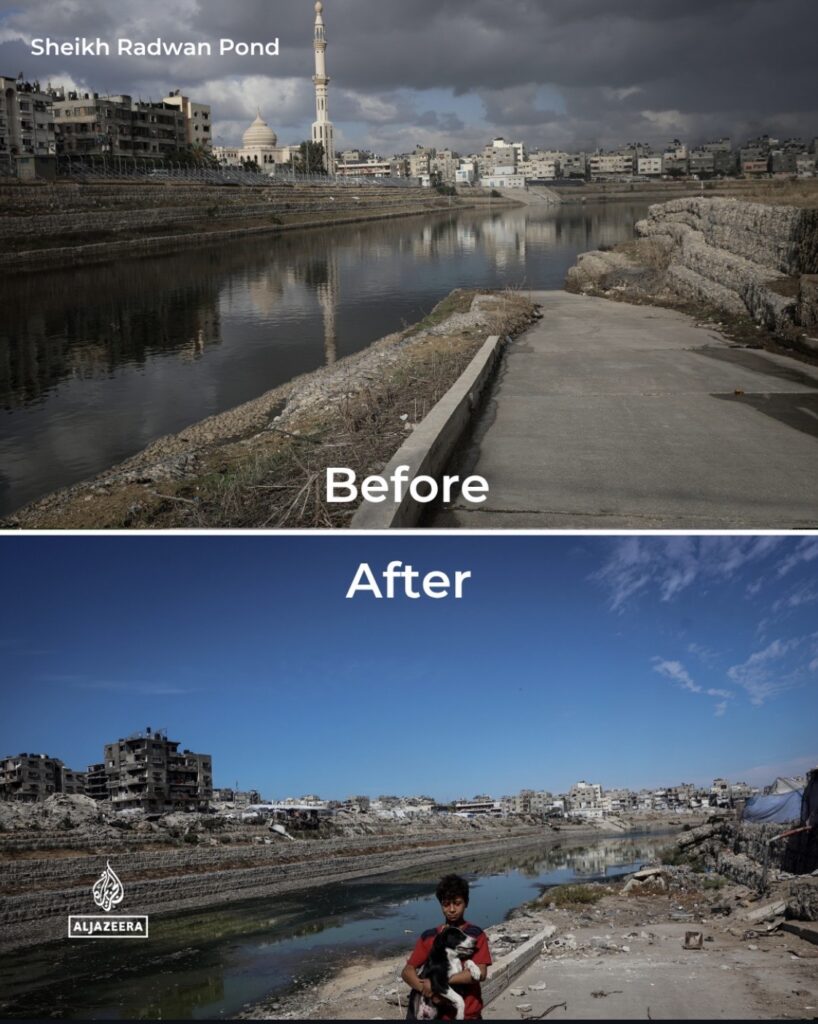
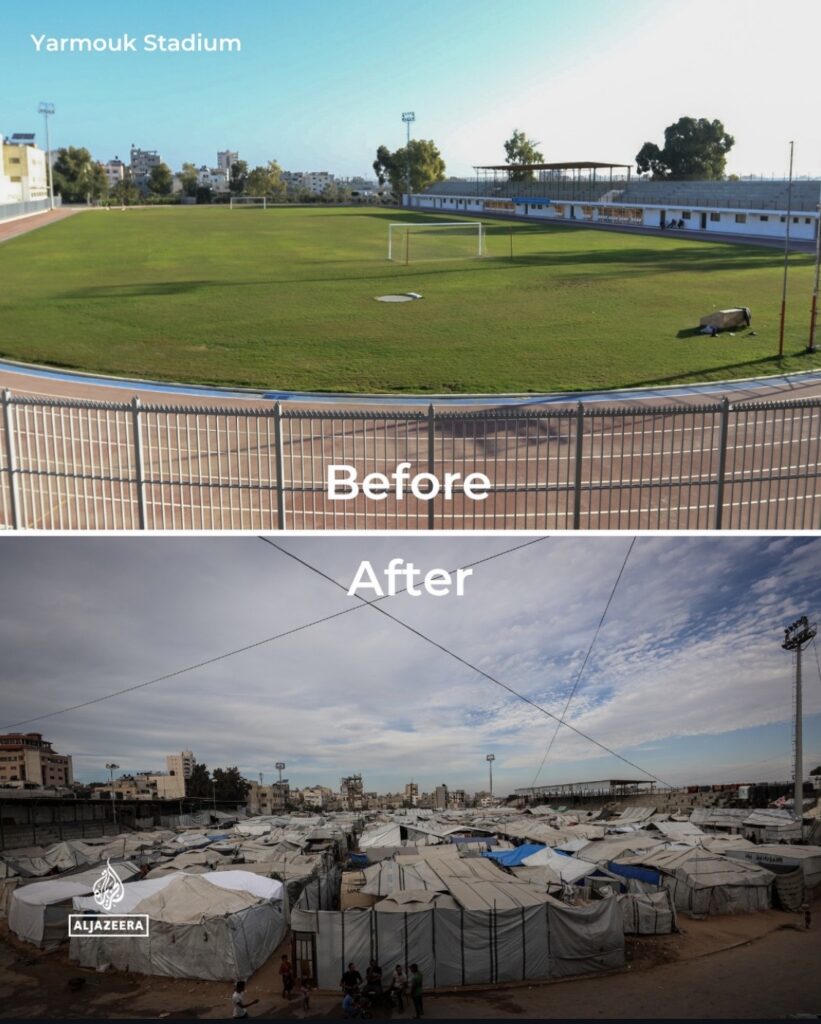
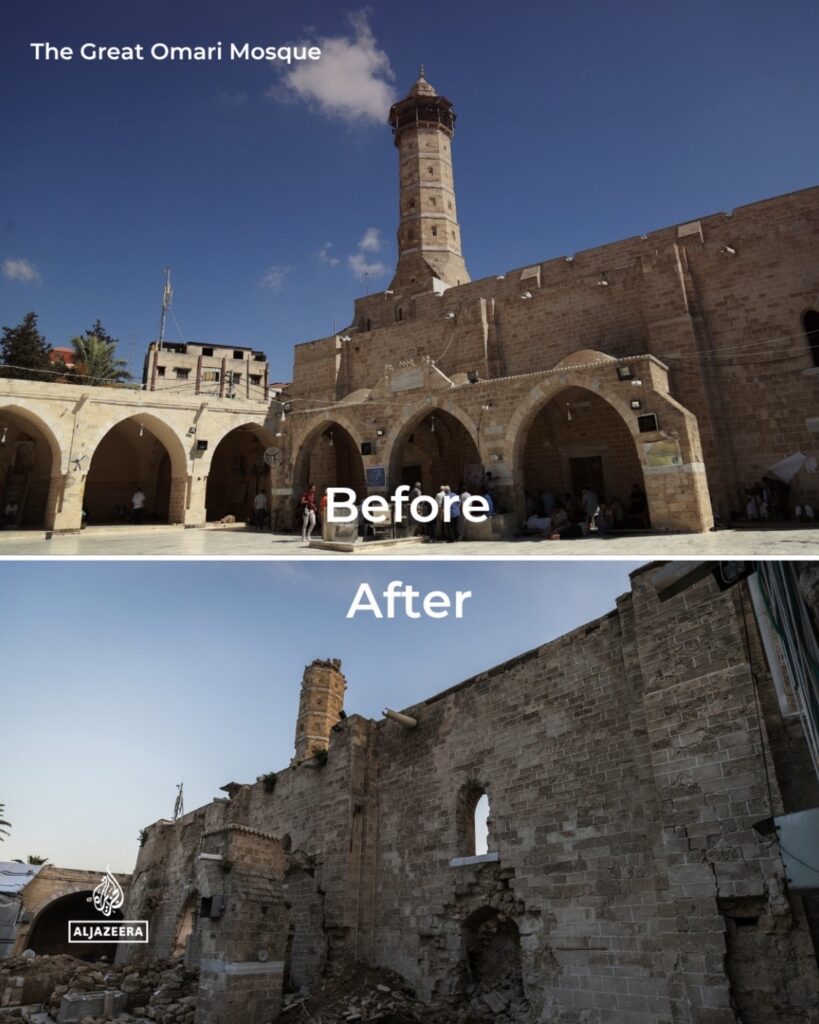
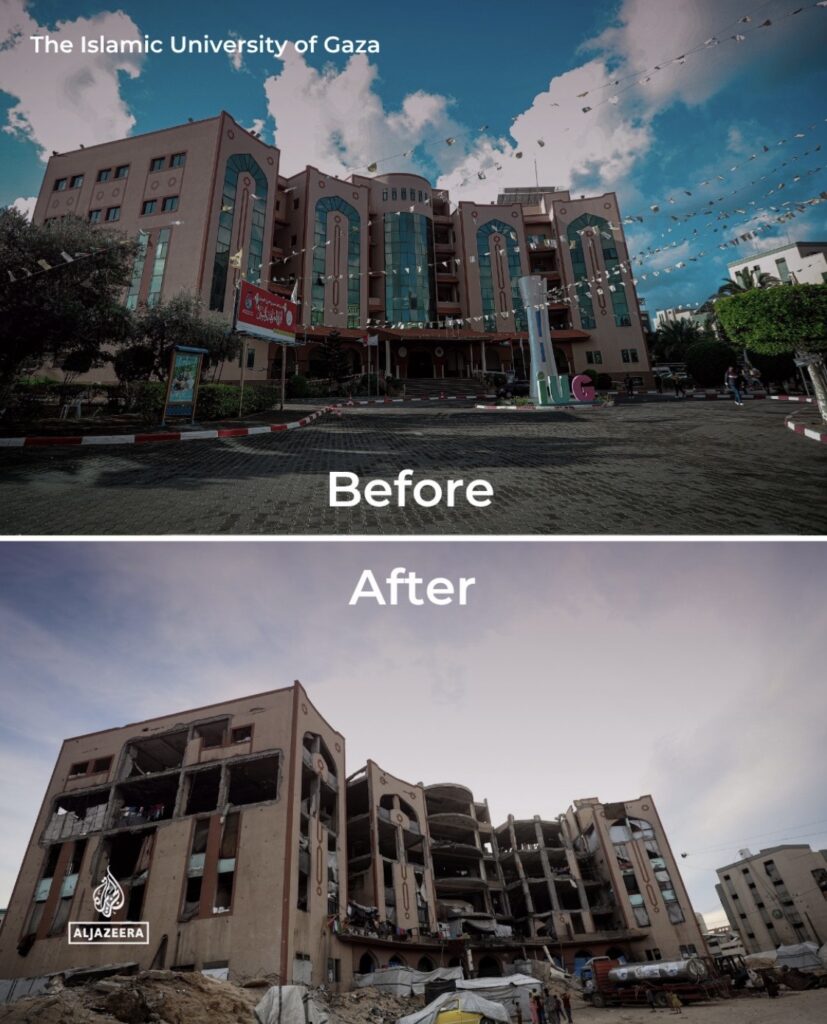
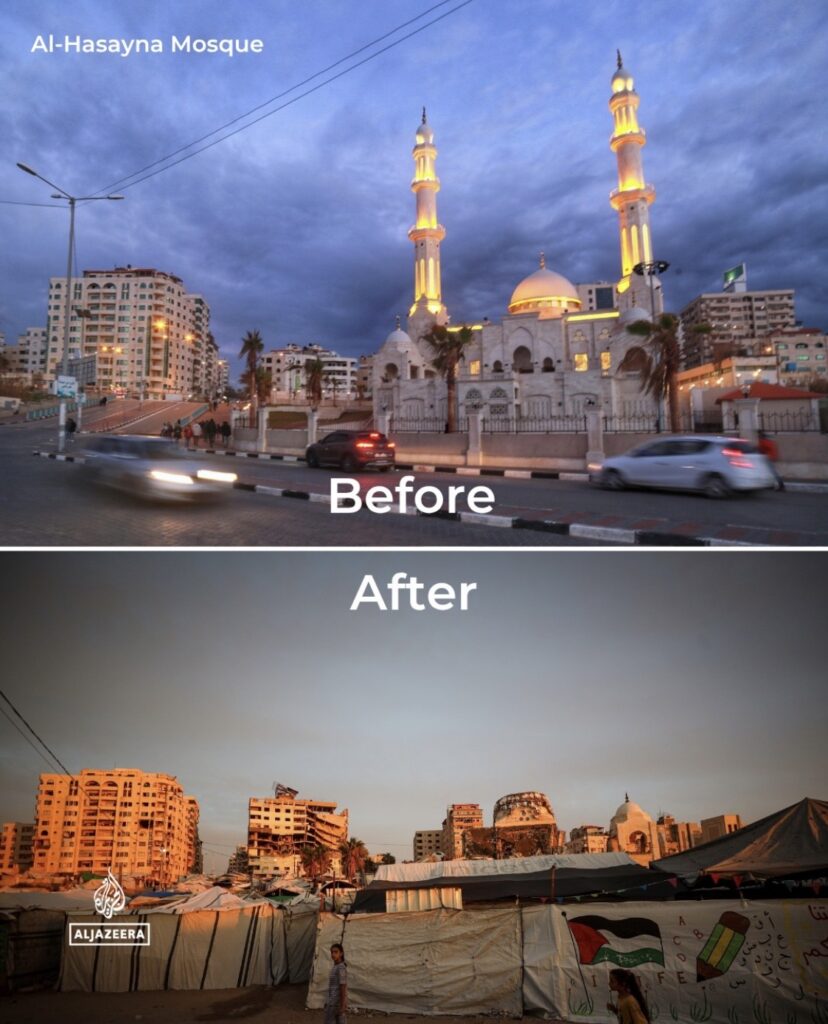
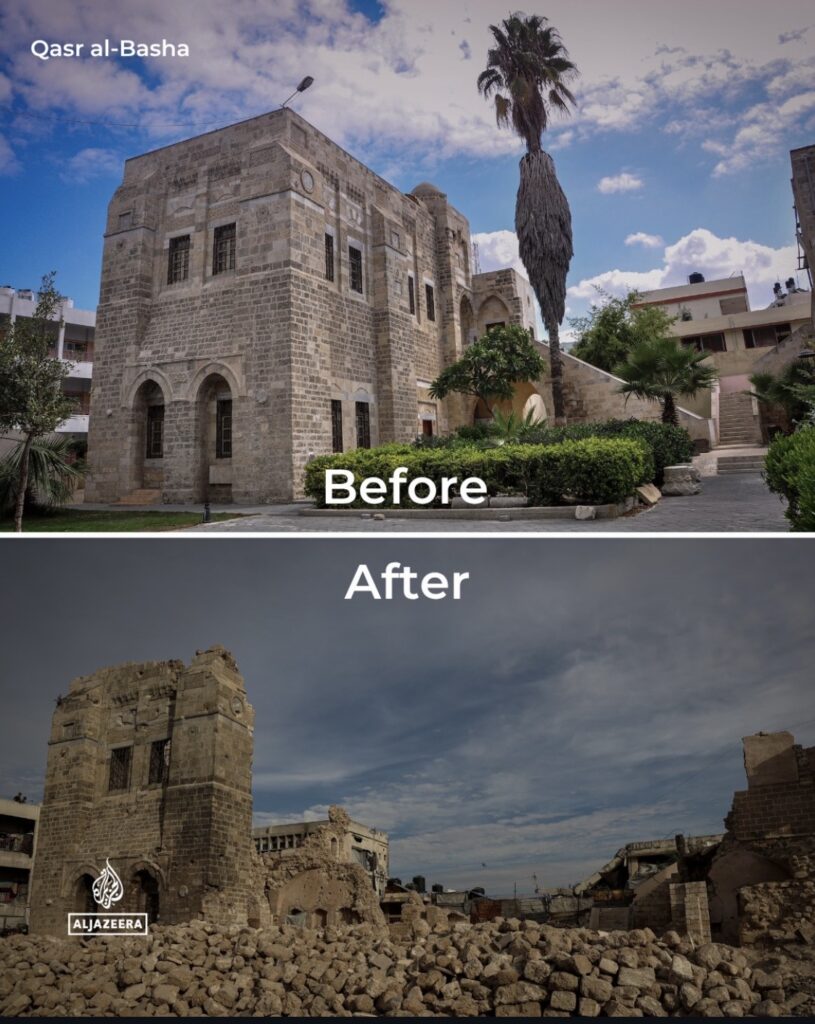
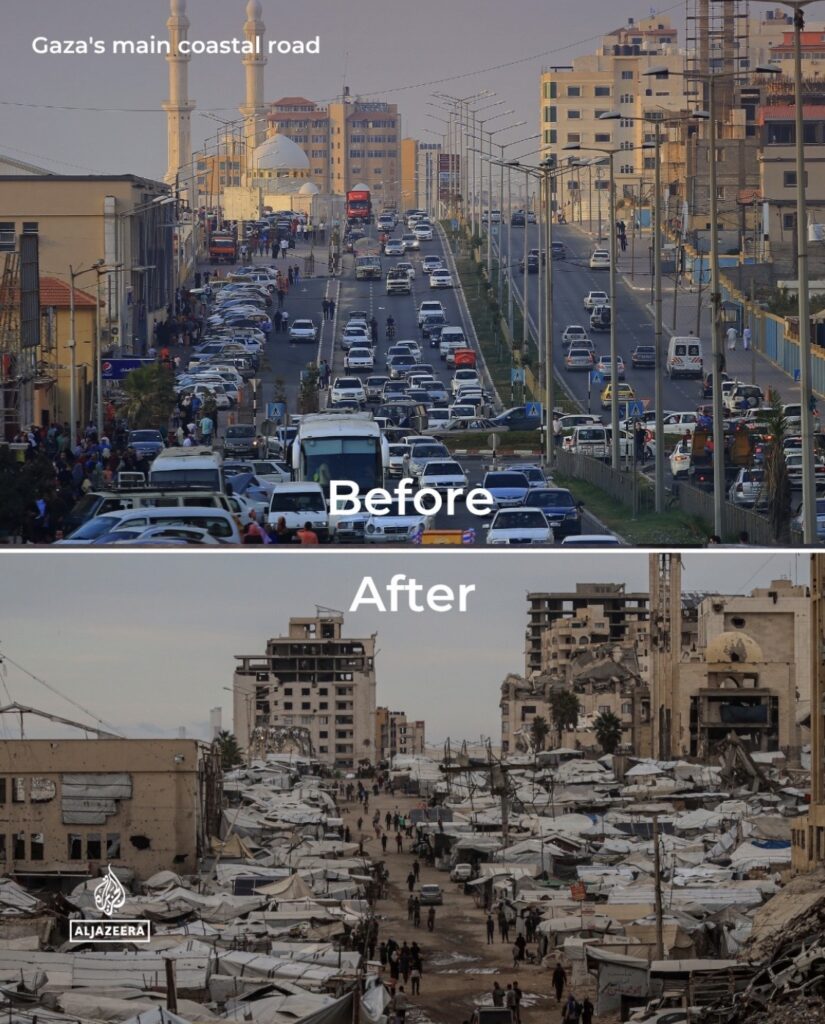
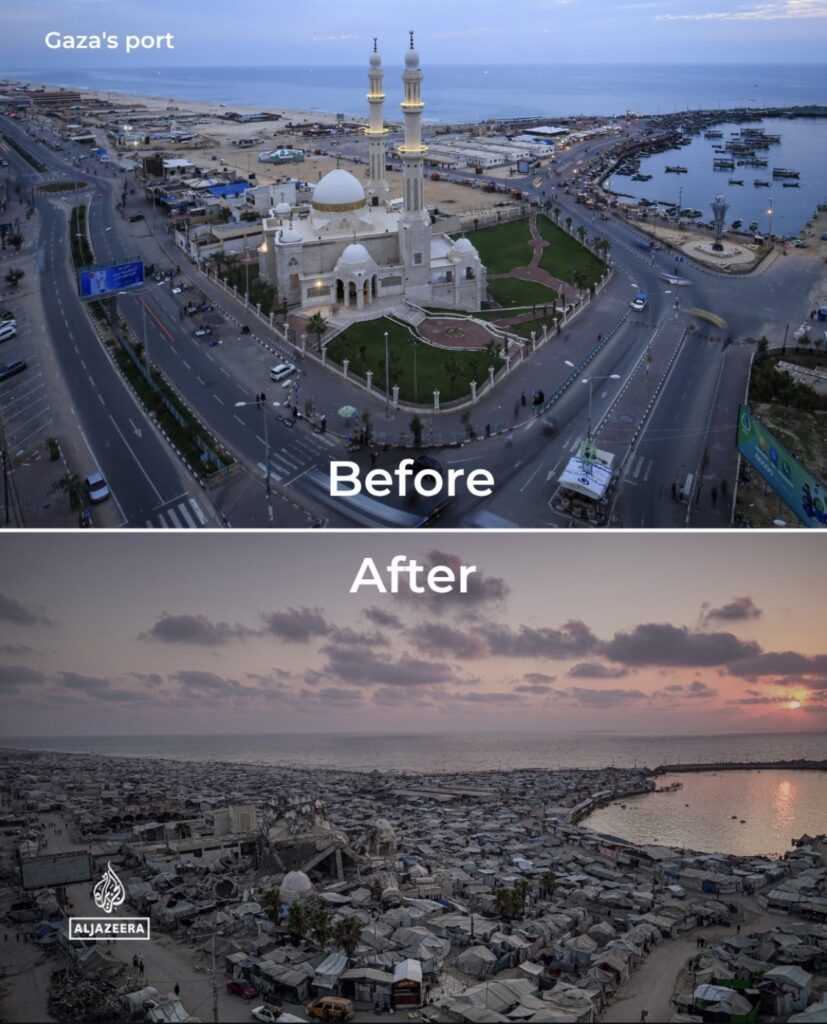
The accompanying photographs document extensive destruction, showing damaged landmarks and familiar public spaces reduced to rubble. But they also raise questions about Al Jazeera’s previous reporting. If these streets, universities, and recreational facilities were part of everyday life in Gaza, why did the broadcaster so frequently rely on descriptions that encouraged audiences to imagine something altogether different?
The Problem With the “Open-Air Prison” Narrative
The description of Gaza as an “open-air prison” became so deeply embedded in international reporting that it was frequently treated as an established fact rather than a politically loaded metaphor.
Al Jazeera used the expression in March 2021 in an article examining the blockade and conditions in Gaza, illustrated partly by photographs of destruction from the 2014 conflict. In another article published in June 2022, the broadcaster again employed the prison description while explaining Gaza’s border crossings and restrictions on movement.
TRT World went even further, referring to Gaza as having been described as the world’s largest concentration camp.
Such terminology carries considerable weight, particularly for audiences with little firsthand knowledge of the territory. A prison evokes confinement and deprivation, while the comparison with a concentration camp introduces historical associations of an entirely different magnitude.
These expressions were intended to condemn Israel’s restrictions on Gaza, but their repeated use also helped establish a broader picture of the territory in which the complexities of everyday civilian life were largely overshadowed by a narrative of imprisonment.
There were genuine restrictions on movement and imports, alongside poverty, unemployment, and economic hardship. Israel maintained security controls in response to threats including weapons smuggling and Hamas’ military activities, while Egypt controlled Gaza’s southern crossing. These were legitimate subjects for reporting and scrutiny, but they did not represent the entirety of life in Gaza.
The existence of a modern university or a Mediterranean promenade does not disprove the restrictions imposed on the territory, any more than a photograph of a wedding establishes that every Gazan enjoyed a comfortable standard of living. What these images demonstrate is that Gaza was considerably more complex than the descriptions routinely used to characterize it.
This is where editorial choices become particularly significant. A picture editor can select a photograph of a crowded refugee camp or damaged building to illustrate conditions in Gaza, while another might choose a bustling shopping district, university graduation, or families enjoying the waterfront. Both photographs may be entirely authentic, yet each can leave the reader with a substantially different impression.
When one particular selection of images, reinforced by consistently negative terminology, becomes the dominant representation of an entire society, the cumulative effect can shape public understanding as effectively as the written reporting itself.
What the Photographs Cannot Show
There is another significant omission from these before-and-after comparisons, particularly when attempting to understand the circumstances surrounding Gaza’s destruction.
Beneath the streets, residential buildings, and public spaces depicted in the photographs, Hamas developed an extensive underground military infrastructure, including tunnels used to move fighters, store weapons, and establish operational positions.
Any serious examination of Gaza’s prewar conditions, including Israel’s security restrictions, must acknowledge the military activities of the armed organization governing the territory.
This context is equally important when examining photographs of destruction. A comparison showing a building standing before the war and reduced to rubble afterward establishes that the physical landscape has changed. It does not explain the circumstances of a particular military operation, whether a location was used for military purposes, or what may have existed beneath it.
As previously examined in HonestReporting’s “The Trouble With Looking at Gaza From Space Is You Can’t See Underground,” photographs can document extensive changes to Gaza’s landscape while revealing little about the military infrastructure beneath the surface.
Hamas’ tunnel network does not explain every destroyed building, just as photographs of destruction cannot establish the circumstances of every Israeli military action. Understanding the war requires considerably more context, beginning with the Hamas-led massacre of October 7 and the Israeli military campaign that followed.
Who Is Behind the Photographic Comparisons?
Similar before-and-after imagery has also appeared through international photographic distribution channels.
On October 5, Anadolu Agency distributed comparisons produced by Gaza photographer Ali Jadallah, including images of Al-Rasheed Street and Unknown Soldier Square, subsequently made available through Reuters Connect. Reuters identifies the material as originating from Anadolu and states that it has not independently verified or endorsed the content.
Jadallah was previously the subject of an HonestReporting investigation examining his family connections to Hamas and the public promotion of his photographs by Turkish President Recep Tayyip Erdoğan.
Although there is no established connection between Jadallah and the particular TRT World or Al Jazeera images discussed here, the distribution of his work illustrates how similar photographic comparisons are reaching international audiences through established news channels.
The Photographs Were There All Along
Before-and-after photographs are an effective means of illustrating the consequences of war. Their ability to show what existed before the destruction is precisely what makes them so compelling.
Yet the editorial history of the organizations now publishing these images raises an obvious question: Where were these photographs when international audiences were routinely being told that Gaza resembled an open-air prison?
The universities, coastal roads, commercial streets, and recreational facilities did not suddenly appear in photographic archives following October 7. They existed long before the war, alongside the poverty and hardship that received considerably greater prominence in much of the international coverage.
What has changed is not the reality documented by these photographs but their usefulness to the narrative now being presented.
Today, images of attractive streets, modern buildings, and everyday civilian activities help demonstrate the scale of what Gaza has lost. Before October 7, those same images would have complicated the portrayal of a territory whose defining characteristic was imprisonment.
The photographs of hardship published before the war were not necessarily false, any more than the current images of destruction should be dismissed. The issue is the selective presentation of reality and the impression created when one aspect of a society consistently overshadows everything else.
TRT World and Al Jazeera are now presenting audiences with a Gaza that was rarely central to their earlier descriptions. The contrast is particularly revealing because it emerges from the outlets’ own photographic selections rather than from a competing account.
In attempting to show the world what Gaza has lost, these media organizations are finally giving prominence to what Gaza had. The question is why a more complete picture was not presented all along.
Liked this article? Follow HonestReporting on Twitter, Facebook, Instagram and TikTok to see even more posts and videos debunking news bias and smears, as well as other content explaining what’s really going on in Israel and the region. Get updates direct to your phone. Join our WhatsApp and Telegram channels!
© Divuach Ne’eman R”A, 2025