Key Takeaways:
- The kite imagery was staged. Children, recreational kites and Gaza’s destruction were assembled into a political visual message.
- The imagery substituted one kite for another. Harmless children’s kites became the visual answer to Israeli warnings about border-crossing threats.
- International agencies globalized the frame. Variations appeared across major photographic feeds within roughly 24 hours.
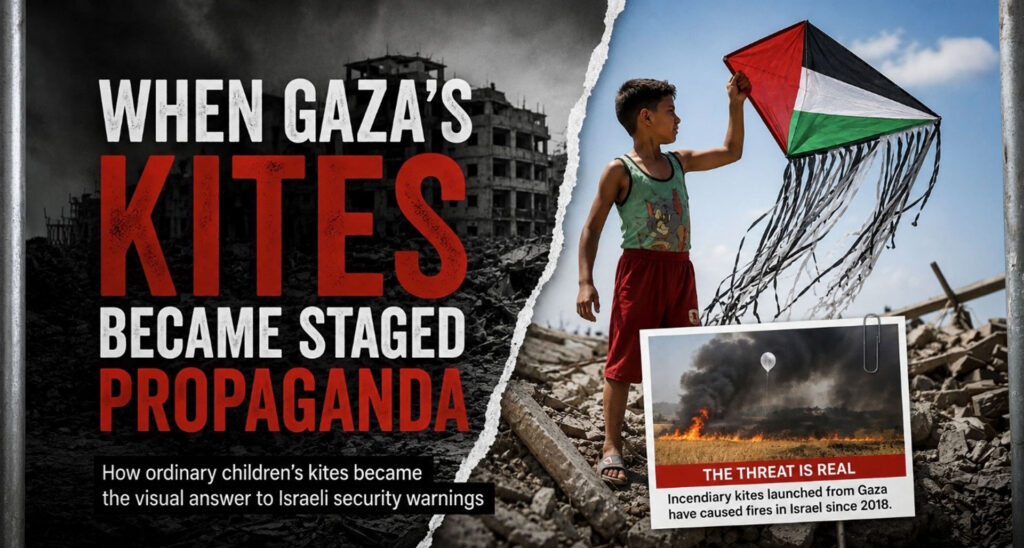
A Palestinian boy stands on a pile of rubble in Gaza City, an oversized black-and-white kite beside him and a damaged facade filling the background. Photographed by Gaza photographer Majdi Fathi on August 23, the composition contains all the elements required for an extraordinarily effective image: a child, a kite and the destruction of war.
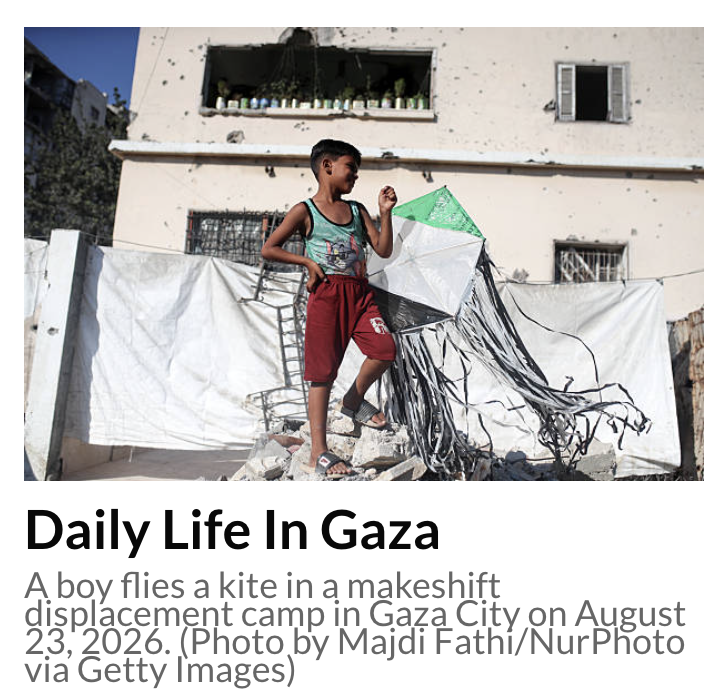
The photograph was distributed by NurPhoto through Getty Images and appeared on Reuters Connect under the innocuous classification “Daily Life in Gaza.”
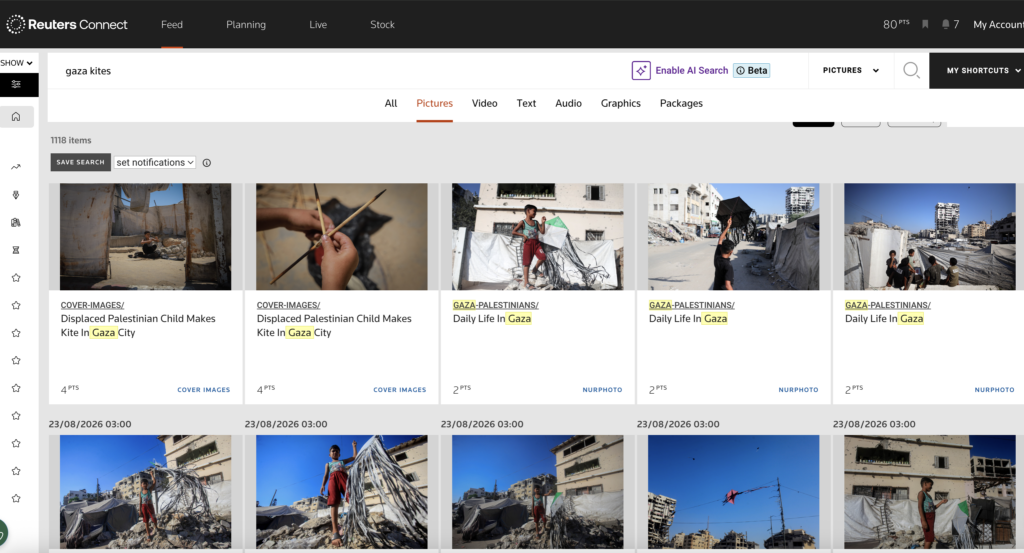
Within roughly 24 hours, international photographic platforms carried multiple variations of the same theme: Palestinian children making kites, children flying kites, children standing beside kites, and families living among the tents and damaged buildings that provided the visual backdrop.
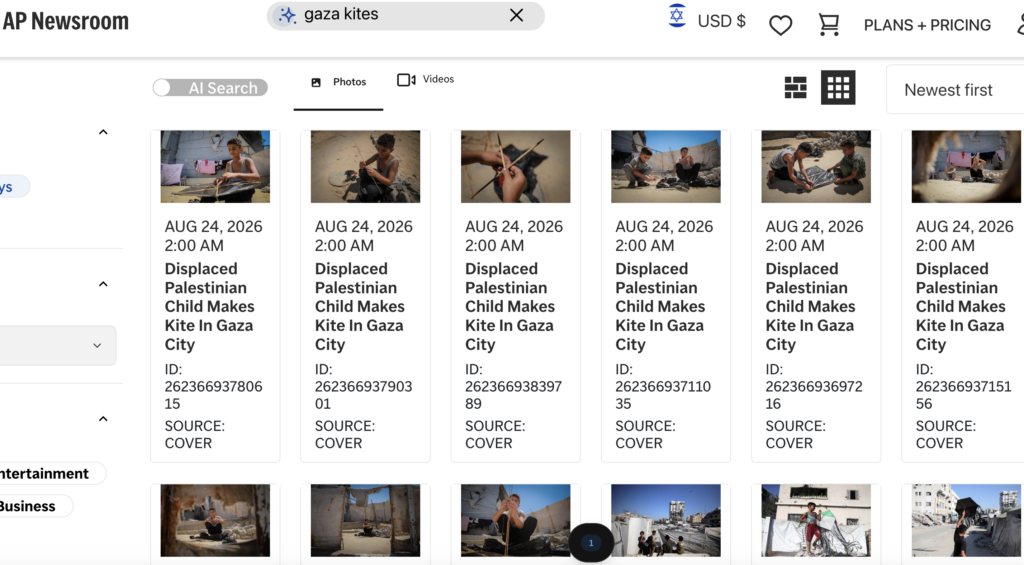
AP Newsroom carried an entire sequence titled “Displaced Palestinian Child Makes Kite In Gaza City.” Rather than an incidental photograph of a child encountered flying a kite, the package documented the activity as a photographic essay: preparing materials, constructing the kite, handling it and presenting the finished object.
The kite had become the story. But the story was not really about children’s toys.
From Security Threat to Children’s Game
Israel has encountered weaponized kites from Gaza before.
During the 2018 Gaza border violence, incendiary kites and balloons carrying burning material were launched across the border into southern Israel, setting agricultural land and nature reserves ablaze. HonestReporting documented the phenomenon at the time and examined why Israel was treating seemingly primitive devices as a genuine security threat.
Eight years later, kites again became part of the Gaza news cycle following Israeli warnings concerning objects reportedly being launched from the territory.
But the photographs distributed internationally showed something fundamentally different. They showed ordinary recreational kites. There were no incendiary devices attached to the kites being photographed, no burning material and nothing in the images showing those particular children’s kites crossing into Israeli territory.
That distinction should have been fundamental to the reporting.
Instead, the innocent kite became the visual answer to Israel’s security warning.
Building the Image
The wider material surrounding the photographs shows how deliberately that visual answer was constructed.
Video footage produced by Abu Ali Express did not simply record a kite appearing incidentally in everyday Gaza life. Children and recreational kites were deliberately placed within Gaza’s damaged landscape, bringing together innocence, play and destruction within the same visual frame.
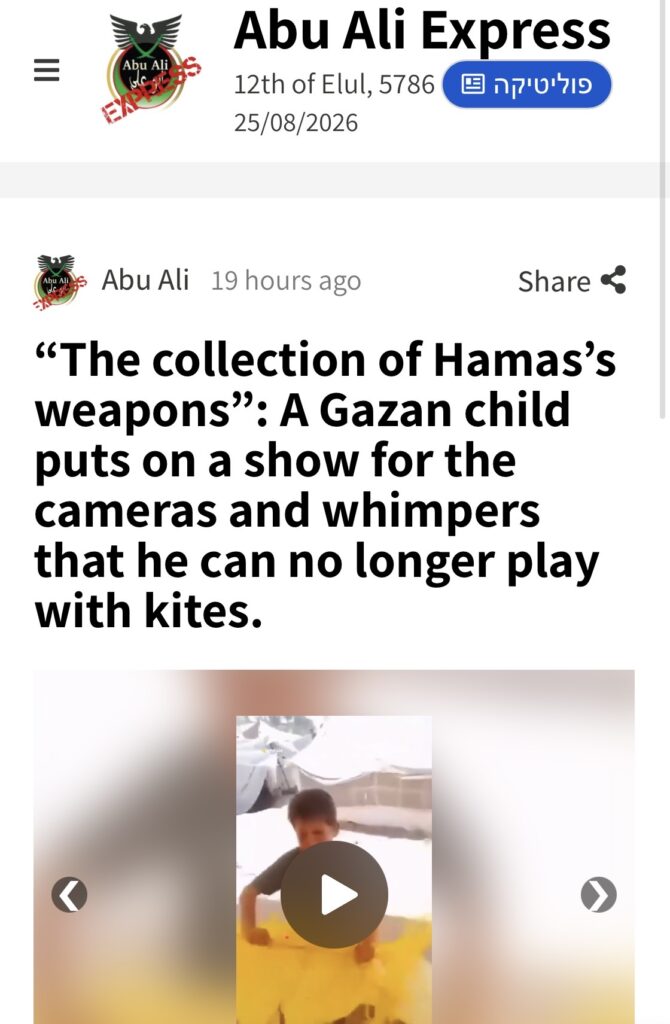
In one sequence, a child is surrounded by multiple brightly colored kites as he addresses the camera. A separate production by Quds News Network builds its argument through Gaza destruction, a Palestinian child and an ordinary kite before describing the kite as a “symbol of freedom.” The same video contrasts “children’s kites” with Israeli claims of a “security threat” and characterizes the Israeli response as “dehumanization.”
The political message is therefore not something imposed retrospectively on otherwise unrelated imagery. It is built into the presentation itself.
Fathi’s photography reproduces the same visual formula. His images place children and oversized kites against displacement tents, rubble and damaged buildings. His Instagram carousel similarly describes Palestinian boys flying a kite in a makeshift displacement camp while combining the kite photographs with images of children and families living there.
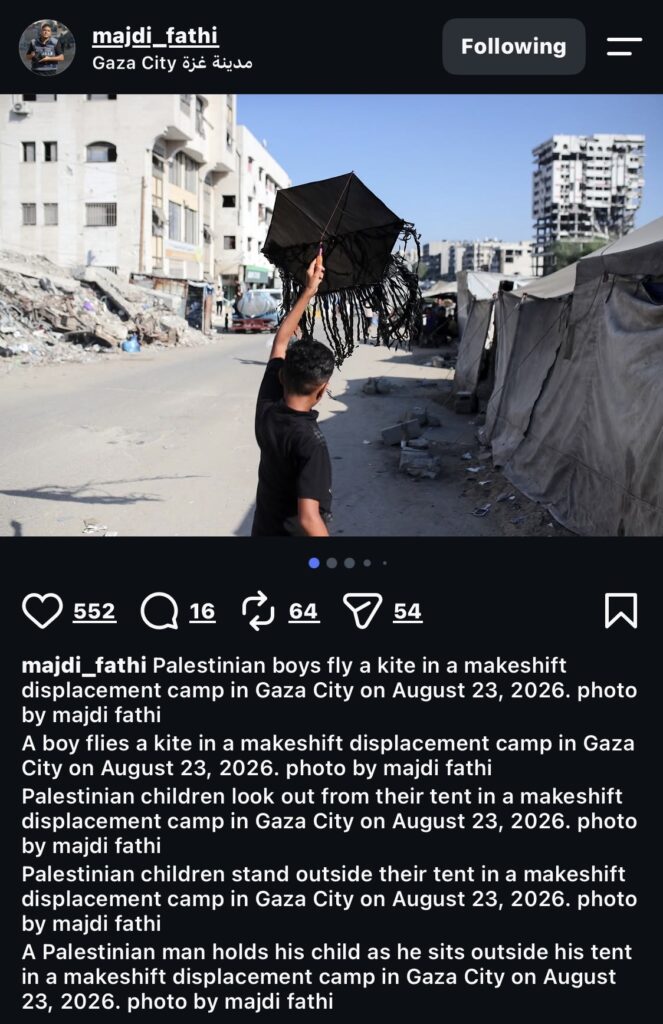
The staging turns a security claim about objects allegedly crossing into Israel into an entirely different visual proposition: Palestinian children playing with harmless kites amid Gaza’s destruction.
That is staged propaganda.
The Agencies Join In
The narrative did not remain inside Palestinian social media. It entered the international photographic distribution system.
AP/Cover Images produced its dedicated kite-making sequence on August 24. Fathi’s NurPhoto photographs circulated through Getty Images and appeared on Reuters Connect. Across the picture feeds, editors were supplied with professionally produced variations on the same combination of children, displacement and recreational kites.
Then Anadolu made the political connection explicit.
Its August 24 coverage, photographed by Ahmad Hasaballah, showed Gaza artist Ahmed Al-Halabi painting a child flying a kite against a bright blue sky. Children stand beside the artist while displacement tents and the surrounding Gaza landscape establish the setting.
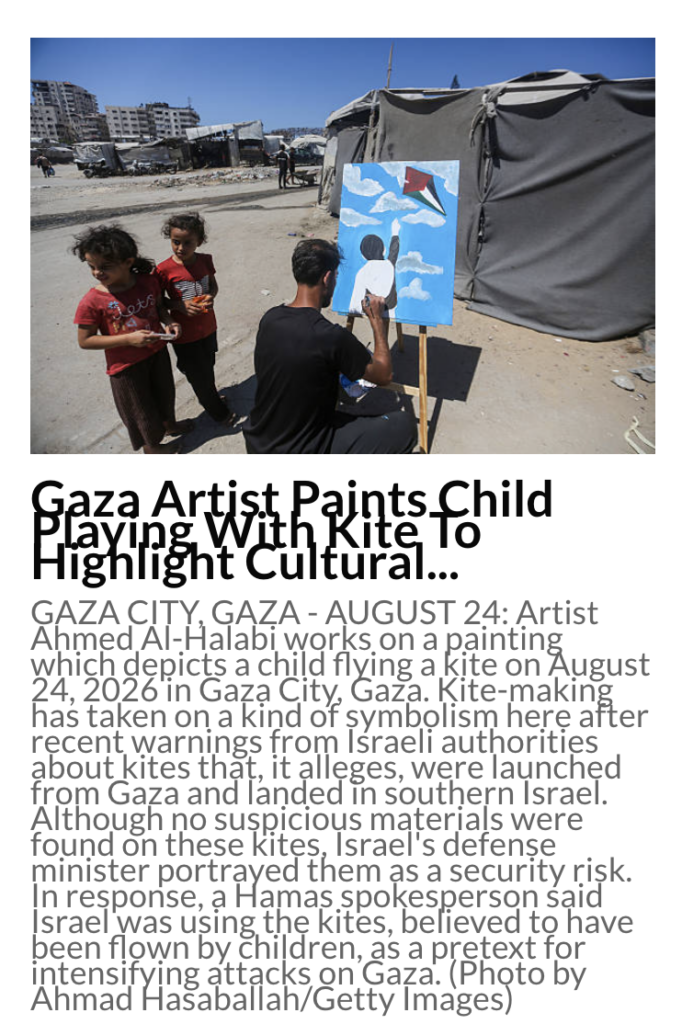
The accompanying Getty Images caption explained that kite-making had acquired “a kind of symbolism” following Israeli warnings about kites allegedly launched from Gaza toward southern Israel. It emphasized that “no suspicious materials were found on these kites” and quoted a Hamas spokesman accusing Israel of using the issue as a pretext for intensifying attacks on Gaza.
But “these kites” are precisely the problem with the comparison.
The security allegation was not that every kite in Gaza was a weapon, nor that Palestinian children could no longer fly ordinary kites. The issue was whether particular kites entering Israeli territory represented a threat.
Photographing harmless recreational kites inside Gaza and observing that nothing dangerous was attached to them does not answer that question.
It replaces it.
When the Child Becomes the Argument
Photography makes that substitution particularly effective.
A child flying a kite carries an immediate association with innocence and play. Photograph that child among rubble, damaged buildings and displacement tents and the emotional meaning changes again. Insert those pictures into a news cycle concerning Israeli warnings about potentially dangerous kites and a security question has been transformed into a visual story about Palestinian childhood.
But the photographs establish only that Palestinian children fly recreational kites. They cannot establish whether other kites or airborne objects were deliberately sent toward Israeli territory or whether those objects represented a threat.
The historical record makes the distinction particularly difficult to ignore. During the 2018 Gaza border violence, incendiary kites and balloons launched from Gaza crossed into Israel and started fires across agricultural land and nature reserves.
An ordinary kite being flown by a Palestinian child is not the same thing as an incendiary kite or another airborne object deliberately sent across a hostile border.
The two share a name. They do not share a function.
Yet within an extraordinarily compressed period, professional photographic platforms had produced and distributed variations of essentially the same visual proposition. The innocent Palestinian child and his recreational kite became the international visual answer to Israel’s security claim.
The Picture Was the Message
None of this requires claiming that the children were not really flying kites. They were. Nor does it require disputing the destruction visible behind them.
The staging lies in how those real elements were brought together and turned into a political visual narrative: the child, the recreational kite, the rubble and the Israeli security warning.
Once produced, international agencies supplied the distribution infrastructure capable of carrying that narrative far beyond Gaza.
Visual propaganda does not require a fake photograph. Real subjects, genuine destruction and authentic objects can be assembled and contextualized to communicate a message that none of those elements independently establishes.
Here, we can see that process developing from the Palestinian video productions through the photographic staging and into the professional international picture feeds.
Israel raised a security concern about particular kites or airborne objects entering its territory. International audiences were instead presented with Palestinian children flying harmless recreational kites against the ruins of Gaza.
Those were never the same kites.
Liked this article? Follow HonestReporting on Twitter, Facebook, Instagram and TikTok to see even more posts and videos debunking news bias and smears, as well as other content explaining what’s really going on in Israel and the region. Get updates direct to your phone. Join our WhatsApp and Telegram channels!
© Divuach Ne’eman R”A, 2025