Key Takeaways:
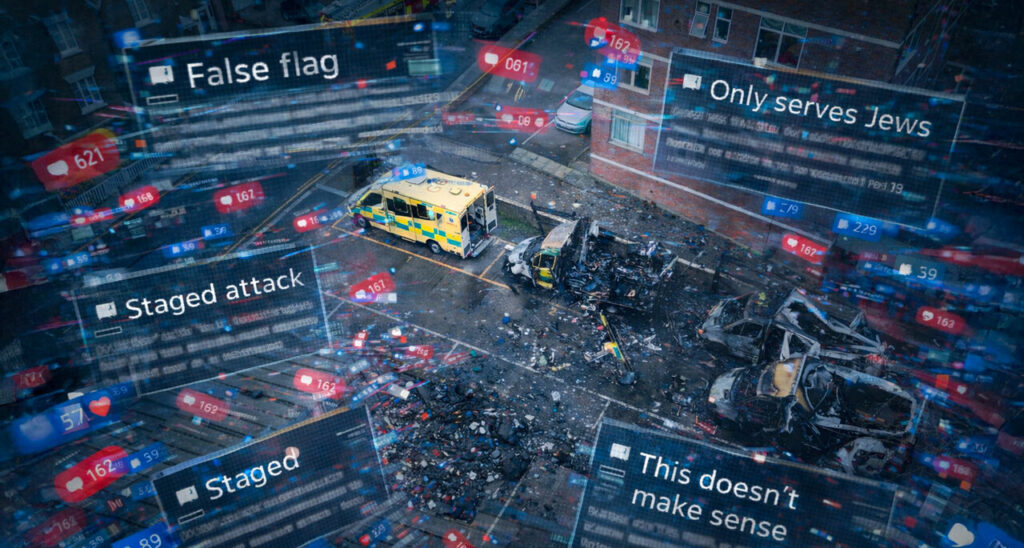
- From clarity to conspiracy: A clear act of anti-Jewish violence was immediately distorted into “false flag” claims, reflecting a recurring refusal to recognize Jews as victims.
- Isolation as justification: The claim that Hatzola “only serves Jews” reframes Jewish communal care as exclusion, making it easier to minimize or rationalize violence against Jews.
- Deflection erases the event: The rapid pivot to Israel shifts focus away from the attack itself, turning Jewish civilians into proxies and allowing the violence to disappear into a broader political narrative.
The attack on the Hatzola ambulances in Golders Green should have been a moment of clarity. Four emergency vehicles targeted in a terror attack. It is difficult to imagine a more unambiguous violation of basic civic norms. And yet, almost immediately, the response revealed something deeper and more troubling about the current moment. Instead of recognition, there was distortion. Instead of solidarity, there was suspicion.
From Victims to Suspects
Within hours, conspiracy theories began to circulate. Claims that the attack was a “false flag.” Assertions that it had been staged. One widely shared post declared: “The false flag is a classic Zionist tactic.” This was not fringe in the sense of being invisible. It was part of a recognizable pattern, one that emerges with striking consistency whenever Jews are the victims.
If someone’s reaction to the burning of four Hatzola ambulances in London is to blame Jews/Zionists/Israel for a ‘false flag’, they are an antisemite. There’s really no other reason or explanation. Quite handy for them all to expose themselves in one go tbh.
— Dave Rich (@daverich1) March 24, 2026
Alongside this came a different but related claim: that Hatzola ambulances “only serve Jews,” and therefore should not be understood as part of the public emergency infrastructure. The implication was clear. If Jews are seen as serving only themselves, then violence against them can be reframed as something less than an attack on society as a whole, and perhaps it is even justified.
This was stated explicitly. One widely shared post by Dr. Rahmeh Aladwan claimed: “Jews are the only group who operate their own ambulances (hatzola)… In the US, Hatzola has been accused of tending to jews while non-jews have died… Why the apartheid?”
Hatzola serves anyone in need. It operates within the broader emergency response system, providing care regardless of background or identity. The claim is not just inaccurate. It is part of the same pattern of isolating Jews from the societies they help sustain.
It shouldn’t need to be said. But Hatzola isn’t a Jewish volunteer organization only for Jews. It serves the local community, both Jewish and non-Jewish alike. Its primary motivation is to save lives.
By failing to make this clear, too many media outlets like @SkyNews are… https://t.co/5nYryhUk6f pic.twitter.com/DALJMOB4QS
— HonestReporting (@HonestReporting) March 23, 2026
Deflection and the Disappearance of the Event
What we are seeing here is not random. It reflects a deeper reflex. When Jews are targeted, the instinct in certain quarters is not to confront the hatred, but to reinterpret the event until it becomes something else. A provocation. A fabrication. This reflex exists alongside another: deflection.
As reports of the attack spread, many responses did not engage with what had happened at all. Instead, they pivoted immediately to Israel. Accusations of “genocide.” Claims about Gaza. Assertions that Israeli actions somehow contextualize, justify, or at least relativize violence against Jews elsewhere.
It takes a specific act of anti-Jewish violence in London and reframes it through a geopolitical lens thousands of miles away. The result is that the victims disappear. The attack itself becomes secondary. What matters instead is a narrative in which Jews are never simply civilians, never simply part of the societies in which they live, but always representatives of something else.
View this post on Instagram
An Environment Where Conspiracy Replaces Reality
This is what erasive Jew-hate looks like in practice. It does not always present as explicit hostility. Often, it operates through denial, distortion, and redirection. The event is questioned. The victims are redefined. The context is shifted until the original act is no longer visible in its own right.
The scale of this problem is not hypothetical. Last year, the UK recorded approximately 3,700 antisemitic incidents. That number alone should be enough to establish that anti-Jewish hostility is not marginal. And yet, even within that context, the same patterns repeat. Each new incident is treated not as further evidence of a problem, but as something to be explained away.
There is also a broader failure that cannot be ignored. The same media outlets that will now publish statements of solidarity, condemnations, and carefully worded concern must also examine their own role in shaping the environment in which this takes place. Narratives that consistently cast Jews, and particularly the Jewish state, as uniquely suspect, uniquely powerful, or uniquely culpable do not remain confined to the pages on which they are written. They filter outward. They shape how events are interpreted. They make it easier, not harder, for people to see ambulances attacked and reach for conspiracy before compassion.
Platitudes after the fact are not enough if the conditions that make those reactions possible remain unchallenged. This is why the response to the Golders Green attack matters. Because it shows that the issue is not only the act itself, but the environment in which it is received. A society in which ambulances can be targeted is already in difficulty. A society in which that attack is immediately reframed as a conspiracy is something else entirely.
Jew-hate is not a Jewish problem. It is not something Jews create, control, or resolve. It is a pathology that emerges from within the societies in which Jews live. And the response to moments like this tells us whether that society is willing to confront it. Right now, too many are not. Instead, we see the same patterns: conspiracy over clarity, deflection over responsibility, narrative over reality.
Four ambulances were set alight. That should be enough.
Liked this article? Follow HonestReporting on Twitter, Facebook, Instagram and TikTok to see even more posts and videos debunking news bias and smears, as well as other content explaining what’s really going on in Israel and the region. Get updates direct to your phone. Join our WhatsApp and Telegram channels!
© Divuach Ne’eman R”A, 2025