Key Takeaways:
- Erasure works by deletion, not just demonization. Jewish culture, history and identity are increasingly recast as though Jews were never part of them.
- Small acts form a larger pattern. Renamed foods, reassigned heritage, hidden Jewish symbols and erased maps all push Jewish presence out of view.
- The ultimate erasure is Jewish peoplehood itself. Denying Jewish indigeneity and historical experience makes Israel appear foreign and Jewish claims to culture and homeland illegitimate.
Somewhere in the past two years, the word “Israeli” started to disappear from menus. Israeli salad became a “chopped salad.” Israeli couscous turned into “pearl couscous.” In more than one place the change came after a complaint, or in expectation of one, the word quietly dropped so that nobody would have to think about where the food came from or who makes it. It is a small thing. A salad is a small thing. But that is exactly why it is worth looking at.
The salad is not really the point. The removal is the point, and the removal is happening in more than one place at once. It is happening on our plates, in our wardrobes, on the world’s maps, and in the record of where we have been. Every time, it is happening to the same people. Jews are being written out. Not argued with. Written out.
I have spent years describing a form of Jew-hate I call erasive Jew-hate. It is the anti-Jewishness that does not so much attack the Jew as delete him. Cultural erasure, the quiet vanishing of Jews and Israel from food and clothing and geography, is its most visible surface and its most deniable one. Each instance looks trivial. Taken together they are a pattern.
On the Plate
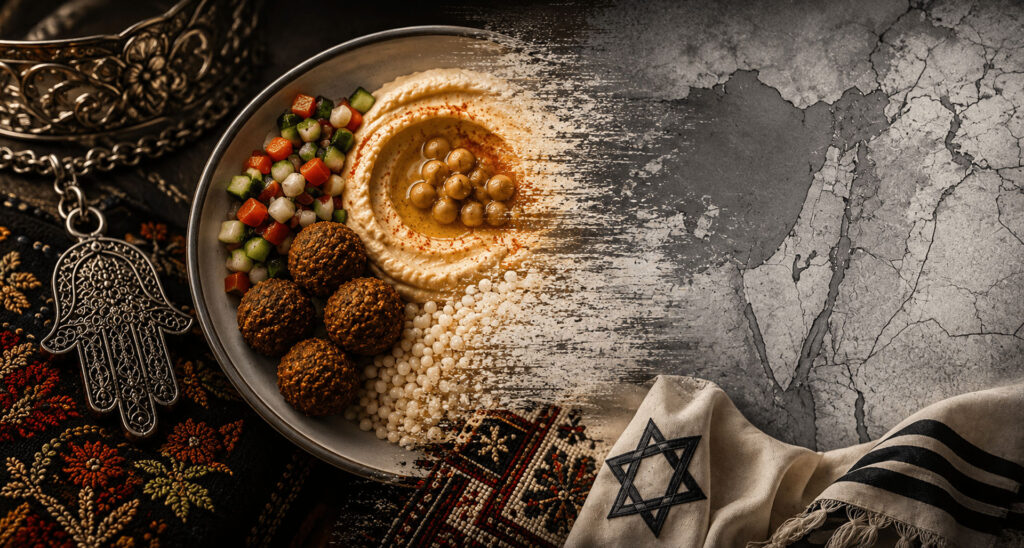
The cooking of Jews from the Middle East and North Africa, the Mizrahi and Sephardi families who lived across that region for well over a thousand years, is being recast as purely Arab or Palestinian, with the Jewish presence lifted out of it. Falafel, hummus, za’atar and kubbeh are declared authentically Palestinian and then declared stolen. Activist explainers state, flatly, that the very idea these foods could be Israeli is a “myth”, a fabrication invented to launder a theft.
The shape of the claim gives it away. It is not “this food is shared,” which would be both true and beautiful, since Jews and Arabs did live alongside one another and ate from the same pot. It is “this was never yours,” And the Jews who carried these recipes out of Baghdad and Sana’a and Cairo and Casablanca, as they were being driven from those cities with nothing else, are erased twice over. Once from the Arab lands that expelled them, and again from the plate those lands taught them to love.
What happened to those Jews is a matter of record. In the years around the founding of Israel, around 850,000 Jews were driven out of the Arab and Muslim world, from communities that predated Islam and in many places predated Christianity. They reached Israel and elsewhere with their prayers and their recipes, and very little else. The food now being reassigned to the countries that expelled them is, in many cases, the one possession those refugees were able to carry out. To call it stolen Palestinian property is to finish the expulsion by other means. First the Jew is removed from the country. Then the Jew is removed from the dish he cooked there. There is a theft in this story, but it runs in the opposite direction to the one being alleged.
This is not a disagreement about recipes. It is the denial of a people’s presence, served as a question of authenticity. A cuisine is one of the truest records a people keeps of where it has been. To say the Jews have no claim to the food of the lands they lived in for millennia is to say the Jews were never really there. That is the whole message, hidden inside a debate about chickpeas.
What We Wear
The same thing is done to what Jews have worn and made. Yemenite Jewish silverwork, the embroidery stitched by Jewish women across the Middle East and North Africa, the jewelry and the textiles that are part of a living Jewish heritage, get folded into a single generic “Arab” story with the Jewish thread pulled cleanly out. And when Israeli artists and designers draw on that regional inheritance, the one their own grandmothers stitched, they are accused of having stolen it.
The accusation assumes its own conclusion. It can only make sense if the region was never Jewish to begin with, if Jews are newcomers with nothing of their own, so that anything a Jew wears must by definition have been taken from its rightful owner. Strip away the assumption and the charge collapses. The heritage was always shared, because the peoples lived together. What is new is the insistence that only one of them may claim it.
There is a second erasure in clothing, and it is closer to the bone. This is internalized erasure: erasure by the wider world that the Jew is made to perform upon themself. Jews in London and New York now slip the Star of David under a collar before leaving the house, leave the kippah at home, or otherwise hide the sign that marks them as Jews, because to wear it in the open has become a serious risk. That is erasure too, and a very efficient kind. No law has to be passed. When a Jew removes the visible fact of their Jewishness in order to cross a city safely, the public square has been emptied of one more Jew, and it was the Jew who was made to do the emptying.
Both movements point the same way. In the first, the beautiful things Jews made are declared to have belonged to somebody else all along. In the second, Jews themselves cover over the sign of who they are. The heritage is claimed by others and the identity is hidden by its owners, and at the end of both roads there are fewer visible Jews in the world than there were.
Off The Map
The largest thing being erased is a whole country. Israel is being taken off the map, sometimes in the most literal sense available. A children’s reference work was found presenting the land as “Palestine” with Israel simply gone, and corrected the entries only after people objected. Maps in apps and in school textbooks show the territory between the river and the sea as a single space that is anything but Jewish, the Jewish state absent as though it had never been declared.
Running alongside the cartography is its cultural twin. Israeli films are pulled from festivals, Israeli writers are dropped from panels, Israeli musicians are disinvited from stages, the flag is handled as though it were too poisonous to be allowed in the room. None of this is a quarrel over a policy or a border. A border dispute argues about where the line should fall. This argues that the state on one side of the line should not appear at all. The aim is a world arranged so that the Jewish state is simply not there to be seen, and a generation raised on maps and reading lists in which it never was.
There is a war on the name itself, running underneath the war on the map. Israel becomes “the Zionist entity,” or simply a set of scare quotes placed around its own name, so that even in speech the country is held at arm’s length from the fact of its existence. A place people refuse to name is a place they are rehearsing not to recognize. The cartographer’s eraser and the careful vocabulary are doing one job from two directions.
A Name For It
These are not separate irritations to be filed away and forgotten. They are one phenomenon in different clothes, and the phenomenon has a logic worth naming. Classic Jew-hate says the Jew is wicked. Erasive Jew-hate says the Jew is not here and never was. It says he has no story of his own to tell. The first demonizes. The second deletes. It is often the quieter of the two, and for that reason it is frequently the more effective.
Erasive Jew-hate works, first, on our identity. It reduces Jewishness to a private faith, a matter of what happens inside a synagogue, and quietly strips away the deeper truth that Jews are a people, an Am (a nation), indigenous to a specific land, carrying a whole civilization that includes what we cook and what we wear. Once the peoplehood is gone, the rest follows without a fight. If Jews are only a religion, then the food belongs to whoever else lives there, and the homeland belongs to whoever else claims it. The Jew is left holding a theology and nothing more. I have written before that the reduction of Jewishness to religion alone is not a neutral misunderstanding. It is the ground on which every other erasure is built.
There is a further layer, and it is the one I have spent the most years on. Erasive Jew-hate denies that Jews are indigenous to the Land of Israel. It recasts a people returning to its ancestral home as a band of European colonizers with no prior claim, which requires writing off three thousand years of continuous Jewish presence and ignoring the eastern, brown-skinned, Arabic and Farsi speaking majority of the Jewish world. Deny the indigeneity and the food becomes loot and the return becomes an invasion. The Jewish state becomes a crime rather than a homecoming. Every renamed salad and redrawn map is a small down payment on that larger denial.
It works, second, on our experience. It waves away the millennia-long horror show Jews have been made to endure by the non-Jewish world. It insists that Jew-hate is not systemic, and that light-skinned Jews are simply privileged and so cannot really be victims. It empties the Shoah of its Jewish specificity so that the catastrophe can be handed to others or turned back against us. When Ruth Bader Ginsburg died, a great deal of the tribute to her managed to forget the Jewishness she herself said had shaped the person and the judge she became. When a Mizrahi family’s expulsion from an Arab country goes unmentioned, decade after decade, their experience is being quietly deleted to keep a simpler story clean. This is erasure of memory, and memory is where a people lives.
Who is allowed a history of suffering, and who is not? The Jew is told, in almost the same breath, that he is too powerful to be a victim and that his particular catastrophe was not really about him. Both halves do the same work. They take the one people whose modern history is defined by a genocide committed against it and quietly move that people into the column of the comfortable, where its pain stops counting and its fears can be waved off as hysteria. That is not an argument about Jews. It is the removal of Jews from the moral category of those to whom something was done.
The Small Thing
A renamed salad is where the method can be watched with its guard down. Few would be scandalized by the claim that changing “Israeli couscous” to “pearl couscous”, and the people making the change are counting on precisely that. The erasure advances because each single instance is small enough to laugh off. A word gone from a menu. A caption that reassigns a dish. A map “corrected.” A designer accused. A necklace tucked away. Each one, on its own, deniable. Placed end to end, however, and it is a people being shown the door.
First the word “Israeli” leaves the menu. Then the country leaves the map. These are the same argument at different scales, and the argument is that Jews were never really here and have nothing that is truly theirs. The distance between those two removals is a great deal shorter than it is meant to look.
A people is rarely erased in one stroke. It is erased in increments small enough that each of them can be called reasonable, until one morning the whole is gone and no single person can be said to have done it. That is the danger hidden in the trivial. It was never trivial.
Liked this article? Follow HonestReporting on Twitter, Facebook, Instagram and TikTok to see even more posts and videos debunking news bias and smears, as well as other content explaining what’s really going on in Israel and the region. Get updates direct to your phone. Join our WhatsApp and Telegram channels!
© Divuach Ne’eman R”A, 2025