Key Takeaways:
- Social media framed Israel blocking a cardinal from entering the Holy Sepulchre church as persecution, ignoring the security context.
- The eventual agreement with the Church and the cardinal’s own measured response received far less attention than the initial outrage.
- The episode shows how quickly viral narratives take hold when complex realities are reduced to a single image.
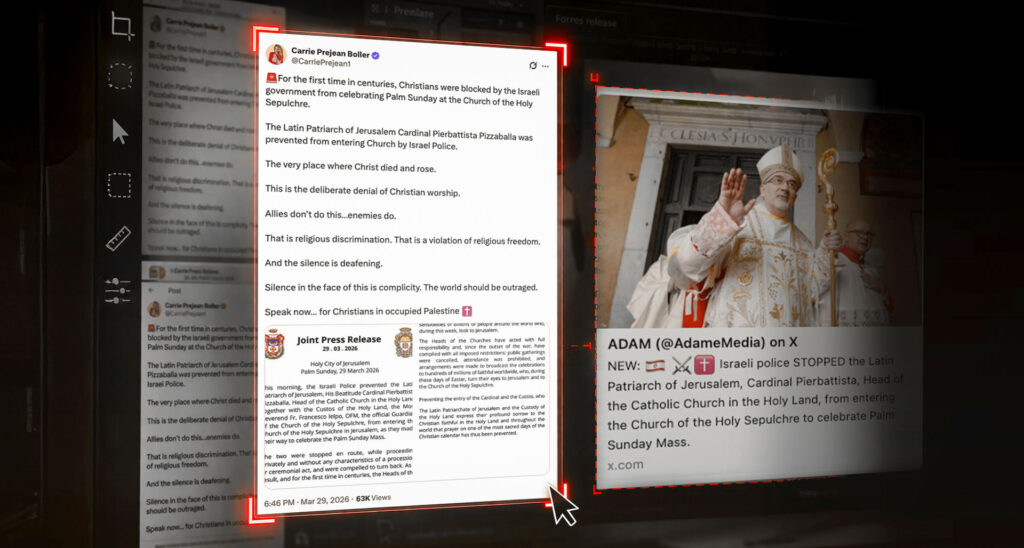
News that Israeli police had blocked Latin Patriarch Cardinal Pierbattista Pizzaballa from entering the Church of the Holy Sepulchre in Jerusalem on Palm Sunday spread rapidly across social media this week. The reaction was swift and severe, with Israel accused of restricting Christian worship and violating religious freedom at one of Christianity’s holiest sites.
But much of the outrage was missing key facts.
Israeli police, along with the prime minister and president, said the measures were driven by security concerns at Jerusalem’s holy sites during wartime. With Iranian missile fire ongoing and fragments already landing near religious locations, authorities cited the risk of mass casualties in an area with limited shelter and difficult emergency access.
The decision, they said, was about protecting both the cardinal and worshippers.
What was also largely overlooked is that the situation was quickly resolved. Following coordination between Israeli authorities and the Catholic Patriarchate, an agreement was reached allowing prayer under agreed limitations, and access was restored.
There is room to criticize what was, at best, a clumsily handled situation that should have been resolved before escalating publicly. But there was no evidence of malice — only an attempt to enforce safety regulations under wartime conditions.
That context, however, was almost entirely absent from the viral narrative.
Pro-Palestinian accounts on X portrayed the incident as a deliberate act against Christians. Some framed it as persecution; others as proof of systematic religious discrimination.
One widely shared post by Quds News Network claimed Israel had prevented the cardinal from entering the church with no reason given, omitting any reference to security measures or crowd control, and reinforcing the perception of deliberate obstruction.
Israeli police just prevented Roman Catholic cardinal Pierbattista Pizzaballa from entering the Church of the Holy Sepulchre in occupied Jerusalem to hold the Palm Sunday service, which marks the beginning of the Catholic Easter observances. pic.twitter.com/WNvcGsLfh5
— Quds News Network (@QudsNen) March 29, 2026
In another post, Palestinian writer Mosab Abu Toha — previously criticized for disparaging Israeli hostages in Gaza — cast the incident as part of a broader pattern of restrictions on worship, again without mentioning the security rationale cited by Israeli authorities.
Israel is preventing Christians from celebrating one of the holiest days in Christianity for the first time in centuries.
Israel must realize that Jerusalem is not its city to decide who enters or leaves.
Al-Aqsa Mosque has been closed to Muslims for over a month, particularly… pic.twitter.com/m4CzE9V2YN
— Mosab Abu Toha (@MosabAbuToha) March 29, 2026
Susan Abulhawa went further, using the incident to promote inflammatory rhetoric about “parasitic Jewish supremacists,” falsely claiming that Jews were granted unrestricted access while Christians and Muslims were barred.
Israel closed the holiest sites to Muslims and Christians, but they’re allowing parasitic Jewish supremacists into the compounds to defile these sites.
Israel must be destroyed for humanity’s sake. https://t.co/PQn46UZ4Qd— susan abulhawa | سوزان ابو الهوى (@susanabulhawa) March 29, 2026
Other commentators, including Ethan Levins, Carrie Prejean, and longtime Israel critic Mehdi Hasan, echoed similar claims — all reinforcing the same stripped-down narrative: denial of access, devoid of context.
?For the first time in centuries, Christians were blocked by the Israeli government from celebrating Palm Sunday at the Church of the Holy Sepulchre.
The Latin Patriarch of Jerusalem Cardinal Pierbattista Pizzaballa was prevented from entering Church by Israel Police.
The… pic.twitter.com/UJAyUg0Nqw
— Carrie Prejean Boller (@CarriePrejean1) March 29, 2026
?Israeli police STOPPED Sunday mass for Palm Sunday.
Israel is the enemy of Christianity. https://t.co/2F1ubfqWaW
— Ethan Levins ?? (@EthanLevins2) March 29, 2026
Missing from much of the online reaction was the perspective of Cardinal Pizzaballa himself. He stated that he was treated with politeness and emphasized the importance of respectful dialogue moving forward.
Cardinal Pizzaballa: “It is true that the police had said that the orders from the internal command prevented any kind of gathering in places where there is no shelter, but we had not asked for anything public, just a brief and small private ceremony to preserve the idea of the… https://t.co/uGNwus8RAw
— Rich Raho (@RichRaho) March 29, 2026
In reality, Israel faced a difficult choice: allow unrestricted access during Holy Week amid an active war and credible security threats, or impose temporary limitations and face international backlash.
Either option carried consequences. Had a mass casualty event occurred, the criticism would likely have been far more severe.
This is the nature of a lose-lose scenario.
Events in Jerusalem, particularly around religious sites, do not unfold in a vacuum. They are shaped by security realities, historical sensitivities, and the challenge of balancing competing religious claims.
Reducing such incidents to a single viral image strips away that complexity.
The Palm Sunday episode is a case study in how quickly a misleading narrative can take hold when context is omitted, and how rarely subsequent clarifications receive the same attention as the initial outrage.
In the end, the situation was resolved not through outrage, but through dialogue.
That, too, is part of the story.
Liked this article? Follow HonestReporting on Twitter, Facebook, Instagram and TikTok to see even more posts and videos debunking news bias and smears, as well as other content explaining what’s really going on in Israel and the region. Get updates direct to your phone. Join our WhatsApp and Telegram channels!
© Divuach Ne’eman R”A, 2025