Key Takeaways:
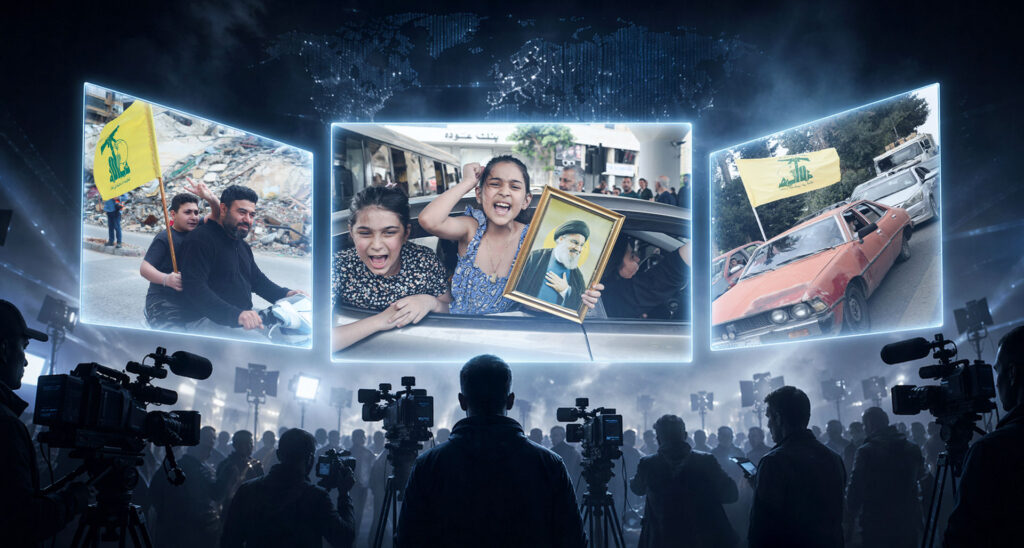
- When international outlets present videos and photos of Lebanese families returning to their homes in the south, they are often accompanied by Hezbollah flags, posters, and paraphernalia.
- These visuals display the extent to which Hezbollah has embedded itself in society. But the media do not provide any context as to what a Hezbollah stronghold means and why these families are holding Hezbollah paraphernalia.
- When the reporting omits vital context, it obscures the nature of the war Israel is fighting in southern Lebanon and the need to secure its border region.
As the 10-day ceasefire between Israel and Hezbollah took effect, thousands of Lebanese began returning to their villages in the south. Despite Israeli military warnings not to return to areas south of the Litani River, roads quickly filled with displaced civilians heading home.
But this was not just a story of return.
Alongside the crowds came a flood of Hezbollah flags, paraphernalia, and posters of “martyrs,” including former leader Hassan Nasrallah — unmistakable symbols of the terror group’s entrenched presence.
Yet much of the international media simply looked away.
CNN, via Reuters, broadcast footage framed as a heartwarming homecoming. But in the 45-second clip, Hezbollah propaganda saturates nearly every frame — flags, posters, symbols — all left entirely unmentioned in both the video and accompanying text.
1/
Let’s play a game.Watch @CNN’s footage via Reuters of what’s framed as cheerful, heartwarming scenes of displaced Lebanese returning home in the south… and look closely at what fills the frame. pic.twitter.com/9jPQONwI5Q
— HonestReporting (@HonestReporting) April 21, 2026
The same pattern repeated across outlets, including BBC, The Guardian, NBC, and The Washington Post. Images of returning residents were presented without context — stripped of the very details that explain the reality on the ground.
But visuals are not neutral. They reveal who controls the space, what narratives dominate, and how power is exercised. When media outlets omit that context, they don’t simplify the story — they distort it.
2/
See it? Hezbollah flags everywhere, huge posters of its leaders and “martyrs.”Yet the reports almost never mention what their own cameras are showing. If outlets like @CNN, @NBCNews, @BBCNews, @washingtonpost, @gaurdian want to use these images, fine – but they owe their… pic.twitter.com/B5UYoNirN6
— HonestReporting (@HonestReporting) April 21, 2026
This failure is even more glaring in environments shaped by terrorist control. As previously documented, Hezbollah influences the conditions under which journalists can operate. That reality makes context not optional, but essential.
Yet The New York Times also glossed over the visible Hezbollah presence, failing to connect the imagery to the group’s dominance in the area.
The absolute state of @nytimes. Their own footage shows “displaced” Lebanese rushing south waving Hezbollah & Nasrallah flags.
Last image even acknowledges the flags – yet says NOTHING about a designated terror group being openly celebrated in supposedly civilian convoy. pic.twitter.com/lI2iOEZLjH
— HonestReporting (@HonestReporting) April 17, 2026
Even the most basic implications are ignored. Hezbollah flags waved by children, posters glorifying militants, and the normalization of terror symbolism are all treated as irrelevant or simply invisible along with Hezbollah’s use of human shields.
This is not an oversight. It is a narrative choice.
By stripping away the context of Hezbollah’s presence, coverage presents Israeli actions as arbitrary and disproportionate, rather than responses to an entrenched terrorist infrastructure embedded within civilian areas.
None of this denies that civilians live in southern Lebanon. But portraying these communities without acknowledging the environment in which they exist produces a fundamentally incomplete picture.
Media outlets frequently refer to “Hezbollah strongholds.” But without explaining what that means, the term becomes hollow.
A stronghold is not just an area of support. It is a space where Hezbollah exerts control across civilian, social, economic, and military life, embedding itself within everyday infrastructure and blurring the line between civilian and combatant environments.
Since the 1979 Islamic Revolution, Iran has worked to export its ideology to Lebanon, building Hezbollah into a powerful proxy force. The group has systematically undermined Lebanon’s state institutions while entrenching itself deeply in the south and Beirut’s suburbs.
That is the reality viewers are not being shown.
Because visuals without context don’t clarify the story — they conceal it.
Liked this article? Follow HonestReporting on Twitter, Facebook, Instagram and TikTok to see even more posts and videos debunking news bias and smears, as well as other content explaining what’s really going on in Israel and the region. Get updates direct to your phone. Join our WhatsApp and Telegram channels!
© Divuach Ne’eman R”A, 2025