Key Takeaways:
- The Guardian’s coverage on Israel is consistently one-sided, but this week showed there is an explicit, repeatable pattern in biased and inaccurate coverage.
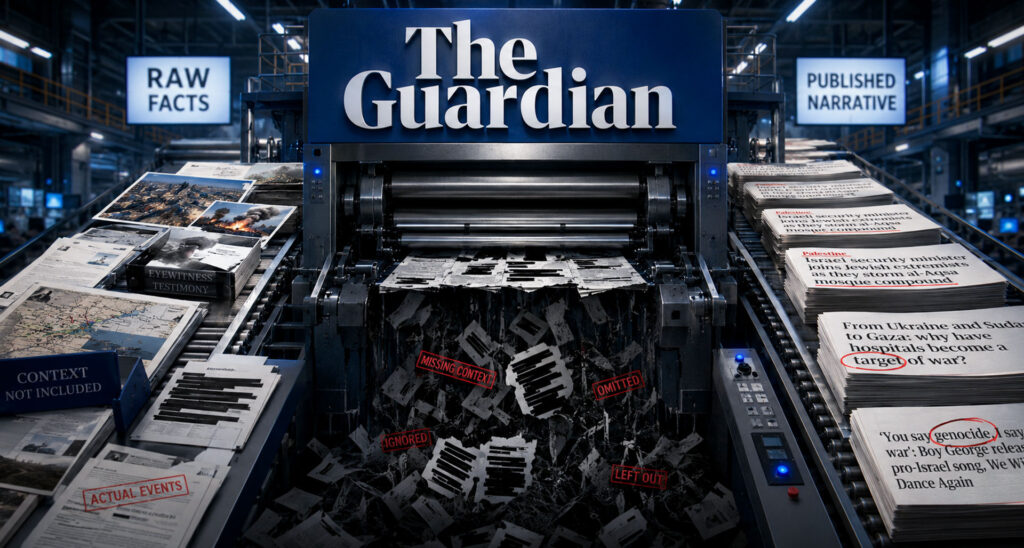
- Across different topics, The Guardian consistently omits the information that would complicate its narrative.
- When a media outlet lets its reporting serve an agenda rather than the facts, accuracy becomes secondary, and journalism fails to meet its fundamental purpose.
The Guardian is not known to be the biggest supporter of Israel. Often, that bias shows up as an overarching tone. But there are some weeks when that pattern is impossible to ignore as its coverage diverges from its own editorial code of accurate and objective reporting, and starts publishing articles with a clear agenda.
This past week emphasized exactly that agenda.
The Guardian’s reporting on Tisha B’av, the saddest day in the Jewish year, marked the start of the week of poor reporting. Tisha B’av recognizes the destruction of the First and Second Temples, among other tragedies that befell the Jewish people on that day.
Yet none of that background would be known to readers. Instead, The Guardian took a page out of the notebook of Palestinian and Islamic outlets by referring to Jewish mourners who ascended to the Temple Mount as “extremists” who “stormed Jerusalem’s most sensitive holy site.” By phrasing peaceful visits to the holiest site for the Jewish people as an act of aggression, The Guardian creates a false narrative of a threat to a holy site, despite there being none.
It is not only the narrative on the Temple Mount that The Guardian got wrong. The Guardian has been one of the proponents of the claim that Israel intentionally caused a “famine” in the Gaza Strip. But its own reporting now contradicts that very narrative. The Famine Review Committee of the Integrated Food Security Phase Classification (IPC) revised its metrices for famine so that its famine report would affirm that conditions were “met” in the Gaza Strip. Despite famine claims collapsing under any scrutiny, The Guardian has held on to this narrative, even when it publishes articles with photos of children who appear physically healthy.
That same editorial framing extends beyond news about the war and into pop culture stories. When British pop star Boy George released a song in support of Israel, The Guardian was quick to frame the song through the same anti-Israel lens, for it was incapable of publishing one story that acknowledged the cause of the war and the antisemitism that has since run rampant.
In Boy George’s song, he recognizes the massacre of October 7, specifically noting the hundreds of civilians murdered at the Nova Festival for merely wanting to dance. Rather than emphasizing the total number of casualties from that day, The Guardian chose to distinguish between civilians and security personnel at the Nova. Palestinian casualties from the war are not given the same differentiation, despite the fact that the casualty figures include terrorists.
Selective omission is The Guardian’s specialty. It is therefore not surprising that even the lyrics it chose to highlight from Boy George’s song were curated to tell the narrative that suits the outlet. By only highlighting a lyric rejecting the accusation of genocide, it implied that supporting Israel’s right to self-defense is equivalent to supporting war or defending genocide, even when the very claims of genocide are highly contested.
3/
— HonestReporting (@HonestReporting) July 28, 2026
Then there are the parts of the song The Guardian chooses to mute.
Boy George sings:
"Young girls raped against trees / Murdered brutally / For the crime of dancing."
Instead, readers get only:
"You say genocide, I say war."
The lyrics explaining why he stands with…
That pattern of intentionally twisting details of Israel’s war against a terrorist organization was executed again in an article on global attacks on healthcare.
Throughout the war against Hamas, there has been overwhelming evidence that Hamas and other terrorist organizations in Gaza have abused hospitals by storing weapons, building tunnels underneath the hospital infrastructure, holding command-and-control facilities within the compound, and holding hostages within them.
Now, as terrorist organizations release posters of their combatants killed in the war, more evidence has come to the surface of the extent to which civilian infrastructure and civilian positions, including posing as doctors, have been exploited for terrorism. This bolsters the case that the IDF did not indiscriminately attack the healthcare system, but specifically sought to root out terrorism in Gaza. Omitting this information purposefully misleads readers to assume healthcare was a primary target of the war.
4/
— HonestReporting (@HonestReporting) July 28, 2026
The same omission appears in The Guardian's graphic.
It reports raw totals of healthcare workers killed.
It doesn't distinguish doctors from Hamas operatives who also worked in Gaza's health system.
Without that distinction, the numbers tell only part of the story. pic.twitter.com/WTAUl9XZCx
Taken together, these pieces offer a glimpse of the editorial standards at The Guardian. When context is omitted for grave accusations and the truth is sidelined for a narrative, the very mission of journalism fails.
The Guardian didn’t misreport these stories by accident, four separate times, in one week. It created an environment in which an anti-Israel narrative takes precedence over all else.
Liked this article? Follow HonestReporting on Twitter, Facebook, Instagram and TikTok to see even more posts and videos debunking news bias and smears, as well as other content explaining what’s really going on in Israel and the region. Get updates direct to your phone. Join our WhatsApp and Telegram channels!
© Divuach Ne’eman R”A, 2025