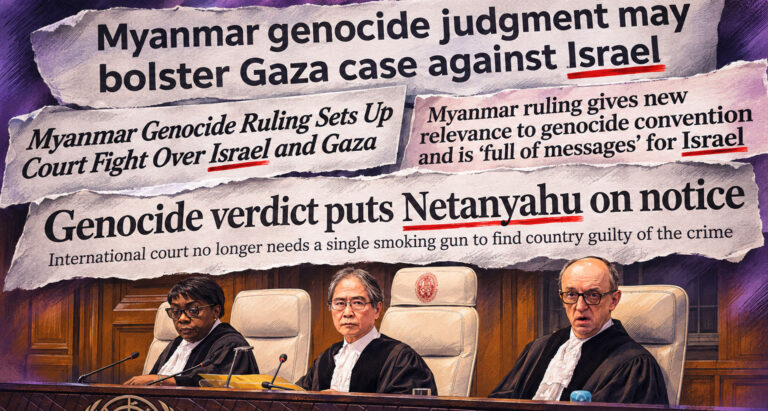
That’s the question now dominating coverage of the International Court of Justice’s landmark ruling.
But amid the rush to speculate about what the judgment means for South Africa’s case against Israel, something important is being overlooked.
The court did not formally lower the legal threshold for proving genocide. Yet six of its 15 judges warned that the majority’s approach risks weakening that threshold in practice.
And the implications could extend far beyond Israel.
By a nine-to-six majority, the ICJ found that Myanmar committed genocide against the Rohingya during military operations in 2016 and 2017.
Crucially, the court reaffirmed its longstanding requirement that when genocidal intent is inferred from a pattern of conduct, it must be the only reasonable inference that can be drawn from the evidence.
That is an exceptionally demanding legal standard, and one the court has previously applied in cases involving some of the worst atrocities in modern history.
In 2007, the ICJ recognized the Srebrenica genocide but did not find Serbia responsible for committing it.
In 2015, it rejected genocide allegations in Croatia v. Serbia, despite acknowledging serious atrocities, because the exceptionally high threshold for proving genocidal intent had not been met.
So what changed in the Myanmar ruling?
On paper, the legal definition of genocide remains unchanged.
But in their joint dissenting opinion, six judges argued that the majority had effectively broadened the concept of destruction required for genocide “through the backdoor,” blurring the distinction between genocide and other grave international crimes.
They also warned that the majority’s approach to evaluating evidence risked shifting the burden onto the accused state to demonstrate that another reasonable explanation existed.
In other words, the concern was not that the court had openly rewritten genocide law, but that it had effectively changed how that law is applied.
The dissenters did not deny the atrocities suffered by the Rohingya. Their objections concerned whether the specific intent required for genocide had been established to the demanding legal standard.
And here’s why the implications extend far beyond Myanmar or Israel.
Consider Russia.
Moscow has repeatedly invoked allegations of genocide in Ukraine’s Donbas region to justify its invasion. In December 2025, the ICJ admitted Russia’s counterclaims alleging genocide by Ukraine for consideration.
Could Moscow now attempt to invoke the Myanmar judgment’s approach to establishing genocidal intent?
Absolutely.
And Russia is hardly the only potential concern.
As Andrew Tucker of the Hague Initiative for International Co-operation warned in his November 19 analysis, the judgment’s reasoning could have serious consequences for NATO and other multinational forces conducting military operations against terrorist and insurgent groups.
Tucker highlighted the court’s position that compliance with international humanitarian law does not automatically exclude conduct from the scope of the Genocide Convention.
He warned: “This risks giving the ICJ an unwarranted power to micromanage armed conflict, including urban warfare against terrorists and other non-State armed groups.”
The concern is straightforward: if the dissenting judges are correct, a broader approach to inferring genocidal intent could be used against any state conducting such operations.
And that is precisely why the distinction between genocide and other serious violations of international law is critical.
Genocide requires the specific intent to destroy, in whole or in part, a protected group as such.
Those celebrating the Myanmar judgment because they believe it strengthens South Africa’s case against Israel should consider whether they would welcome the same legal reasoning if Russia sought to invoke it – or if it were invoked against NATO member states conducting counterterrorism operations.
Legal standards cannot be selectively loosened or tightened according to political convenience.
Liked this article? Follow HonestReporting on Twitter, Facebook, Instagram and TikTok to see even more posts and videos debunking news bias and smears, as well as other content explaining what’s really going on in Israel and the region. Get updates direct to your phone. Join our WhatsApp and Telegram channels!
© Divuach Ne’eman R”A, 2025