Key Takeaways:
- Contrasting treatment of Jewish and anti-Jewish authors reflects broader cultural exclusion. Jewish voices are presented as increasingly marginalized while anti-Jewish rhetoric receives institutional tolerance or support.
- Institutional decisions are portrayed as contributing to the erasure of Jewish belonging. Exclusion is described as occurring through publishing, bookselling, and wider cultural life rather than through explicit bans.
- Independent Jewish institutions are presented as the long-term response. Building Jewish publishing houses, festivals, and cultural platforms is proposed as a way to preserve and strengthen Jewish voices.
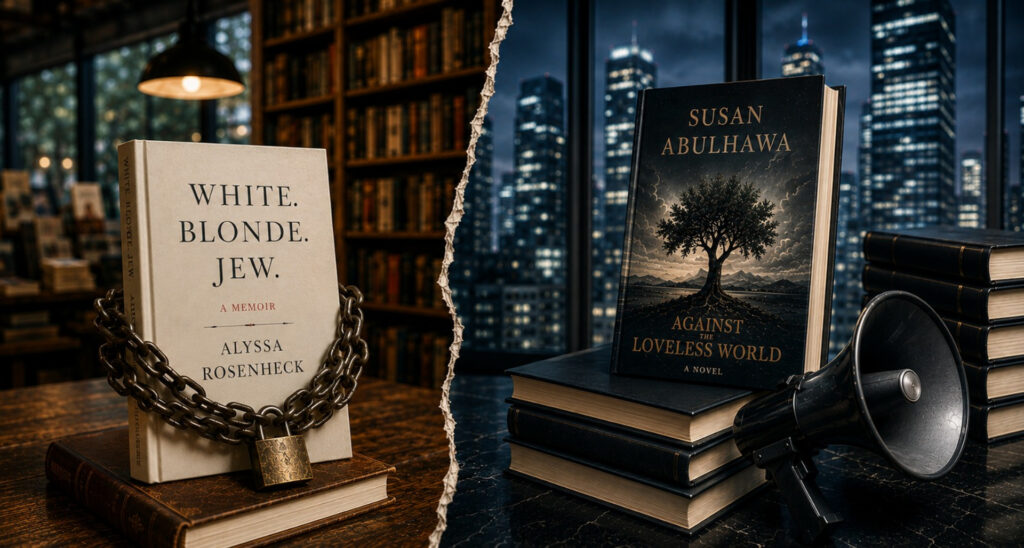
In Nashville, a bookshop called Bell Bird Books was due to host the launch of a memoir. The book is called White. Blonde. Jew. Its author, Alyssa Rosenheck, had written about her life as a Jewish woman. The launch was set for August 20. Then a campaign began online; activists accused the shop of promoting Zionism, and the event was canceled. The owner, Mary Ann Weprin, explained her reasoning plainly. Her concern, she said, was“whether my small neighborhood bookstore could responsibly host an event that appeared likely to require heightened security.” Rosenheck herself named it for what it was: bookshops that “cancel authors under pressure from activists,” she said, “are silencing speech and making a mockery of the First Amendment.”
The Other Author
At roughly the same time, Simon & Schuster, one of the largest publishers in the world, confirmed it would republish the backlist of the writer Susan Abulhawa. Her author page is live on their website. The publisher praises her work as“lyrical.” Her novels are being repackaged and pushed back out into the world with the full weight of a major house behind them.
Here is what that same house has decided it can live with. She writes, in her own posts, of “parasites.” She writes of“demons.” She has described the objects of her contempt as“Jewish supremacist zionist ghouls, vampires, parasites.” After the Mayor of New York, Zohran Mamdani, mildly distanced himself from her, she turned to American Jews as a class and called them“monsters,” “the most privileged demographic in this country,” and added that she did“not have a vocabulary that’s terrible enough to describe what they’re doing.”
Abulhawa is a Jew-hater. Parasites, vampires, ghouls, demons: this is the oldest vocabulary of Jew-hate, the imagery of the medieval blood libel and of the twentieth-century cartoon, dressed for 2026. It did not come from a fringe account with nine followers. It came from a woman a global publisher has chosen to celebrate.
So, let’s contrast these two situations. One author cannot be hosted in a shop because she is Jewish and it is deemed a security risk. The other author calls Jews demons and is handed a marketing budget. This is a single system, working exactly as it now works.
As a Jewish Author
I write this as a Jewish author. I have written three books about our people. I wrote about Jewish Pride as the answer to the shame the non-Jewish world keeps trying to hand us. I wrote about reclaiming our own story from those who would tell it for us. And I wrote about the Jews as an indigenous people, with the right every people has to name itself and speak for itself. That is the work of my life, and it is Jewish work, done openly and unapologetically as a Jew.

I am also a gay man, and I have spent much of my life thinking about what it means to carry more than one identity. So let me say clearly what I have watched happen to my own books. They have been largely ignored by the mainstream, non-Jewish world. Not attacked. Not argued with. Ignored.
And I have asked myself a question I would now put to you. Would that have been the case if my intersecting identities were not gay and Jewish, but gay and almost anything else? A gay author writing with pride about the indigeneity and dignity of another minority would find the world’s doors open to him. The festivals would want him. The review pages would find the room. It is the Jewish half of the sentence that closes them. The same progressive culture that taught me the word “pride” turns out to have no use for it once the people reclaiming it are mine.
This is not a suspicion I am reading into a silence. I was told, directly, by an editor at The Sunday Times that they do not publish Jewish stories unless those stories intersect with the wider population. That was not a fringe opinion shouted online. It was said to me plainly, by a gatekeeper at one of the most respected newspapers in the world.
So I do not write what follows from the outside, and I do not write it lightly. I know what it is to put a Jewish book into the world in this climate. I know what it is to be told that a Jewish voice is welcome only once it has apologized for itself. And I know precisely what these two decisions are built to do. They are built to make the open, unashamed Jewish author think twice.
The message a Jewish writer receives from these two decisions is not subtle. Your identity is a liability. Their hatred of you is a literary sensibility. When the mob comes for you, the institution will discover a sudden concern for security. When the mob loves the one who hates you, the institution will discover the word “lyrical.”
The Thread to Power
There is a detail here that people would call unbelievable in a novel. An essay by Abulhawa was illustrated by Rama Duwaji, the woman who is now the First Lady of New York, the wife of Mayor Zohran Mamdani. When it surfaced, Mamdani himself called Abulhawa’s rhetoric “reprehensible” and“patently unacceptable.” His wife, he said, had been commissioned as a freelance illustrator, had “never engaged with nor met” Abulhawa, and did not know her record.
But why was the work of a known racist sitting in front of the future First Lady of New York in the first place? Why did it reach a mainstream illustrator as ordinary, unremarkable, publishable material, and not as something radioactive that no serious artist would agree to touch?
The answer is that this is precisely what normalization looks like. Abulhawa’s hatred of Jews is not a secret she has to be caught confessing. It is published. It sits out in the open, in her own words, under her own name, for anyone who cares to read it. And still her work moves smoothly through the cultural bloodstream, illustrated here, anthologized there, until it comes to rest on the list of one of the largest publishers on earth. That is the machinery I want you to see. A woman calls Jews vampires and demons, and the people around her keep handing her their talent, their platforms, and their imprint, as though none of it counts.
A Wider Pattern
This does not begin or end with one shop or one publisher. It is the shape of a much larger phenomenon, and it reaches far past the world of books.
Across the non-Jewish world, Jewish and Israeli events are now routinely canceled, relocated, or quietly declined, and the reason offered is almost always the same. Security. The costume is always neutral. A venue cannot guarantee safety. An organizer cannot manage the risk. A shop cannot take on the burden. And what makes the reasoning so effective is that it never has to say the word “Jew” at all. The Jew is simply the person whose presence has become inconvenient, the event that is too much trouble to hold, the risk it is easier not to run.
We saw the publishing edge of this described plainly on The Honest Take with Meg Keene, in its episode “No One Wants a Jewish Protagonist,” which drew on a PEN America report documenting how Jewish and Israeli writers are being frozen out of the industry. PEN America is the oldest free-expression organization in the country. When it is the one raising the alarm about a blacklist, the problem is not a rumor. It is a finding.
I have written before that Jew-hate is the world’s most adaptive hatred. It survives by borrowing whatever language a society holds sacred and turning it against Jews. Once the accusation was deicide, and the sacred language was the Church. Then it was race, and the sacred language was biology. Now the sacred language is human rights and anti-colonialism, and the accusation is that the Jew is the coloniser, the supremacist, the oppressor who forfeits his place. The costume changes. The accusation does not. What we are watching in these bookshops is that same ancient move, wearing this decade’s clothes. A Jewish author becomes a “security concern.” An author who calls Jews parasites becomes a voice for the oppressed.
Erased From Belonging
Here I have to name the thing precisely, because naming it is half the work. What we are watching is not only prejudice, and it is not only exclusion. It is Erasive Jew-hate, the form of this hatred that does not argue with the Jew so much as remove us from the shared life of a society until it is almost as though we were never there.
Its third manifestation is Belonging. This is the stage at which Jews are erased not from a single event or a single shop, but from society itself, from the culture, the record, the common story a people tells about who is part of it. And that is why a publishing world which will not publish us matters far beyond the fortunes of any individual author. The fact that Jews cannot get published is a symbol of our erasure. Shut the Jewish writer out of the pages, the festivals, and the shelves, and you have begun to shut the Jew out of the culture itself. First the book disappears. Then, in the story a society tells about itself, so do we.
And publishing is only where I happen to see it most clearly, because publishing is my world. It is part of a far wider phenomenon. The same erasure is underway across public life, in the university and the gallery, the newsroom and the cultural institution, in every place where a society quietly decides who belongs inside its story and who can be edited out of it. The bookshop is not the whole of it. The bookshop is a symptom.
But there is one thing that is ours to do.
Build Our Own House
If the institutions of the non-Jewish world will host those who demonize us while turning away our authors, then we cannot keep waiting at their door for permission to exist in public. We have to build, fund, and defend our own. Our own presses, our own festivals, our own platforms, our own rooms where a Jewish writer can stand up and speak about a Jewish life without a shop deciding she is too dangerous to hold. This is not retreat. It is the oldest survival strategy our people have, and it is an act of pride, the flat refusal of the shame the world would so much prefer we felt. An indigenous people does not ask permission to tell its own story. When the world locks its doors, we have always built our own house.
And here is the irony. Simon & Schuster is named after two Jews. Richard Simon and Max Schuster founded that company in 1924, two Jewish men who did precisely what I am urging. They built their own institution in a country that did not always want them, and they turned it into one of the great publishing houses of the modern world.
A century later, the house those two Jews built looked at a writer who called their people demons, and called her lyrical. It has looked at the mob, and it has flinched.
We can flinch too, and grow quieter, and hope the security concerns land on someone else next time. Or we can do what Simon and Schuster once did, before their names became a logo detached from the people who bore them. We can build.
I know which one I choose.
Liked this article? Follow HonestReporting on Twitter, Facebook, Instagram and TikTok to see even more posts and videos debunking news bias and smears, as well as other content explaining what’s really going on in Israel and the region. Get updates direct to your phone. Join our WhatsApp and Telegram channels!
© Divuach Ne’eman R”A, 2025