Key Takeaways:
-
Turkish state propaganda in disguise: Anadolu Agency operates under President Recep Tayyip Erdoğan and consistently echoes Ankara’s pro-Hamas narrative while being treated in the West as neutral journalism.
-
Laundered through Western platforms: Anadolu content is distributed via Getty Images, Reuters Connect, and Agence France-Presse — entering global newsrooms stripped of context about its state-controlled origins and ideological bias.
-
Serious accountability gaps: From biased correspondents operating inside Israel to Gaza-based journalists who crossed into Israel on October 7 alongside Hamas terrorists, Anadolu’s footprint raises urgent questions about vetting, access, and Western media due diligence.
For much of the Western media ecosystem, Anadolu Agency is treated as just another international wire service: a source of breaking news, images, and video from the Middle East, routinely syndicated through major distribution platforms.
But Anadolu is not an independent news outlet. It is Turkey’s state-run news agency, operating under the authority of President Recep Tayyip Erdoğan’s government. And its coverage of Israel, Hamas, and regional conflicts repeatedly aligns with Ankara’s ideological agenda, including the sanitization of terrorist actors and the promotion of extremist narratives.
What makes this particularly concerning is not only Anadolu’s output, but the way it is laundered into Western newsrooms through partnerships and content-sharing arrangements with major platforms such as Getty Images, Reuters Connect, and AFP. Through these pipelines, Anadolu material enters global circulation stripped of political context, editorial scrutiny, or disclosure of origin.
At the same time, Anadolu journalists with a documented record of sharply anti-Israel bias operate inside Israel with official Israeli-provided credentials, while in Gaza, Anadolu photographers were among those who crossed into Israel alongside Hamas terrorists on October 7 — a dual reality that raises serious questions about vetting, access, and accountability.
This is not a marginal issue. It is a structural problem in how terrorism-linked narratives gain legitimacy in the international media system.
Ideological Mission, Western Distribution
Anadolu has long functioned as a mouthpiece for the Turkish government’s foreign policy priorities. Under Erdoğan, Turkey has openly hosted Hamas leaders, provided political backing to the group, and framed Hamas as a “resistance movement” rather than a terrorist organization.
That framing is mirrored in Anadolu’s reporting. Hamas figures are routinely quoted without challenge. Israeli military actions are framed through accusatory language. Terror attacks are contextualized or minimized, while Israeli responses are amplified as alleged war crimes.
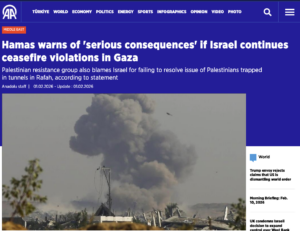
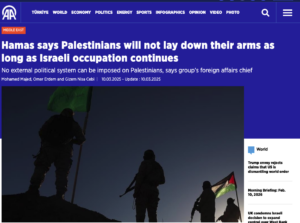
This pattern has been documented by HonestReporting, which has exposed Anadolu’s role in disseminating content sympathetic to jihadist ideology and hostile to Israel.
Despite this record, Anadolu content is distributed by some of the most influential Western media platforms.
Getty Images has featured Anadolu photographers whose social media activity included praise for jihadist violence and antisemitic rhetoric, without informing clients of that background. In another case, the global agency charged thousands of dollars for an October 7 video by an Anadolu journalist calling Jews “dogs.”
Reuters Connect — global media’s leading content distribution platform — has enabled Anadolu video and text to be licensed by newsrooms worldwide.
AFP has partnered with the Turkish media agency in ways that allow Anadolu-sourced material to flow into international coverage.
This matters because once Anadolu content appears on these platforms, it is no longer perceived as Turkish state media. It is perceived as neutral journalism.
These cases demonstrate how distribution platforms fail to conduct basic due diligence on contributors operating in terrorist-controlled environments.
In addition, one of Anadolu’s most effective tools is language.
Terrorists are “fighters.” Rocket fire is “resistance.” Israeli victims are statistics. Hamas infrastructure is “civilian.” This is not accidental phrasing. It mirrors Turkish government rhetoric and Hamas talking points, carefully calibrated for Western consumption.
For example, in an article titled “Hamas holds Israel responsible for any clashes with its fighters in Gaza’s Rafah,” Anadolu refers to the terror organization as the “Palestinian resistance group” and describes “its fighters” defending themselves in Rafah.
Another article, titled “Hamas to return remains of another Israeli soldier under Gaza ceasefire,” describes the soldier as captured by “Palestinian resistance fighters” in 2014, linking that term to Hamas’ military wing.
Once this language is redistributed by Getty, Reuters Connect, or AFP, it shapes headlines, captions, and public understanding far beyond Anadolu’s direct readership.
And this is how state propaganda becomes global news.
Anadolu’s Footprint in Israel and Gaza
Anadolu also maintains teams on the ground in Israel, the West Bank and Gaza.
In Israel, Anadolu journalists operate with official Government Press Office credentials, granting them access to press briefings, government sites, and conflict zones. Those credentials are issued on the assumption that journalists operate independently and in accordance with professional standards.
Yet Anadolu’s institutional alignment with a government that openly backs Hamas raises serious questions about whether such access is appropriate, and whether Israeli authorities and Western partners are adequately assessing the risks.
To make matters worse, according to a report by Israel’s Ministry of Diaspora Affairs and Combating Antisemitism, which has been compiling data on Anadolu’s activities and coverage, the agency’s journalists in Jerusalem are inherently biased.
The Ministry’s findings state that Anadolu’s Jerusalem correspondent, Enes Canli, is a reporter who does not publicly distinguish between Hamas and the broader Palestinian population in his coverage and often presents the conflict as a struggle against Israeli military actions and their impact on civilians, without providing broader context.
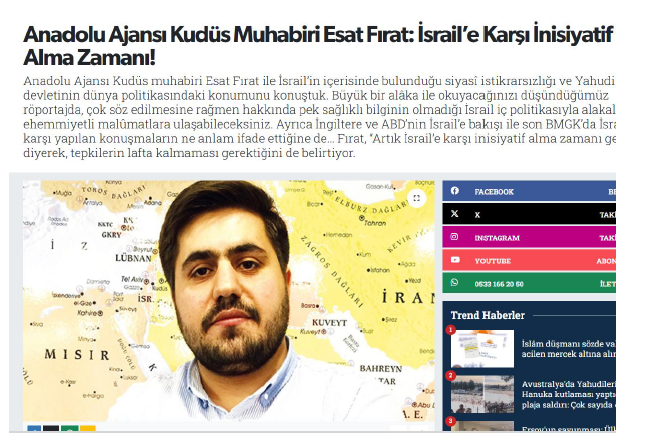
The Ministry also flagged an interview given to a Turkish newspaper by another Anadolu correspondent in Jerusalem, Esat Firat, titled: “Anadolu Agency correspondent in Jerusalem, Firat Esat: It’s time to take the initiative against Israel”. Hardly the comment of an objective journalist.
In Gaza, the concerns are even sharper.
On October 7, 2023, two Anadolu reporters from Gaza — Hani Alshaer and Abed Rahim Khatib — crossed into Israel alongside Hamas terrorists (together with multiple journalists working for Western outlets who were later exposed by HonestReporting.)
Another Gaza-based journalist working for Anadolu, Ali Jadallah, belongs to a well-known family with ties to Hamas and even received a commendation from Turkey’s president, Recep Tayyip Erdogan.
What is already clear is that Gaza-based media operations function under Hamas control. Journalists cannot operate independently without cooperation, coercion, or ideological alignment. When Anadolu employs Gaza-based staff, their reporting cannot be separated from that reality.
Accountability Gap
The problem is not that Anadolu exists. State media is not unique to Turkey.
The problem is that Western media networks see Anadolu on the platforms of Reuters, Getty Images, or AFP, without disclosure, scrutiny, or safeguards. Clients are rarely told they are licensing Turkish state media and that those behind the cameras are biased. Readers are rarely told whose narrative they are consuming.
Nor is there evidence that distribution partners systematically review Anadolu contributors for extremist ties, incitement, or terrorist affiliations.
This is an accountability vacuum.
At a minimum, Western media platforms must:
- Clearly label Anadolu content as Turkish state media
- Conduct rigorous vetting of Anadolu contributors operating in Gaza and other terrorist-controlled areas
- Review past material distributed under their platforms for ethical and legal exposure, as well as payments made to compromised Gaza personnel
- Explain to clients how propaganda safeguards are enforced
Without such steps, the current system incentivizes precisely what Hamas and its state allies seek: credibility through Western amplification.
Anadolu’s integration into the Western media ecosystem is not a technical oversight. It is a structural failure.
When a state-run agency aligned with a Hamas-supporting government gains seamless access to global distribution networks while also relying on biased teams on the ground, journalism is no longer informing audiences. It is being used.
Liked this article? Follow HonestReporting on Twitter, Facebook, Instagram and TikTok to see even more posts and videos debunking news bias and smears, as well as other content explaining what’s really going on in Israel and the region. Get updates direct to your phone. Join our WhatsApp and Telegram channels!
© Divuach Ne’eman R”A, 2025