



Key Takeaways:
-
CNN’s claim that women’s rights are sharply declining in Israel relies on a flawed global index that measures broad societal conditions – not uniquely women-specific rights – and heavily reflects Israel’s wartime security reality rather than legal or social regression.
-
The Index ranks Israel below countries like Saudi Arabia, Qatar, and Oman – all of which impose legally-embedded discrimination against women – creating a misleading comparison that CNN repeats without scrutiny.
-
CNN’s framing further distorts reality through selective imagery, incomplete context, and weak causal links – such as implying women’s political representation or increased gun ownership equate to systemic rollback of rights, while ignoring Israel’s ongoing war and its unique balance of Jewish and democratic legal frameworks.
-
While Israel, like every democracy, has challenges and debates around gender policy, the dystopian narrative CNN promotes is not reflected in Israeli society, where women continue to exercise wide-ranging rights and freedoms.
Israeli women are living in a dystopian reality where, year by year, they are being stripped of their most basic rights. At least, that’s what one would think from reading CNN’s “Women’s rights are on a sharp decline in Israel. Advocates blame Netanyahu’s far-right government.” But it is a far stretch from the truth.
Without reading a single sentence, the article frames Israel through a distorted lens of reality. Women wearing red gowns and a white hat lead the cover image of the article. It presents the context of the article as a nightmarish reality, where women are living in a version of Margaret Atwood’s “The Handmaid’s Tale.” But read the fine print, and you see that this image, taken nearly three years ago, concerned demonstrations against Israeli legal reforms, not the decline of women’s rights.
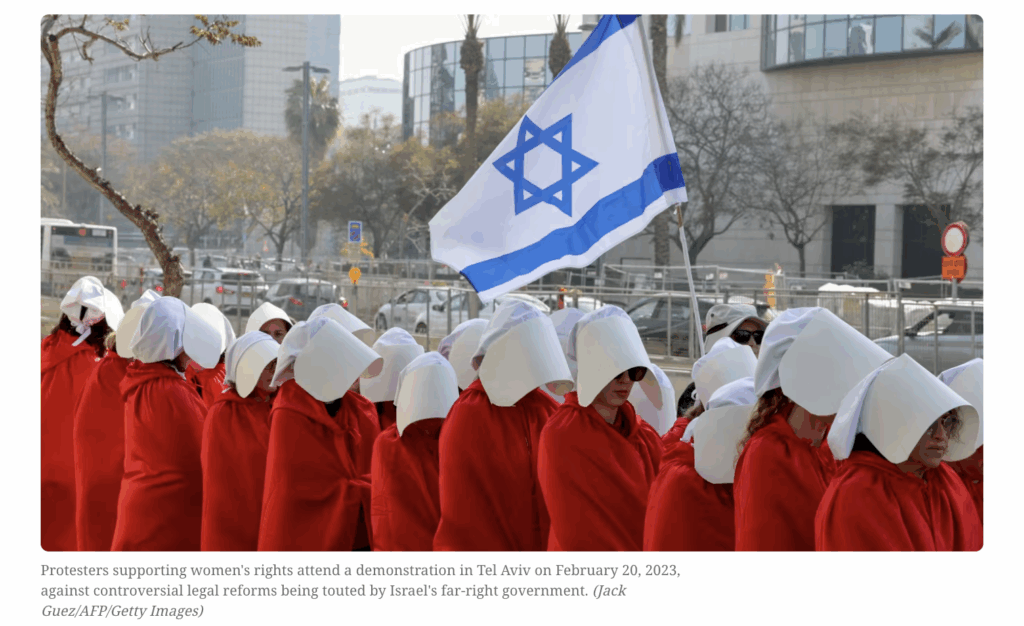
From there, the framing of the article is set. The continued distortion of women’s rights is not accidental but structural, rooted in how CNN selects imagery, language, and ultimately the data it relies on to construct its narrative.
Relying on a Faulty Index
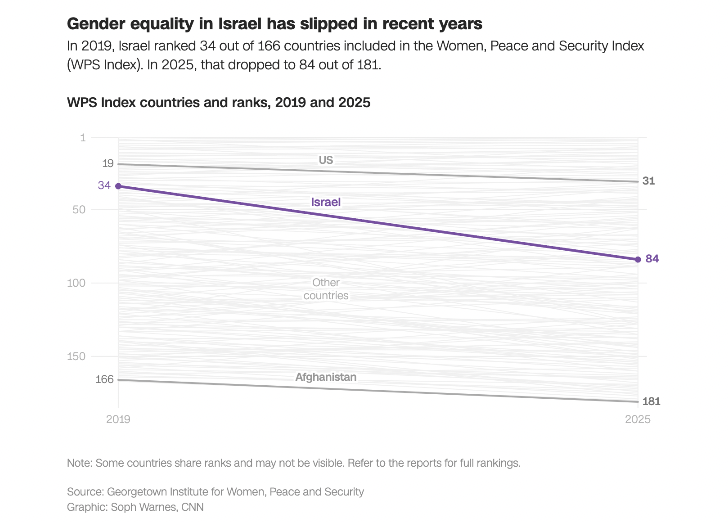
CNN’s article is based on data from the Women Peace and Security Index (WPS Index) by the Georgetown Institute for Women, Peace and Security. The index scores and ranks 181 countries on women’s wellbeing based on 13 indicators, including employment, education, and access to justice, cellphone use, son bias, and proximity to conflict. Taken together, these indicators are not uniquely gender-specific. Many reflect broader societal conditions that affect the entire population.
The findings declared that Israel ranked in 84th place, noting that in 2023, Israel ranked 27th. Remarkably, Israel is behind several countries that have extremely poor women’s rights. Oman ranked 58th, despite openly discriminating against women in terms of divorce and legal guardianship. Saudi Arabia ranked 63rd, though women require a male guardian, and Qatar ranked in 70th place, despite women requiring a guardian’s permission to leave the country, marry, or pursue higher education on a scholarship. There are several other countries with long-demonstrated records of laws that restrict women in several aspects of life. Israel is not one of them.
CNN originally published the article without mentioning that three years ago, Israel was not in the midst of a multi-front war after terrorist organizations attacked its sovereign borders. It since issued a correction and a one-line update, but it is remarkable that it was published without this crucial information in the first place, as this directly impacts the findings of the WPS Index, which encompasses many categories related to safety, terrorism, and conflict more broadly. Thus, even if there is a lack of change in other categories, the change in the security situation directly impacts the index.
In the WPS Index, Israel is compared to other developed countries such as the United Kingdom, Germany, and the U.S., further skewing the presentation of the results. Those countries are not contending with sustained warfare on multiple fronts. By contrast, Palestine – ranked 167 and unmentioned in the CNN article – is grouped with fragile states, including Yemen, Qatar, and Afghanistan. This asymmetrical framing by the WPS Index, which CNN adopts without scrutiny, creates a misleading comparison that exaggerates Israel’s decline.
Nonetheless, a graph created by CNN compares Israel to the U.S. and Afghanistan, which ranked 181. This visual representation further distorts the reality, as Afghanistan is not in the same group as either Israel or the U.S., and the U.S. is not in the middle of a war in proximity to its own territory.
Skewing the Reality
CNN additionally suggests that because there are currently fewer women in Israel’s parliament, this correlates to a lack of women’s rights. Of course, it would be nice to have more women’s representation, but the lack of representation does not imply malicious intent or systemic rollback. Women’s political representation fluctuates over time and varies across electoral cycles in every democracy. Many democratic countries face similar gaps. The U.S., for example, is only four percentage points ahead of Israel in this regard. Improving women’s representation is a challenge shared globally, not evidence of a uniquely Israeli failure.
Israel is, however, unique in that it is the world’s only Jewish state. That means it is the only state that also incorporates aspects of Jewish law, which inherently differ from Western secular norms. As such, rabbinical courts run by men have more power over Jewish family law than secular courts in Western states. While CNN presents this as an issue that sprouted during the past three years during this current government, there has been a consistent and ongoing debate in Israeli society about the extent to which religion can and should influence the law.
If CNN truly wanted to present this issue in a non-partisan manner, it would have interviewed both perspectives as well as judges from the courts. However, a heartbreaking story of one woman’s challenges with the court is presented as representative of the system as a whole – an approach that privileges emotional impact over balanced analysis.
CNN further jumps the gun on the conclusion that there is a link between the increase in gun ownership and femicide. Yet there is no data to suggest this connection exists. In reality, Israelis rushed to buy guns in the aftermath of October 7 as a measure to protect themselves, and with encouragement from the government. And, unlike the U.S., for example, stringent gun laws and licensing ensure that gun ownership remains limited to qualified individuals.
No, Israel is not a perfect country, and, like all democracies, it has areas that require ongoing debate and improvement. What makes Israel unique is that it navigates the challenge of being both a Jewish and democratic state, allowing its citizens to practice their rights within a legal framework shaped by centuries of tradition and modern law.
While CNN attempts to present a dystopian reality of what it means to be a woman living in Israel today, this is not reflected in Israeli society. Rather, Israeli women exercise their rights in an environment that strives to balance religious principles with democratic freedoms, even in the midst of a war.
Liked this article? Follow HonestReporting on Twitter, Facebook, Instagram and TikTok to see even more posts and videos debunking news bias and smears, as well as other content explaining what’s really going on in Israel and the region. Get updates direct to your phone. Join our WhatsApp and Telegram channels!