Key Takeaways:
-
Munther Isaac is routinely presented by international media as a moral Christian voice from Bethlehem, yet outlets omit that he publicly justified the October 7 Hamas massacre as an understandable response to Israeli actions rather than condemning it as terrorism.
-
Isaac’s sermons and writings explicitly contextualize and excuse the massacre, portraying Hamas violence as the inevitable result of Israel’s existence, Gaza’s “siege,” and decades of alleged oppression – framing civilian slaughter within a grievance narrative instead of rejecting it on moral grounds.
-
His role in activist groups is rarely disclosed, despite their promotion of antisemitic theology, boycotts of Israel, and narratives denying Jewish ties to the land – allowing media to elevate Isaac as a voice of conscience without transparency about his ideological commitments.
Every Christmas season, international media outlets return to the same familiar figure in Bethlehem: Munther Isaac. Introduced as a Lutheran pastor offering moral reflection from Jesus’ birthplace, Isaac is routinely quoted lamenting the impact of Israeli policy on Palestinian Christians.
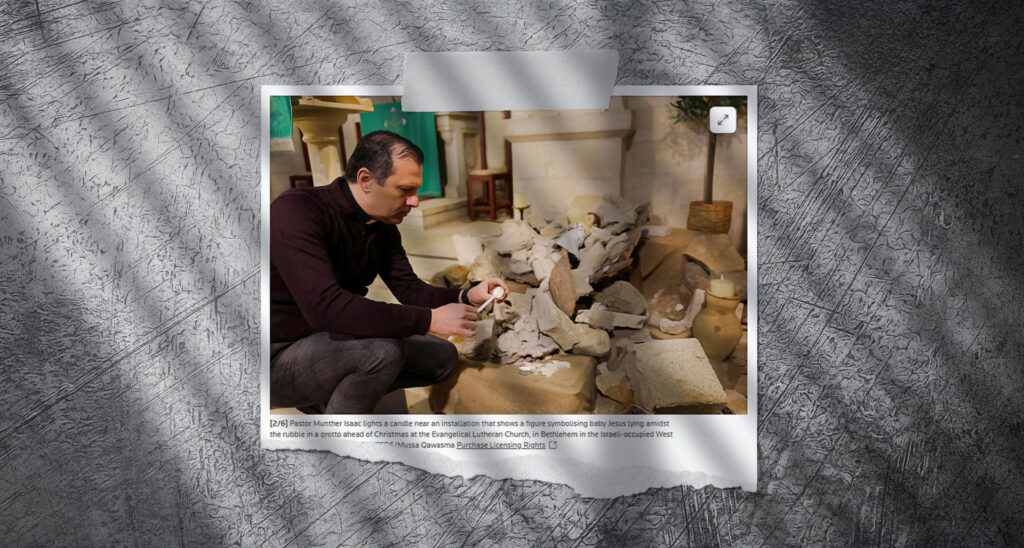
His voice, amplified by the widely circulated “Christ in the Rubble” image during the latest war in Gaza, is treated as authoritative, compassionate, and morally grounded.
And just like last year, Munther is pictured by @Reuters with a nativity scene set up by the Evangelical Lutheran Christmas Church in Bethlehem, which depicts a baby “Palestinian” Jesus draped in a keffiyeh and laying atop a pile of rubble. pic.twitter.com/uwFSZwmKsk
— HonestReporting (@HonestReporting) December 2, 2024
But what audiences are not told is that this same pastor publicly justified the October 7 Hamas massacre, framing it as a predictable and even understandable response to Israeli actions.
On October 8, 2023, one day after Hamas terrorists murdered more than 1,200 Israelis in southern Israel, Isaac delivered a sermon in which he described the attack not as terrorism but as a consequence of circumstance. Referring to Gaza’s so-called “siege,” he spoke admiringly of “the strength of the Palestinian man who defied his siege,” portraying the violence as an outgrowth of endurance rather than an atrocity.
According to media analyst Eitan Fischberger and Jewish Insider correspondent Lahav Harkov, who reported on the now-removed sermon, Isaac went on to contextualize the massacre within what he described as decades of injustice dating back to Israel’s establishment in 1948. In other words, the deliberate targeting of civilians was not condemned on its own terms but folded into a historical grievance narrative.
Here’s footage of him on October 8th justifying the massacre that had just taken place (footage courtesy of @JordanSchachtel).
You can find his full remarks online, but here’s a transcript of the relevant part:
“What is happening is an embodiment of the injustice that has… pic.twitter.com/ciAvI7RFi7
— Eitan Fischberger (@EFischberger) March 29, 2025
Isaac’s written work reinforces this worldview. In his book, published in March 2025, “Christ in the Rubble: Faith, the Bible, and the Genocide in Gaza” he explicitly rejects separating October 7 from the broader political context. “We cannot talk about the war on Gaza, or October 7, without addressing the siege on Gaza that started sixteen years before October 2023 and the multiple wars waged on Gaza during that period,” he writes. Elsewhere, he insists that “if the seventy-five years of colonialism and oppression toward Palestinians serve as the wider context for October 7, the siege of Gaza is the immediate context for October 7.”
He goes further, addressing those who condemned the massacre directly: “For those who are quick to condemn the violence of Palestinians of October 7, I ask you to try walking in our shoes before lecturing us on how we should respond.” He describes Gaza as “the world’s biggest open-air prison,” arguing that a violent response was an almost inevitable outcome of lived conditions.
Related Reading: How the Media Blame Israel for Ruining Bethlehem’s Christmas (Again)
These statements matter because Isaac is not simply a local cleric. He is a board member of Kairos Palestine, a Palestinian Christian movement founded in 2009 whose foundational document has drawn criticism for antisemitic themes, including replacement theology that denies Jewish historical and religious ties to Israel. That document also characterized the First Intifada, a period marked by widespread attacks on Israeli civilians, as a peaceful struggle. Today, Kairos Palestine labels Israel’s war in Gaza as genocide and actively promotes international boycotts.
Isaac also heads Christ at the Checkpoint, a Bethlehem-based evangelical initiative that, according to NGO Monitor, advances a theological and political framework portraying Israel as an oppressor while questioning Jewish ties to the land.
This context is rarely disclosed when Isaac is quoted in Western media. As HonestReporting documented in its coverage of Bethlehem Christmas reporting last year, outlets routinely present him as a moral witness while omitting his ideological commitments and explicit justification of violence.
Isaac is not merely criticizing Israeli policy. He is providing religious and moral cover for Hamas’ actions, including the worst massacre of Jews since the Holocaust. That reality is incompatible with the lofty religious image repeatedly offered to global audiences.
The question is not whether Isaac has the right to his views. It is why media outlets continue to elevate him as a voice of conscience without informing readers and viewers of what he actually said when it mattered most.
Liked this article? Follow HonestReporting on Twitter, Facebook, Instagram and TikTok to see even more posts and videos debunking news bias and smears, as well as other content explaining what’s really going on in Israel and the region. Get updates direct to your phone. Join our WhatsApp and Telegram channels!
© Divuach Ne’eman R”A, 2025

Dr. Rinat Harash
Rinat Harash, Ph.D, is a veteran news media professional, with 15 years of experience as a Reuters journalist, video editor and producer covering Israel and the Palestinian territories. She is also the author of “Apollo, Dionysus and the Übermensch at Sinai: An Attempt at a Nietzschean Analysis,” a pioneering study that fuses Jewish thought with the field of aesthetics.