Key Takeaways:
- In February 2026, Hamas’ own economy ministry and business leaders told Gazans there were six months of essential stocks as aid volumes surged under the Board of Peace’s CMCC.
- In April, Hamas’ media office abruptly claimed “engineered famine,” and anti‑Israel social media plus outlets like TRT World, Drop Site News, Mondoweiss, Middle East Eye, and Al Jazeera English quickly amplified the charge.
- Aid and malnutrition data do not show an Israel‑engineered famine in April 2026; they show Hamas running the same propaganda script, issuing extreme allegations and having aligned networks turn them into unchallenged “facts.”
In April 2026, a coordinated narrative began circulating online and across social media accusing Israel of “engineering famine” and “weaponizing starvation” in Gaza.
Yet only weeks earlier, in February 2026, Hamas‑run economic bodies inside Gaza had publicly reassured Palestinians that the Strip held six months’ worth of essential goods in reserve.
This is about more than just a contradictory timeline. The difference between Hamas’ own February assurances and its April famine rhetoric reveals a familiar pattern: allegations are crafted for maximum outrage, fed into a loyal media and activist ecosystem, and only then echoed by international outlets until they harden into “facts” that few ever bother to revisit.
The February Baseline: “Six Months of Supplies”
On February 28, 2026, Gaza’s Hamas‑run Ministry of National Economy announced that stocks of essential items were sufficient “for up to six months” and urged citizens not to rush to hoard goods.
Acting Gaza Chamber of Commerce head Hossam Al‑Huweiki also confirmed that Gaza had food and clothing stocks adequate for roughly six months, a comment later highlighted by Israel’s COGAT.
These statements were directed at Gazans themselves, not foreign audiences. They were reassurances that basic needs would be met despite regional tensions and price spikes linked to the Israel–Iran conflict.
At the same time, data from the Board of Peace and the Civil‑Military Coordination Cell (CMCC) showed a dramatic scaling‑up of aid flows since October 2025: weekly trucks rose from about 1,300 to roughly 4,200, while diversion rates were reported to have fallen from about 90 percent of trucks to about 1 percent.
That combination—months of declared stocks plus rising, more tightly monitored aid—forms the factual baseline against which the April “famine” narrative must be judged.
1/
? A new narrative is spreading across media: Gaza is facing an “Israel‑engineered famine.”THIS IS A LIE.
Our investigation shows Hamas admitted Gaza had months of food, then built a famine story and pushed it through influencers and media. pic.twitter.com/UndvL7cc4C
— HonestReporting (@HonestReporting) April 29, 2026
The Sudden Pivot to “Engineered Starvation”
HonestReporting’s proprietary AI monitoring platform first flagged this pivot on April 12, when multiple Hamas‑aligned sources began promoting identical famine language almost simultaneously.
On April 11–12, Hamas’ Government Media Office issued statements warning that Gaza faced a severe flour shortfall and accusing Israel of pursuing a “policy of engineered starvation.”
The office claimed that:
- Gaza needs about 450 tons of flour per day but receives only around 200 tons, largely due to reduced contributions from the World Food Programme and other NGOs.
- Only about 30 bakeries are operating, producing some 133,000 bundles of bread daily, which it claimed “does not cover the actual needs of the population.”
- Israel is allowing only “38 percent of pre‑war supply levels” despite ceasefire provisions that supposedly permit the entry of 600 trucks a day.
In accompanying comments, the Government Media Office described Israel as pursuing a “systematic, deliberate, and escalating” policy and warned of a looming collapse of Gaza’s bread system for 2.4 million people.
Spread by Anti‑Israel Misinformation Social Media
Within hours, the statements jumped from Hamas’ official channels into the social‑media ecosystem.
Hamas‑linked Quds News Network posted that the Government Media Office “warns that Israel is subjecting Gaza to an engineered starvation policy,” repeating the flour and bakery figures almost verbatim.
Gaza Notifications (@gazanotice, c. 450,000 followers) distilled the message into a slogan: “Israel is engineering famine in Gaza.” The account added that “shipments containing jelly sweets, Nutella, and large quantities of soft drinks like Coca‑Cola” were allowed in, while essential supplies such as flour and basic staples were allegedly restricted.
This framing—candy versus chemotherapy, Nutella versus baby formula—was designed for virality. The post spread widely on X, including through shares by known disinformation peddler Susan Abulhawa (around 72,700 followers) and French Member of Parliament Aymeric Caron (around 185,500 followers).
Other ideologically aligned accounts, including @TheSaviour (around 440,000 followers), added emotional‑shock content such as an old Joaquin Phoenix clip about starving children, presented as if it referred to the new flour allegations.
At each step, the sourcing grew thinner while the language became more absolute. The original phrase “engineered starvation policy” hardened into categorical assertions that Israel “is engineering famine” and “weaponizing starvation” across Gaza.
Ideological Media Move In
Between April 11 and April 15, the same claims transitioned from activist posts into ideologically aligned outlets and then into more widely known media brands.
TRT World ran a piece headlined, “Gaza faces acute flour shortage as supplies fall far below demand,” repeating the Hamas Government Media Office’s flour figures and warning of an impending bread crisis.
Drop Site News echoed the Hamas line about the “engineering of starvation,” citing Motasem A. Dalloul, a commentator with a long record of amplifying Hamas narratives.
Mondoweiss published and posted that Gaza health officials were warning of “irreversible harm” to an “entire generation” of children as bread and baby formula allegedly “run out,” explicitly tying this to Israeli restrictions.
Middle East Eye tweeted within minutes of the Mondoweiss post, using the same “engineered starvation” framing and emphasizing bread shortages and long queues.
Al Jazeera English followed with coverage describing Israel’s “weaponization of logistics” and asserting that severe food shortages were the result of deliberate Israeli policy.
UNRWA reinforced the same storyline in its own messaging, warning that rising energy prices were limiting access to food and basic needs and highlighting that it treated more than 3,700 malnourished children under five in February 2026, contradicting the broader UN‑backed data showing that acute child malnutrition admissions have been falling sharply since mid‑2025 and that aid volumes into Gaza have risen dramatically over the same period.
By this point, the narrative had completed its journey: from Hamas’ media office, to Hamas‑aligned channels, to activist social accounts, and finally to outlets that present themselves as independent journalistic sources.
This information‑operation pattern was later documented not only by HonestReporting but also by Fox News Digital, which relied on our AI‑driven monitoring. Fox’s report traced how the “engineered starvation” narrative jumped from Hamas‑linked channels to viral posts about soda and Nutella, and then into ideologically aligned outlets, all within a matter of days, using near‑identical language and imagery.
What the Data Actually Shows
The famine storyline also runs up against available empirical indicators on aid flows and child nutrition.
Board of Peace and CMCC figures indicate that after the CMCC’s establishment in October 2025, aid deliveries increased roughly fourfold, from about 1,300 trucks a week to about 4,200, while diversion rates reportedly dropped from around 90 percent of trucks being diverted to around 1 percent.
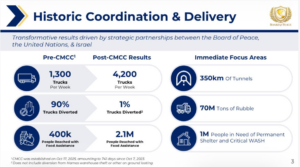
The number of people reached with food assistance rose from roughly 400,000 to around 2.1 million as distribution was professionalized and better coordinated with UN agencies and humanitarian partners.
On the health side, UN and partner data show admissions of children aged 6–59 months to outpatient and inpatient acute malnutrition treatment in Gaza rising through mid‑2025 but then falling steadily, with an 83 percent drop in new admissions by March 2026 compared with their August 2025 peak.
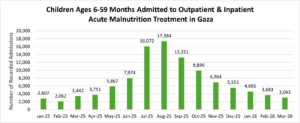
Many of the remaining cases are classified as moderate or reflect chronic medical and genetic conditions requiring feeding support, rather than new, widespread starvation.
Even as the “engineered famine” narrative raced through activist networks and ideologically hostile outlets, a very different picture was emerging from UN‑backed admissions data and CMCC delivery figures. Drawn together by the Board of Peace and presented to the Ad Hoc Liaison Committee, this dataset was first highlighted by HonestReporting and later independently reviewed by Fox News Digital: children aged 6–59 months admitted for acute malnutrition treatment climbed from 2,807 in January 2025 to a peak of 17,384 in August 2025, then fell back to 3,043 by March 2026—an 83 percent drop—with most remaining cases classified as moderate or tied to existing medical conditions. Over the same period, CMCC data show weekly aid trucks rising from about 1,300 to roughly 4,200, diversion plunging from around 90 percent to about 1 percent, and food assistance reaching roughly 2.1 million people.
Conditions in Gaza remain difficult, not least because Hamas has systematically diverted and exploited humanitarian supplies for its own benefit. But the data show there is no emerging Israel‑engineered famine in April 2026: if such a policy were in place, child malnutrition admissions and mortality would be rising sharply, not moving down.
Why Now? Hamas’ Incentives and the Board of Peace
The timing of the famine narrative is closely linked to growing pressure on Hamas over disarmament and control of aid. The US‑led Board of Peace framework ties large‑scale reconstruction and continued humanitarian support to demilitarization benchmarks, including Hamas’ disarmament. As part of that framework, Israel has withdrawn from densely populated areas to positions east of the Yellow Line and has facilitated large‑scale aid flows through the CMCC mechanism.
In April 2026, sources involved in negotiations reported that Hamas rejected a Board of Peace disarmament plan and pushed for changes that would weaken or delay the requirement that it give up its arsenal. A functioning aid architecture that bypasses Hamas—moving supplies directly from crossings to vetted warehouses and local partners—threatens the group’s patronage networks and its claim that it alone can provide for Gazans.
Israeli officials reject the idea that the timing of Hamas’ flour campaign is linked to currency moves, arguing that the shekel’s recent strength against the dollar is driven by broader macro‑economic factors and capital inflows, not Gaza policy. Still, it is hard to ignore the incentives: Hamas conducts much of its weapons and smuggling business in dollars, and over the past year the dollar has lost nearly a fifth of its value against the shekel.
That raises an uncomfortable question: when Hamas tells Gazans there is “no flour” while its own economy ministry acknowledges months of stocks, is it also factoring in the squeeze on its dollar‑based black‑market revenues, and using a choreographed famine narrative to restore political leverage it is losing both to the Board of Peace and to changing economic realities?
By portraying Board of Peace and CMCC‑enabled aid delivery as part of a “starvation policy,” Hamas can simultaneously delegitimize the very mechanisms that reduce its ability to siphon off goods and recast its refusal to disarm as heroic resistance to “engineered starvation” rather than a violation of ceasefire obligations. This fits an established pattern: pushing Western media and governments into an emergency outrage posture in which emotive famine claims overshadow questions about Hamas’ governance, finances and use of civilian infrastructure.
A Familiar Script: How Hamas’ Lies Are Engineered
The April 2026 “engineered famine” storyline is not a one‑off error; it follows the same script Hamas has used for years. First, issue a dire accusation. Then, push it through loyal media and influencers. Finally, rely on international outlets to repeat it without checking it against Hamas’ own previous statements or the underlying data.
From casualty statistics to claims about hospitals and aid convoys, Hamas has used the same formula: publish dramatic figures without independent verification, have aligned networks amplify them, and count on sympathetic media to turn them into headlines. The April 2026 “famine” narrative simply applies that formula to food.
What it reveals is not a sudden collapse of Gaza’s food system, but a sophisticated information operation built on selective data, omitted context and emotional imagery. The question now is whether newsrooms will continue to play along.
Liked this article? Follow HonestReporting on Twitter, Facebook, Instagram and TikTok to see even more posts and videos debunking news bias and smears, as well as other content explaining what’s really going on in Israel and the region. Get updates direct to your phone. Join our WhatsApp and Telegram channels!
© Divuach Ne’eman R”A, 2025