Key Takeaways:
- Palestinian municipal elections took place across Gaza and the West Bank, yet received minimal and often incomplete international media coverage.
- Where coverage did exist, it frequently defaulted to familiar narratives, sidelining internal Palestinian political dynamics and generational shifts, instead putting more emphasis on Israel.
- By ignoring or flattening political developments and changes in Palestinian society, the media obscures Palestinian agency.
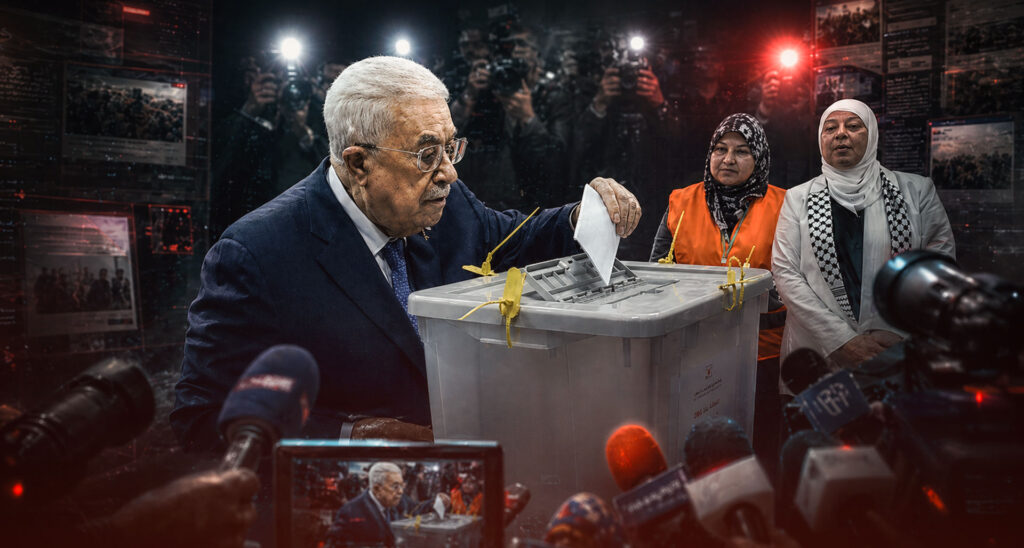
For the first time in 20 years, Palestinians held municipal elections in both Gaza and several locations throughout the West Bank.
It should have been a major media moment.
Israeli elections are still months away, but they are already making headlines. Yet Palestinian election day passed with minimal coverage. And when it was covered, the broader significance was largely ignored: elections offer a window into Palestinian society — its political direction, ideological trends, and future leadership.
By this autumn Israel must have a general election. There should also be a Presidential & general election within the West Bank & Gaza before years end. It is 20 years since the latter.
There will be no practical progress on reviving credible engagement to peacefully resolve… https://t.co/9s33FwEsDZ— Alan Shatter (@Alan__Shatter) April 28, 2026
Covering these elections would have required something many outlets avoid: shifting focus from Israel to internal Palestinian dynamics.
That shift challenges a long-standing media framing that casts Israel as the perpetrator of all wrongdoing and the central obstacle to peace.
Yet the mere fact that elections took place — even at the municipal level and with low turnout — should have made them inherently newsworthy. Journalists based in Israel and the West Bank file daily reports from the region. Silence here was a choice.
And that choice matters.
Ignoring the elections obscures key developments within Palestinian society. A younger generation is becoming more politically engaged, seeking alternatives to Fatah’s Mahmoud Abbas and his 22-year rule.
The early results of the Palestinian local elections are beginning to tell a deeper story.
A young generation of change has now firmly placed itself on the Palestinian political map. Meanwhile, President Mahmoud Abbas and the current leadership are increasingly failing to win the…— Samer Sinijlawiسامر السنجلاوي (@SSinijlawi) April 26, 2026
The elections also highlighted a reality often glossed over: Palestinians are not politically unified.
Gaza and the West Bank operate under entirely different systems, shaped by the unresolved divide between Fatah and Hamas. Despite repeated reconciliation efforts, the split persists — driving fundamentally different political trajectories.
This is not a marginal detail. It is central to understanding Palestinian politics.
Yet when the elections did make headlines, the familiar blame-Israel framing quickly followed. CNN, for example, emphasized Israel’s “bombardment” as a challenge to holding the vote.
Missing from that framing: Hamas.
Under ceasefire terms, Hamas is required to relinquish political power in Gaza. Its absence from the ballot was no coincidence. Participation, as per agreements made by the Palestinian Liberation Organization (PLO) and Palestinian Authority, would have required recognition of Israel and support for a two-state solution — positions fundamentally at odds with Hamas’ ideology.
Still, Hamas’ influence was unmistakable.
Even without formally running, the group maintained control on the ground, patrolling polling stations. Gazans have reportedly shared that some candidates have ties to Hamas. In a territory ruled with an iron fist, true independence is difficult — if not impossible.
Even without a formal victory, Hamas retains power.
Criticism of the group carries severe consequences. Those who speak out have been jailed, tortured, or executed.
And yet, there is a critical — and underreported — detail.
All candidates were required to uphold the agreements recognizing Israel and rejecting violence. That condition alone represents a potential shift — a small but meaningful indicator of political evolution.
It is also a detail too often downplayed.
When context is stripped away, Palestinian agency is reduced to a reaction to Israel rather than a reflection of internal dynamics. Ignoring or flattening these elections distorts reality — and obscures where Palestinian society may be heading.
These elections offered a rare opportunity to explore the complexity of Palestinian politics.
Instead, much of the media chose not to look.
Liked this article? Follow HonestReporting on Twitter, Facebook, Instagram and TikTok to see even more posts and videos debunking news bias and smears, as well as other content explaining what’s really going on in Israel and the region. Get updates direct to your phone. Join our WhatsApp and Telegram channels!
© Divuach Ne’eman R”A, 2025