Key Takeaways:
- Despite coordinated boycotts, rule changes, and sustained media scrutiny, Israel still finished second at Eurovision 2026, highlighting a disconnect between elite media narratives and public sentiment.
- Major international outlets framed Eurovision primarily through the lens of Israel’s participation, turning a music competition into a political referendum on the Jewish state.
- While Israel was accused of using Eurovision as a “soft power tool,” every participating country arguably engages in national promotion, with Israel uniquely singled out for criticism and exceptional scrutiny.
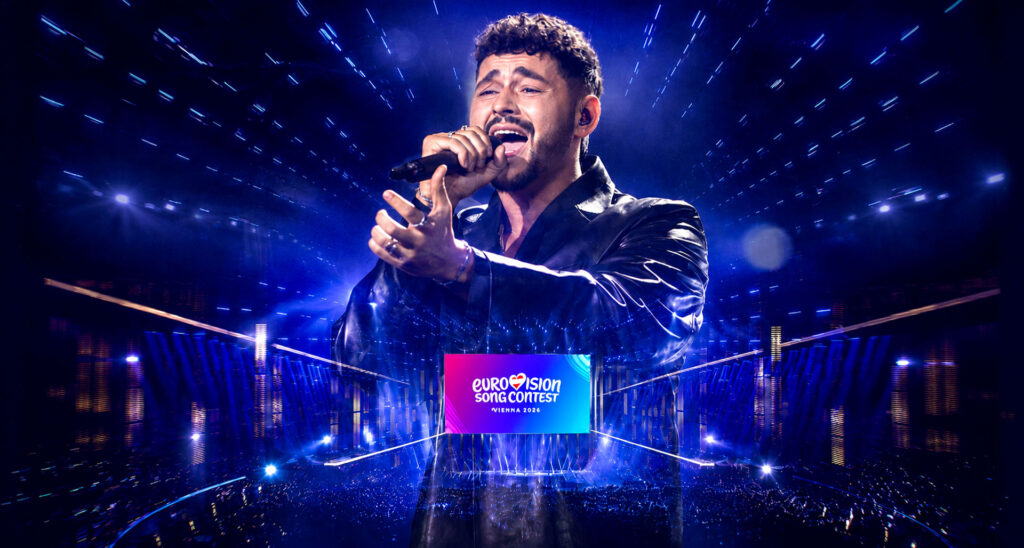
The Eurovision Song Contest final was, as ever, a spectacle of glitz, glamor, and pyrotechnic theatrics. Yet in much of the international media coverage, one word dominated: Israel.
In the year leading up to Saturday’s final in Vienna, there was a sustained – though ultimately unsuccessful – campaign to have Israel removed from the competition. That effort culminated in several countries boycotting the event, turning what is ostensibly a music contest into a political flashpoint.
Despite the absence of any evidence of rule-breaking in the 2025 contest, where Israel placed second, the European Broadcasting Union (EBU) announced a series of voting reforms in November. These changes were described as measures “designed to strengthen trust, transparency and audience engagement.”
They included stricter limits on promotional activity to curb disproportionate third-party influence, including government-backed campaigns, a reduced televoting cap, more demographically diverse jury panels, and enhanced safeguards to detect coordinated or fraudulent voting.
Although Israel was not mentioned explicitly, the timing and framing of the reforms led many to interpret them as a response to allegations that Israel had attempted to influence the previous year’s vote.
View this post on Instagram
And yet, the changes made little difference to the outcome.
Israel finished second in this year’s competition, behind Bulgaria. Notably, Bulgaria’s contestant appeared to signal support for Israel’s participation by sharing a clip of Noam Bettan’s rehearsal performance, Israel’s representative at Eurovision 2026. Israel received the maximum 12 points in the public televote from Finland, Portugal, Switzerland, Germany, Azerbaijan, and France, as well as 12 points from Poland’s professional jury.
In the run-up to and aftermath of the final, headlines across major outlets framed the contest through the lens of Israel’s participation.
- POLITICO declared, “Discord over Israel splits Eurovision.”
- CNN reported, “Bulgaria wins Eurovision, Israel finishes second amid boycotts over its participation.”
- France 24 noted that the final “kicks off amid boycotts over Israel’s participation.”
- The New York Times profiled Noam Bettan, while referencing boycotts linked to “Israel’s military actions in Gaza.”
Yet this intense media focus stands in contrast to the apparent sentiment of the viewing public. The voting results show that, far from isolating Israel, audiences across Europe continued to support its entry in significant numbers.
Days before the final, The New York Times published an “investigation” titled “How Israel Turned Eurovision’s Stage Into a Soft Power Tool,” alleging a “well-organized campaign” by the Israeli government to influence the vote and describing how officials “embraced Eurovision as a soft power tool” to burnish the country’s image.
But this critique raises a broader question: what exactly is Eurovision, if not a soft power exercise?
Every participating country uses the contest as an opportunity to promote its culture, image, and appeal to a pan-European audience of hundreds of millions. National broadcasters, governments, and artists routinely engage in extensive promotional efforts.
Malta, for example, has long invested heavily in paid advertising campaigns across Europe to boost its entries, particularly given its lack of a natural regional voting bloc. At the same time, Eurovision coverage and even the EBU’s own recent enforcement actions acknowledge that multiple delegations run advertising and promotional campaigns, including online ads urging viewers to vote and broader international marketing drives.
In that sense, Israel is not an outlier, but a participant in a well-established dynamic.
What distinguishes Israel is not the scale of its efforts, but the scrutiny applied to them.
That double standard was further highlighted by the actions of the broadcasters from some of the countries that boycotted the contest this year. Spain’s RTVE aired a black screen protest calling for “peace and justice for Palestine,” while Slovenia’s RTVSLO replaced Eurovision coverage with a themed programming strand titled “Voices of Palestine.”
Such editorial decisions effectively turned a shared cultural event into a vehicle for anti-Israel messaging that did not reflect the views of the very public these broadcasters claim to represent.
Eurovision has always existed at the intersection of culture and politics. What 2026 exposed, however, was not that Israel’s participation is somehow more controversial than anyone else’s, but that it is singled out, framed, and scrutinized in a way no other country is.
One could argue that, during the height of the war in Gaza in 2024 and 2025, such heightened scrutiny was at least predictable, if not inevitable, given the intensity of global attention. Yet with the war now over, the persistence of this exceptionalized framing raises a different question: what is the justification now for singling Israel out?
View this post on Instagram
Liked this article? Follow HonestReporting on Twitter, Facebook, Instagram and TikTok to see even more posts and videos debunking news bias and smears, as well as other content explaining what’s really going on in Israel and the region. Get updates direct to your phone. Join our WhatsApp and Telegram channels!
© Divuach Ne’eman R”A, 2025