Key Takeaways:
- The Intercept’s claim that American media is biased against Palestinians collapses under scrutiny, relying on opaque methodology, selective framing, and glaring double standards.
- The article argues that many of its examples merely reflect basic journalistic realities: Israel is a sovereign state responding to a terrorist attack, while Hamas is a genocidal terror organization that systematically embeds itself among civilians.
- By stripping away legal, moral, and factual context — while promoting grotesque anti-Israel smears — The Intercept turns ideological activism into pseudo-scientific “media analysis.”
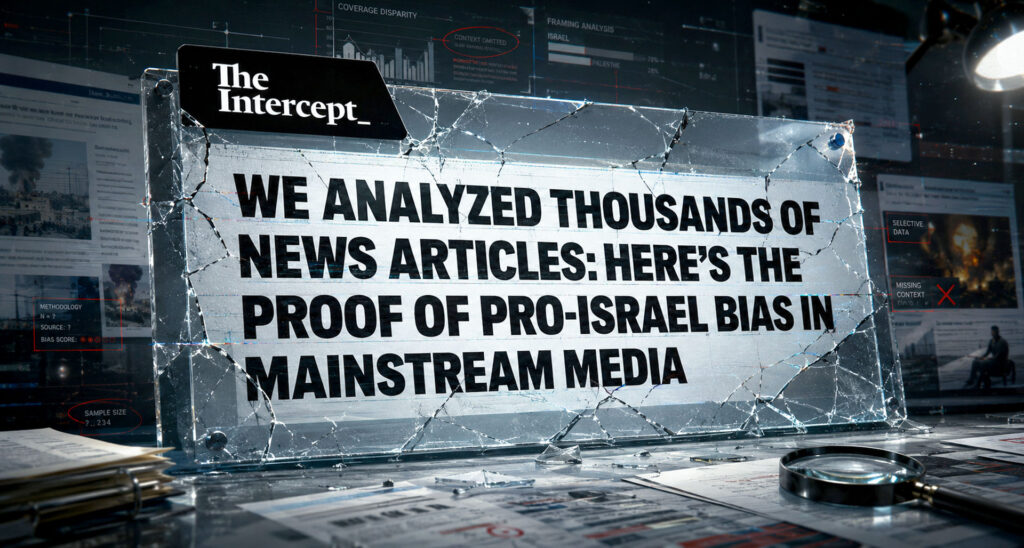
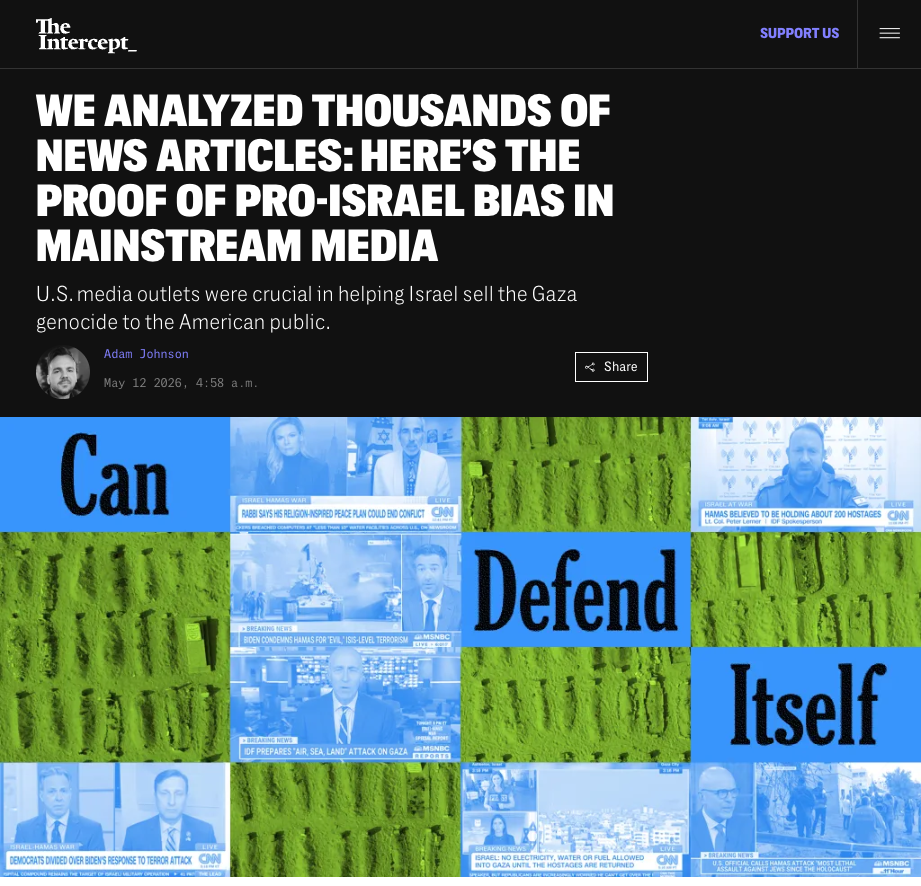
The Intercept has published a piece by Adam Johnson, who claims to have statistical findings that the American media is biased against Palestinians and systematically favors Israel.
Yes, you may want to read that sentence again.
After all, that would erase 25 years of HonestReporting, not to mention invalidating the past few years of witnessing virtually every major Western outlet amplify Hamas casualty figures, platform anti-Israel ‘activists’ and antisemites, obsess over Palestinian suffering, and scrutinize Israel’s every military move in microscopic detail while often stripping away the context of October 7 and Hamas’ strategy of embedding itself among civilians.
But Johnson claims the exact opposite in his new book, How to Sell a Genocide: The Media’s Complicity in the Destruction of Gaza, which he dutifully plugs in the piece. And while his so-called proof is presented with the aesthetic authority of data journalism, don’t be fooled.
The Methodology to the Madness
Let’s start with the most fundamental problem of his findings: we have no idea how any of this was actually counted.
Johnson claims to have examined “over 12,000 articles” and “5,000 TV segments.” But how? What was his methodology? Did he count them himself, or have others assist? Did he use AI? And if so, did he check the accuracy of the results? Were the searches for keywords conducted with any controls for context, or did every mention of “Israel’s right to defend itself,” for example, count equally, whether it appeared in a news report, an op-ed, or a quote from a foreign official? Curious minds want to know.
This isn’t a peer-reviewed study, or even a white paper. It is an anti-Israel person supposedly counting things in ways they don’t explain, to support a conclusion they announced before counting began. It is confirmation bias wrapped up in pseudo-science.
Apparently, International Law Is “Bias” Now
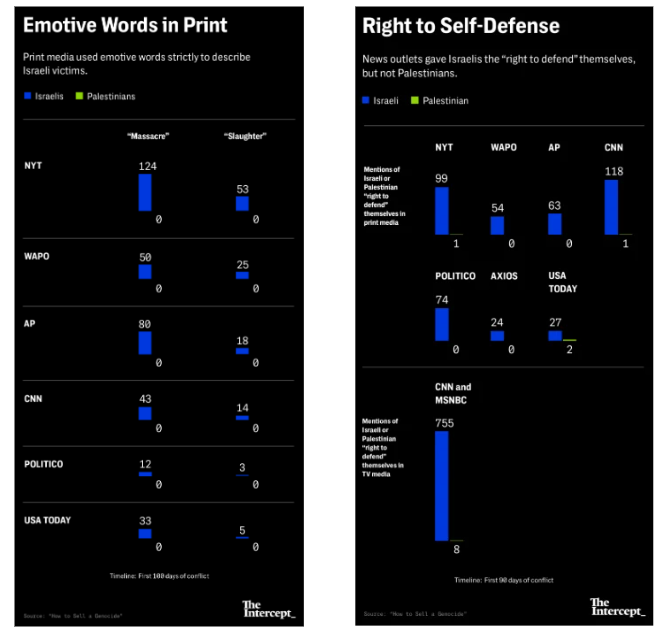
Johnson presents as proof of bias how Israel’s “right to defend itself” was mentioned on CNN and MSNBC 94 times more than Palestine’s equivalent right. But consider the obvious alternative explanation: the “right to defend itself” framing was overwhelmingly deployed by the Israeli government, American officials, and Western leaders in their public statements – statements that journalists are obligated to report. Measuring how often journalists transmitted this phrase tells us about the rhetorical landscape of the conflict, not necessarily about journalists’ own editorial biases.
Yet elsewhere in his piece, Johnson does claim to have filtered out quotes from officials and commentators (notably the “emotive words” charts), but not here. This inconsistency is never explained, so one could assume he did not employ such filtering here.
But more than that, a state has a clear right to self-defence against a cross-border attack by a terrorist organization like Hamas under international law. In contrast, Hamas is not a sovereign democracy defending its population from annihilation. It is a genocidal Islamist terror organization whose founding charter explicitly calls for Israel’s destruction and whose military strategy depends on maximizing civilian suffering for propaganda purposes. Its actions are completely against international law.
The idea that journalists should discuss Hamas’ “right to defend itself” with the same frequency as Israel’s is not evidence of journalistic imbalance. It is simply journalists reporting in this case what exists, while ignoring what doesn’t.
Shocking Discovery: Well-Documented War Tactics Get More Press Than Conspiracy Theories
Johnson claims that “human shields” is a pejorative used to “explain away” civilian deaths, complaining that the term is never applied to the IDF’s actions. But this comparison is stripped of all context that would make it meaningful.
Hamas’ use of civilian infrastructure for military purposes has been documented extensively by the United Nations, NATO, the EU, various intelligence agencies, human rights organizations, and journalists on the ground, including outlets sympathetic to Palestinians. There is substantial evidence to show Hamas routinely operating out of schools, hospitals, and residential buildings.
Conversely, the IDF operates from designated bases and has a sophisticated civil defence system for its population.
Whether or not one agrees with the “human shields” characterization, it’s hardly surprising that a well-documented allegation gets covered. By contrast, the specific legal argument that Israeli military conduct also constitutes use of human shields is a much more contested and less-reported claim, advanced primarily by so-called advocacy groups and bad-faith actors. Treating the asymmetry in coverage as pure bias, rather than as a reflection of the asymmetry in evidentiary weight, is accusation, not analysis.
In Which Johnson Discovers That Different Events Get Different Words
Perhaps the most visually striking charts show that words like “massacre,” “savage,” “barbaric,” and “slaughter” were used overwhelmingly to describe Israeli victims rather than Palestinian ones. The print media charts show literal zeros in the Palestinian column across every outlet.
But this is because of the respective natures of Israeli civilian & foreign national deaths versus Palestinian civilian deaths.
October 7 was a massacre, the deadliest single-day attack on Jewish people since the Holocaust. It involved the intentional, close-quarters torture, rape, and mutilation of civilians – including children and the elderly – in their homes and at a music festival. While the loss of Palestinian civilian life in the ensuing war is tragic, there is a clear linguistic and moral distinction between collateral damage in a high-intensity urban conflict and the deliberate, “barbaric” celebratory slaughter seen on October 7. Furthermore, the deaths in Gaza, which occurred predominantly through aerial bombardment over weeks and months, are a different category of event that journalists might reasonably describe with different language, such as “strikes,” “bombardment,” “attacks,” and “casualties.”
The absence of “massacre” from Gaza coverage reflects linguistic convention and the nature of the violence rather than dehumanization.
Apparently Accurate Attribution Is Bias
Johnson decries the use of the qualifier “Hamas-run” when citing the Gaza Health Ministry, claiming it “discredits” the death counts. But this is simply accurate reporting! Providing context for a source is a pillar of journalism, not a “pejorative” attack.
It is interesting though that he basically admits it is a pejorative. Perhaps he subconsciously understands what Hamas are really about.
Apples, Oranges, and War Crimes
Johnson attempts to compare coverage of Gaza to Ukraine, claiming Ukrainian victims receive more sympathy.
This comparison might, at first glance, sound reasonable. But it obfuscates a massive hidden assumption: that the two conflicts are identical in terms of what was legally and factually established at the time of coverage.
Ukraine is a sovereign democracy invaded by a global superpower in an unprovoked war of conquest. This is not at all the case concerning Israel’s war of self-defense against Hamas and other terror organizations.
Several charts compare Gaza coverage unfavorably to Ukraine coverage (such as fewer mentions of “war crimes,” fewer mentions of child deaths relative to the actual toll, and less use of terms like “genocide”).
Take the term “genocide,” for example. CNN used the term in connection with Ukraine 157 times; for Gaza, only 5. But during the first 30 days of the Gaza conflict, “genocide” was a highly contested legal and political characterization being debated in real time. The International Court of Justice had not yet issued its preliminary ruling, and even after it did, it did not find that Israel had committed genocide.
By contrast, “genocide” in the context of Ukraine had been applied by multiple governments and international bodies by the time the comparison period begins.
Responsible journalists are not being biased by declining to apply a legally charged term that had not achieved institutional consensus. They are being accurate.
The Art of Misunderstanding Why Things Make the Headlines
Johnson’s argument on antisemitism versus Islamophobia may be one of the clearest examples in the entire piece of correlation being lazily repackaged as proof of bias.
Yes, antisemitism received enormous media attention after October 7. But that is because October 7 itself was the largest antisemitic massacre since the Holocaust, carried out explicitly in the name of annihilating Jews. The attack triggered an immediate and unprecedented global surge in antisemitic incidents: synagogue firebombing, assaults on Jews, mobs outside Jewish businesses, threats against Jewish students, glorification of Hamas terrorism, and open calls for violence against Jews on campuses and social media. Journalists did not invent this reality. They reported it.
To compare this to the tragic death of Hind Rajab – a casualty of war in a combat zone – ignores how domestic news cycles work.
A Brief Introduction to the Objective Researcher Behind the Data
It will come as no surprise to discover that Adam Johnson is more heavily biased against Israel than any of the outlets he claims are biased in favor of Israel. A stark example of this is how he has defended the New York Times’ now-infamous Kristof piece accusing the IDF of, inter alia, ordering dogs to rape Palestinian prisoners:
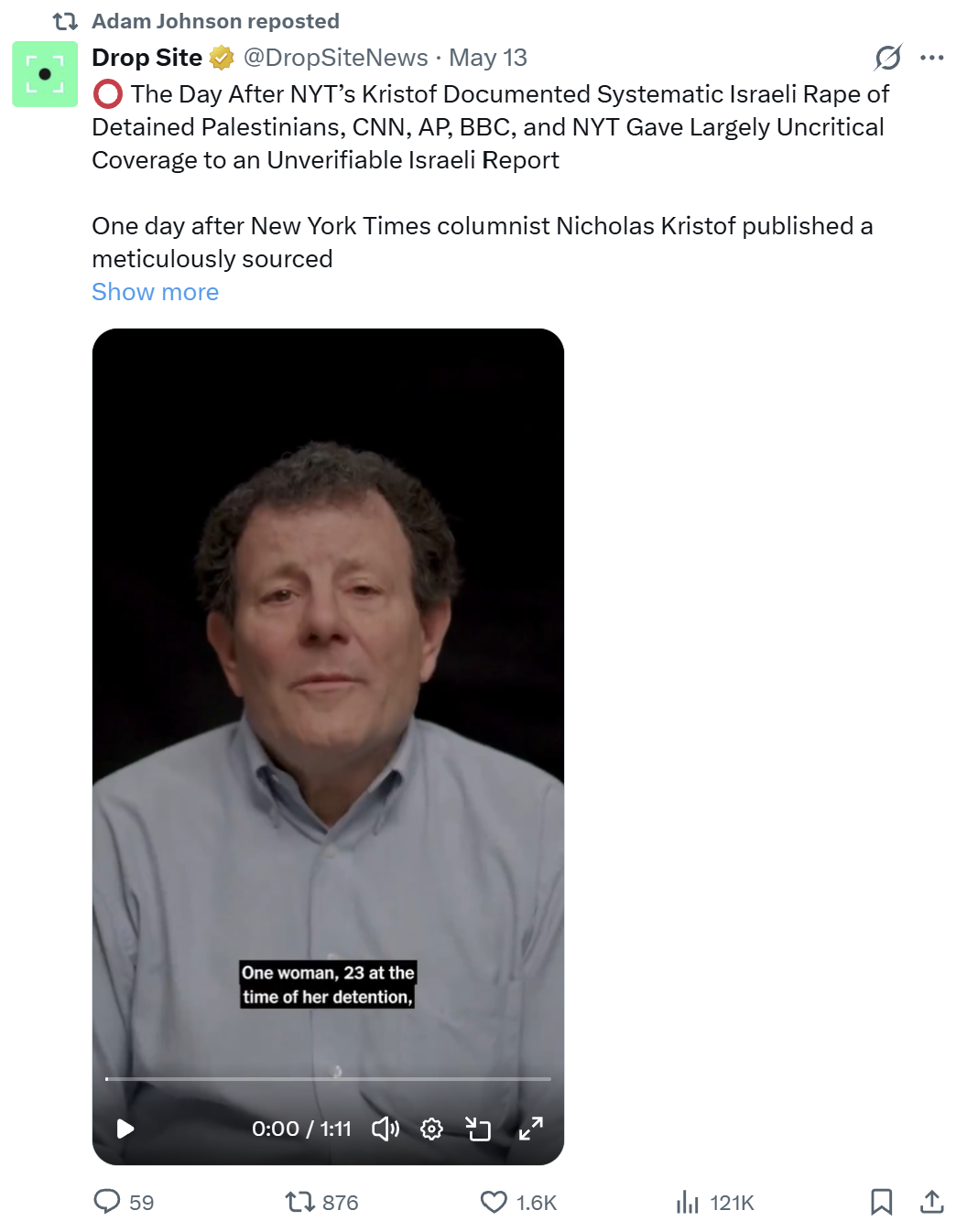
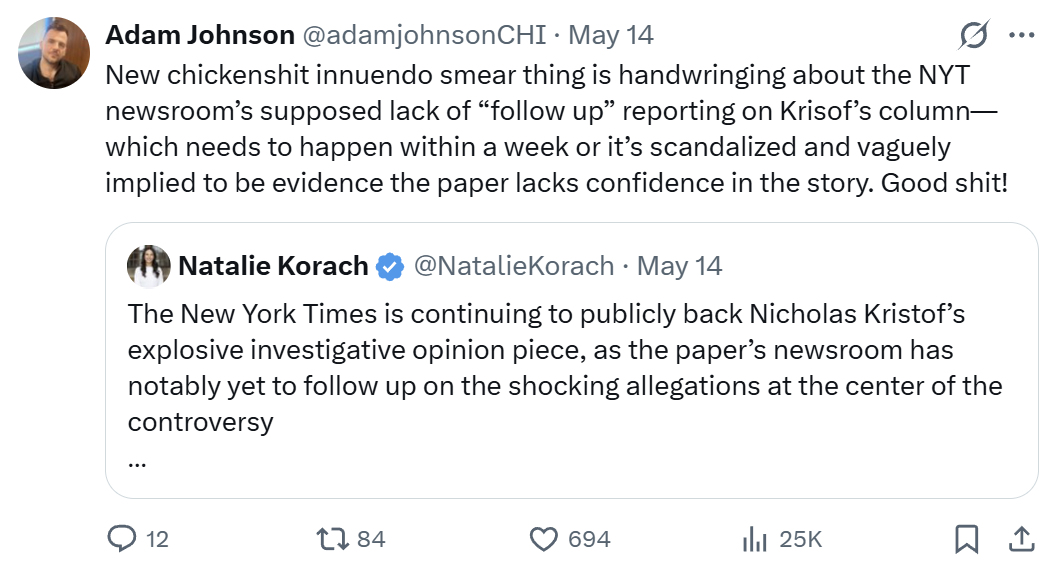
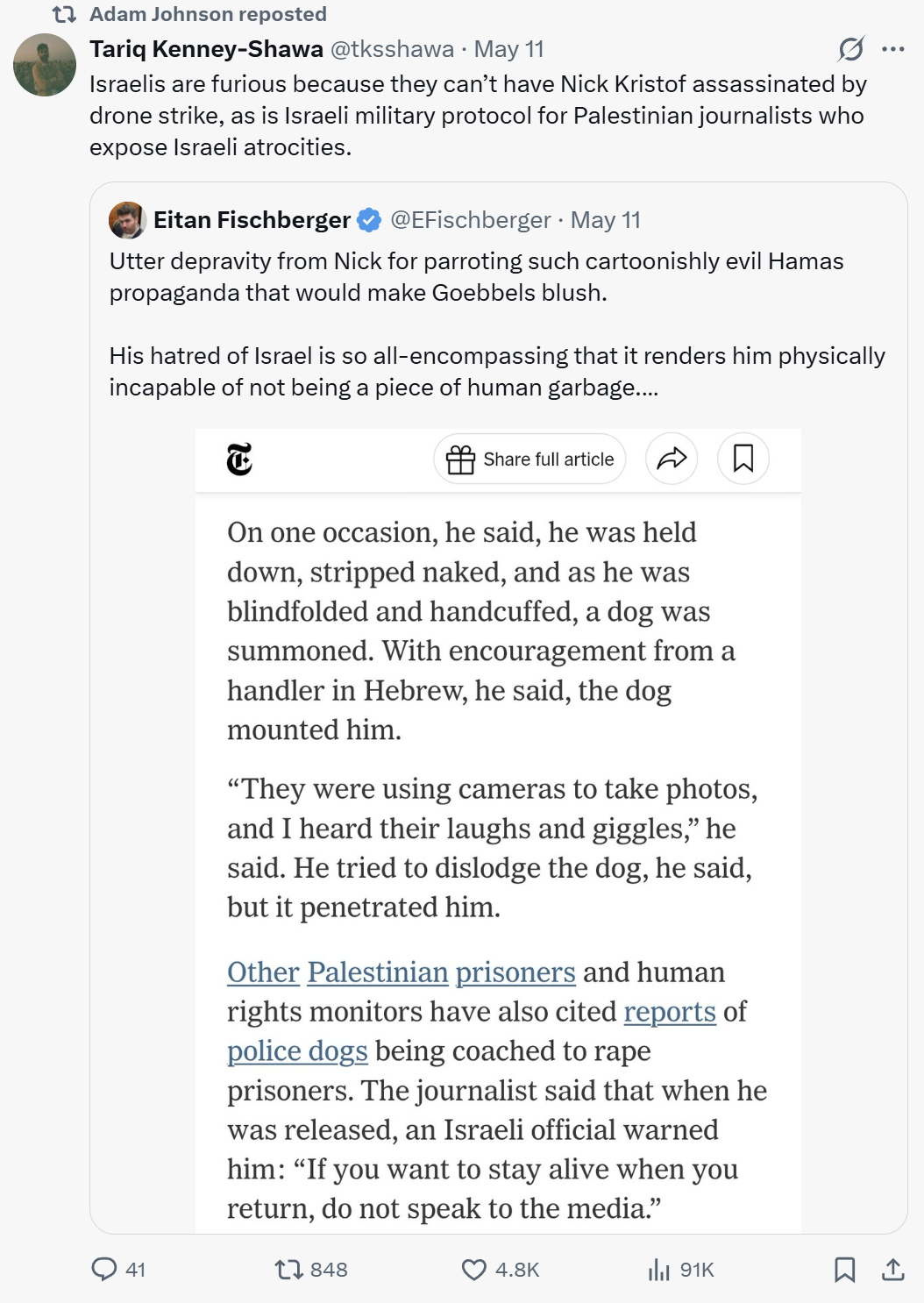
Johnson accuses the media of manufacturing narratives while simultaneously promoting one of the most grotesque and evidence-starved smears of the entire war.
It is his own bias that is off the charts.
Conclusion
The data presented here doesn’t prove media bias; it proves that U.S. media outlets generally recognize the difference between a sovereign state defending itself and a terrorist group’s intentional slaughter of civilians. By stripping away context, Adam Johnson attempts to turn the basic rules of journalism into evidence of a conspiracy. Not that this is surprising, given his own seeming aversion to the truth.
Genuine media criticism matters. Coverage of the Gaza conflict deserves serious scrutiny, as does coverage of every conflict. But scrutiny requires intellectual honesty, methodological transparency, and a willingness to consider competing explanations. What The Intercept has published here is none of those things.
Liked this article? Follow HonestReporting on Twitter, Facebook, Instagram and TikTok to see even more posts and videos debunking news bias and smears, as well as other content explaining what’s really going on in Israel and the region. Get updates direct to your phone. Join our WhatsApp and Telegram channels!
© Divuach Ne’eman R”A, 2025