


Key takeaways:
- Gaza-based photographers routinely use fences, wire, and railings to frame civilians especially children in ways that visually imply imprisonment, even when no detention is taking place.
- Through tight cropping and selective angles, ordinary locations such as UN schools, bakeries, and aid sites are transformed into scenes resembling incarceration or concentration-camp imagery.
- These images invert reality: the appearance of captivity is manufactured visually, while the actual coercion comes from Hamas, which embeds civilians in militarized spaces and uses them as human shields.
Certain visual motifs appear repeatedly in Gaza media coverage. Children behind wire. Faces pressed against metal bars. Hands gripping fences. The images are emotionally charged and instantly legible to Western audiences, evoking imprisonment, captivity, and historical trauma.
Yet in many cases, these photographs do not depict prisons, detention centers, or civilians being held by Israel. They show ordinary civilian locations, UN-run schools, aid distribution points, bakeries, residential courtyards, photographed in ways that fundamentally alter their meaning.
This is not incidental. It is a long-standing visual technique that has intensified since October 7, 2023. By exploiting proximity to fences and aggressively cropping out context, photographers manufacture a narrative of mass captivity that does not reflect the physical reality on the ground.
15 Years Ago: The Same Photo Bias
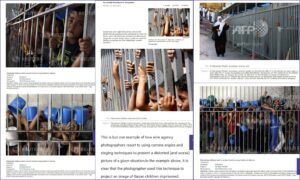
In 2010, HonestReporting documented this same visual manipulation technique in a detailed investigative study. Visual analysis Shattered Lens: Part 3 – Putting Palestinians Behind Bars examined how international wire services repeatedly used bars, fences, and railings in photographs to imply Palestinian imprisonment and captivity, even when no detention was taking place.
That investigation formed part of a broader study into photo bias across the major wire services, AP, Reuters, AFP, and Getty, which identified recurring patterns of selective framing and emotional implication. The study demonstrated how ordinary structural elements were repeatedly used to promote a narrative of suffering through visual suggestion rather than factual context.
The same technique is used today. Fences, wire, and railings continue to be used to frame civilians, especially children, in ways that visually suggest imprisonment, even when the scenes are taken in schools, aid sites, or residential areas. The continued distribution of such imagery by the same wire services underscores not only the durability of the technique, but the failure to address a problem that was clearly identified and documented years ago.
This article revisits that original finding in a contemporary context. The issue is not a failure of observation; the pattern was identified years ago. It is a failure of correction.
The Fence as a Storytelling Device
In visual journalism, fences and wire carry powerful symbolic weight. They signify restriction, loss of freedom, and confinement. When a subject is placed behind a fence and the surrounding context is removed, an image stops documenting a moment and begins asserting a condition.
In recent imagery from Gaza, this framing device is used repeatedly. Children are photographed through railings or mesh. Faces are isolated between bars; hands clutch wire. The background is blurred or excluded, eliminating any sense of location or purpose.
The result is implication rather than documentation. The viewer is encouraged to conclude that the subject is imprisoned, even when no such captivity exists.
Innocent Locations, Manufactured Meaning
Many of these images are taken in locations that are not detention facilities at all.
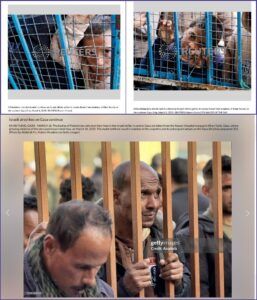
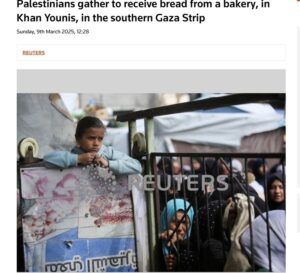
Some originate from UN-run schools used as shelters, including photographs taken immediately after October 7. Others come from bakeries, aid queues, or residential buildings with standard safety fencing.
Under normal circumstances, these fences are unremarkable. Through tight framing and angle selection, however, they become the defining element of the image. Context disappears. The fence becomes the story.
This technique is particularly potent because it borrows from historical memory. The visual resemblance to concentration-camp imagery is not accidental. It reliably generates outrage and moral certainty, regardless of whether the analogy is accurate.
The U.N. School Illusion
The distortion becomes more serious inside UN facilities.
UN schools in Gaza have repeatedly been used by Hamas for military activity, including weapons storage and operational cover. Civilians, especially children, are kept inside these spaces while militants operate nearby.
When photographers enter these locations and isolate children behind railings or window bars, the resulting images suggest captivity imposed from outside. The implication is that Israel has turned schools into prisons.
In reality, the coercive force is internal. Hamas embeds itself among civilians, restricts movement, and uses protected sites as shields. The children are not being held behind bars by Israel. They are being placed in harm’s way by Hamas.
The imagery reverses responsibility.
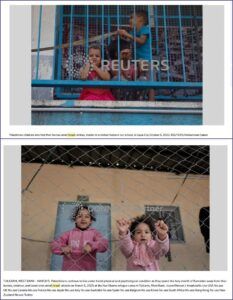
How to Read Fence Imagery Critically
When viewing images of civilians behind fences or wire, ask three questions:
What’s the location? What’s outside the frame? Who controls the space?
Fences alone do not indicate imprisonment. In Gaza, fences often exist at schools, aid sites, courtyards, and residential buildings. When photographers crop out entrances, exits, guards, or surroundings, the image may imply captivity that does not exist.
Critical viewing means distinguishing between physical presence and visual suggestion. When context is missing, an image may be framed to shape emotion rather than to document reality.
This pattern points to a deeper problem in Gaza coverage. The issue is not isolated images or individual photographers, but a normalized visual language that privileges emotional implication over contextual truth.
When fences are repeatedly deployed to suggest imprisonment, and children are framed as captives while the forces restricting their movement remain unseen, imagery ceases to inform the public and begins to direct it.
Understanding this technique matters – not to dismiss images, but to read them critically. In Gaza, the most powerful bars are not always made of metal. Sometimes, they are created by the frame itself.
Liked this article? Follow HonestReporting on Twitter, Facebook, Instagram and TikTok to see even more posts and videos debunking news bias and smears, as well as other content explaining what’s really going on in Israel and the region. Get updates direct to your phone. Join our WhatsApp and Telegram channels!