Key Takeaways:
- Media reports downplayed terrorism and omitted key facts. Several outlets failed to identify the attack as terrorism or clearly state that an Israeli Arab targeted Jewish Israelis inside sovereign Israeli territory.
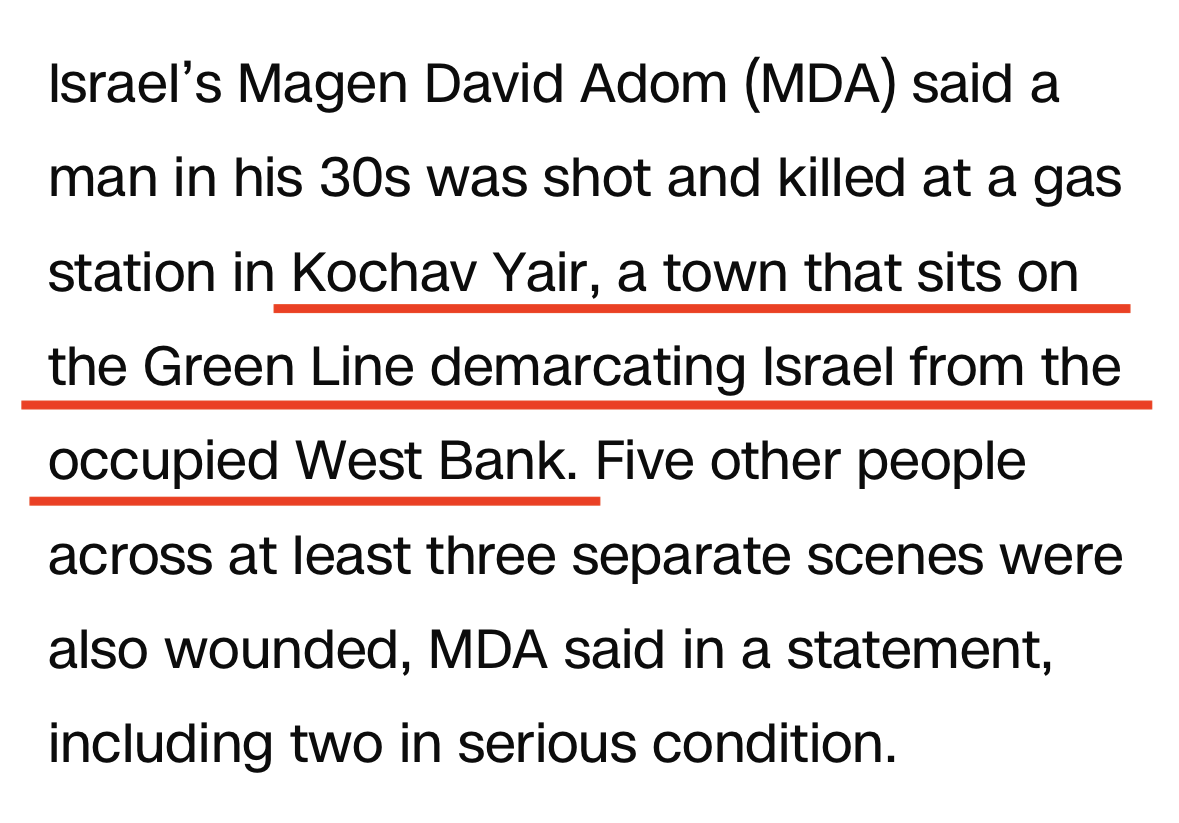
- Geography was used to frame the story. AP and other outlets highlighted the attack’s proximity to the West Bank, introducing context that can imply the violence was connected to location rather than anti-Jewish terrorism.
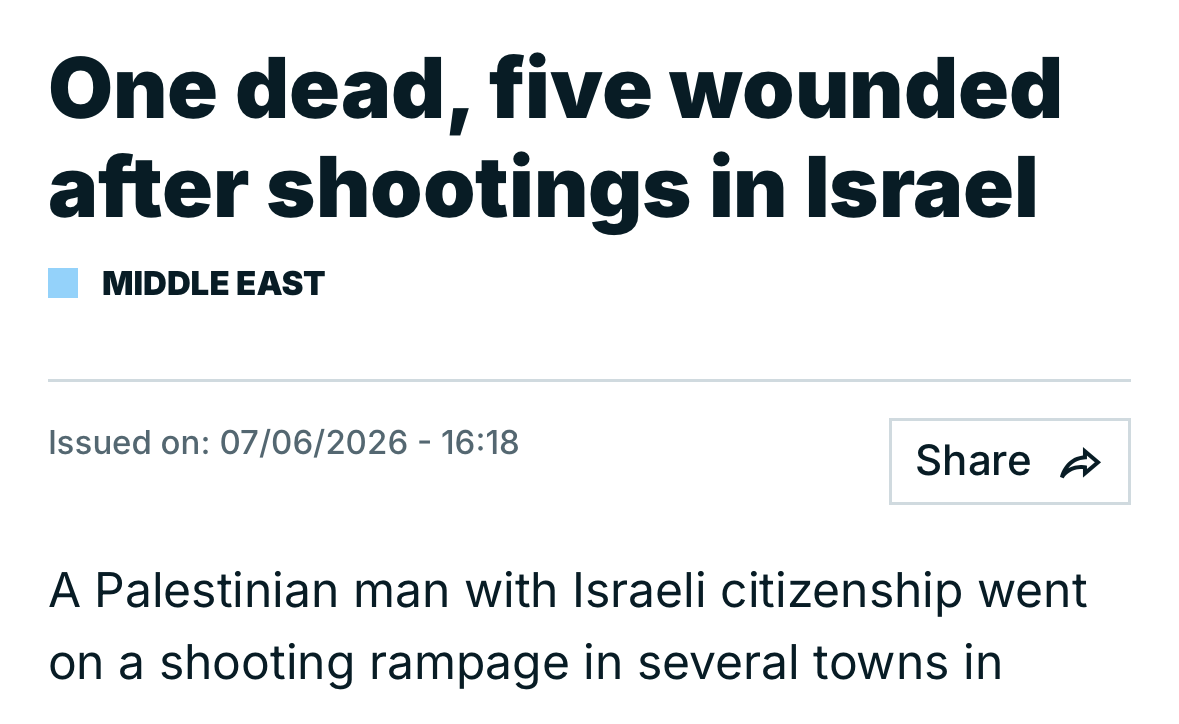
- Coverage distorted the identity of the perpetrator. CNN and France 24 described the attacker as a “Palestinian citizen of Israel,” despite evidence that most Israeli Arabs do not primarily identify as Palestinian and despite the term’s broader political implications.
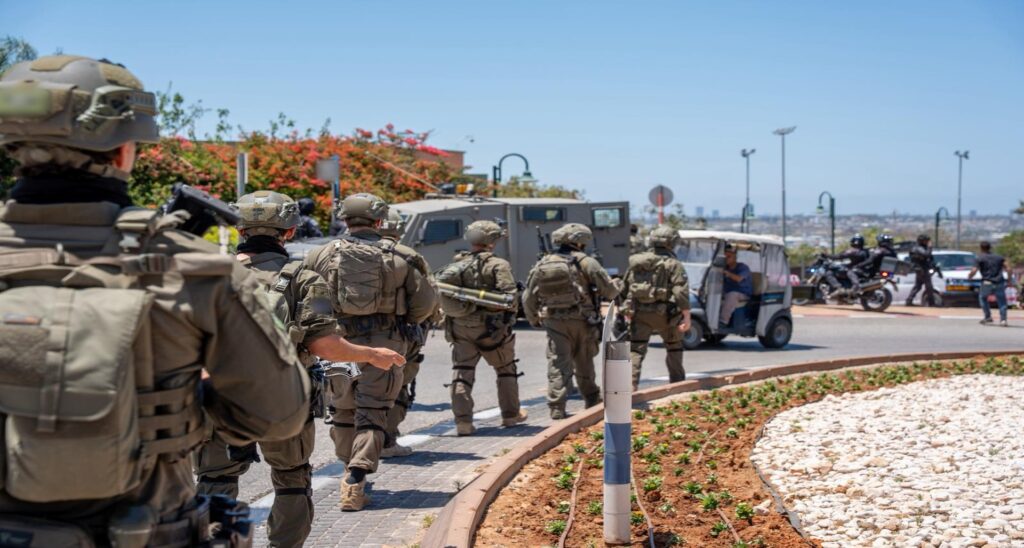
One Israeli man was killed, and five others were wounded after an Israeli Arab carried out a shooting spree in central Israel on Sunday. International media coverage followed a familiar pattern: failing to clearly identify the attack as terrorism while omitting crucial details about both the perpetrator and the victims.
But this latest attack also highlighted another troubling tendency in media coverage of violence against Israelis: the impulse to contextualize or even implicitly justify attacks based on geography.
When Jewish residents of Judea and Samaria are victims of Palestinian terrorism, their murders are too often presented as an inevitable consequence of where they live. Even children and babies, who have no say in where they are born or raised, are frequently stripped of their civilian status. As HonestReporting has previously documented, the label “settler” is routinely used as a means of dehumanization.
What made some of Sunday’s coverage particularly striking was that the attack took place well within sovereign Israeli territory.
Two men in their 30s were shot at a gas station near Kochav Ya’ir. A 31-year-old man and a 61-year-old woman were shot at the entrance to Tzur Yitzhak. Two more men were wounded outside Tzur Natan, one of whom, 55-year-old Haim Kalomiti, later succumbed to his injuries.
Yet the Associated Press’s initial response left much to be desired:
Hey @AP – who was killed? And by whom?
Anyone reading your misleading headline would have no idea.
So let’s supply the missing information:
An Arab Israeli citizen carried out a terrorist attack against Jewish Israelis inside Israel’s sovereign borders, targeting them because… pic.twitter.com/s3RTQ5u0qX
— HonestReporting (@HonestReporting) June 7, 2026
Israel’s narrowest point is only around 15 kilometers (nine miles) wide from the Mediterranean coast to the Green Line. Large parts of the country lie in close proximity to the West Bank.
The question, therefore, is why AP chose to emphasize that the shootings occurred “near the West Bank” rather than simply stating that they took place inside Israel.
The answer appears obvious. Referencing the West Bank serves to provide context and, intentionally or not, explanation. If the victims were sufficiently close to territory routinely described by the media as Palestinian, then the attack can be framed as somehow connected to its location.
That is far easier than confronting the reality: a terrorist targeted Israeli Jews because they were Jews.
While less explicit than AP, CNN also highlighted Kochav Ya’ir’s proximity to the West Bank.
Like AP, France 24‘s headline failed to identify either the victims or the perpetrator. The article itself described the attacker, an Israeli Arab from the town of Taibeh, as a “Palestinian man with Israeli citizenship.”
CNN similarly referred to the terrorist as a “Palestinian citizen of Israel.”
This is despite survey data consistently showing that only a small minority of Israeli Arabs primarily identify as Palestinian.
The media’s preferred terminology not only conflicts with how most Israeli Arabs define themselves; it often serves a broader narrative portraying Israel as an apartheid state or suggesting that its Arab citizens somehow live under occupation.
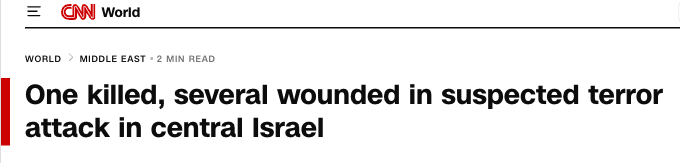
CNN also described the incident as a “suspected” terror attack despite the overwhelming evidence available from the outset.
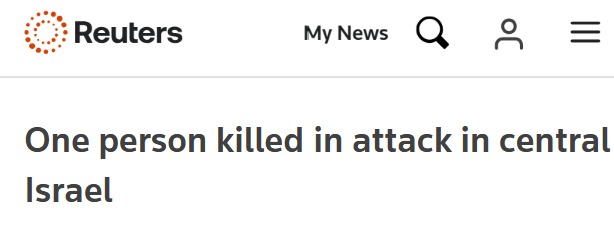
Sadly, the mere appearance of the word “terror” already placed CNN ahead of Reuters, whose initial headline referred simply to an “attack.”
Who was killed? Who carried out the attack? Reuters’ readers were left none the wiser.
The one thing the media can consistently be relied upon to do when reporting attacks against Israelis is to get key elements of the story wrong.
In this latest case, they certainly did not disappoint.
Liked this article? Follow HonestReporting on Twitter, Facebook, Instagram and TikTok to see even more posts and videos debunking news bias and smears, as well as other content explaining what’s really going on in Israel and the region. Get updates direct to your phone. Join our WhatsApp and Telegram channels!
© Divuach Ne’eman R”A, 2025