Key Takeaways:
- The term “settler” has been increasingly used in the international media to describe any Israeli civilian living in the West Bank and eastern Jerusalem, but the term comes with loaded language. On social media, Israelis in general are frequently referred to as “settlers.”
- HonestReporting.ai Labs found that “settler” framing is frequently tied to broader accusations such as “apartheid,” “genocide,” “ethnic cleansing,” and “settler colonialism,” creating an interconnected narrative framework that shapes public perception of Israel far beyond disputes over territory.
- Linguistic patterns in coverage often portray “settlers” as a collective political actor rather than as individuals, shaping how audiences interpret news coverage before engaging with the underlying facts.
It is nearly impossible to look at the news today without encountering a story about “Israeli settlers.” The term has become a fixture in international coverage, shaping perceptions of events – and the people involved – before audiences have the chance to examine the broader context for themselves.
But this terminology did not appear out of nowhere.
Over the past several years, the term “settler” has quickly gained traction. Israelis living in the West Bank – also known by the biblical names Judea and Samaria – are not described by their nationality or their Jewish identity, but by where they live. This default label, often coupled with loaded and dehumanizing adjectives, has increasingly become the defining lens through which they are viewed in the media.
The result is a loss of nuance. Complex individuals and communities are reduced to political symbols, making it easier for audiences to view them through a simplified, frequently prejudicial narrative framework.
What is a “Settler?”
In 1967, Israel launched a preemptive war after gaining intelligence that several Arab armies were preparing to once again attack the fledgling state.
In just six days of war, Israel captured several territories from surrounding countries, including the West Bank and eastern Jerusalem from Jordan, the latter of which was subsequently annexed.
Over time, the more than 700,000 Israeli civilians living in these communities came to be widely referred to in the media simply as “settlers.” On social media, the term has expanded to even those outside the West Bank, with Israelis in general often described as “settlers.”
View this post on Instagram
The Evolution of the Term “Settler”
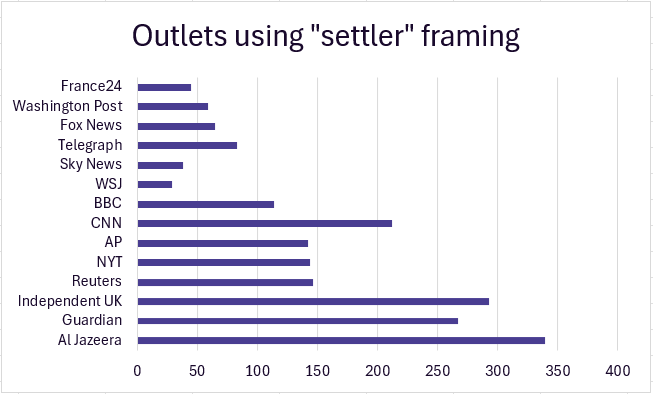
Graph displaying the most prominent media outlets and the volume of “settler”-related alerts generated by each outlet. Based on data from HonestReporting.ai Labs.
From late 2024 through mid-May 2026, with meaningful volume from March 2025 onward, HonestReporting.ai Labs collected 6,422 alerts from top media outlets that used this terminology.
“Settler” has shifted from a neutral geographic label into a loaded moral category. What was once activist language is now embedded in mainstream Western media, signaling a broader institutionalization of the frame.
The data gathered by HonestReporting.ai Labs highlights the role of global wire services such as Reuters and Associated Press (AP), whose pieces are syndicated across hundreds of outlets worldwide. Single editorial wording choices are rapidly amplified into international default terminology, helping standardize the framing across the global media landscape.
Interestingly, the AP style guide does not instruct journalists to use the term “settler” when referring to Israelis living in the West Bank. Yet despite the absence of a formal requirement, the label has increasingly become normalized throughout international reporting, evolving from an occasional descriptor into the dominant language through which these communities are discussed.
Linguistics of the Term “Settler”
The term “settler” functions as far more than a geographic descriptor.
“Settler” is used as an identifier rather than Israeli civilian or Israeli resident, with near universal usage across outlets when describing West Bank Israelis, including when the individual is a victim. This identity substitution replaces words such as “civilian,” “woman,” “family,” or even simply “Israeli,” with the label “settler.”
Through collectivization, “settlers” are portrayed not as diverse individuals or communities, but as a single unified political force – a framing that ignores the major differences between locations, ideologies, and communities throughout the West Bank, including distinctions between established settlement blocs, towns, and outposts.
For example, an article in the New York Times suggested that “With World Distracted by War, Extremist Settlers Intensify Attacks in West Bank,” painting Israeli settlers as a monolithic strategic actor with shared intent. Individual Israelis become instances of a collective project who exploit geopolitical realities.
This is not to suggest that extremist individuals do not commit acts of violence. However, the disproportionate focus on these incidents, combined with the narratives and language attached to them, creates a broader perception in which an entire population becomes associated with the actions of a minority.
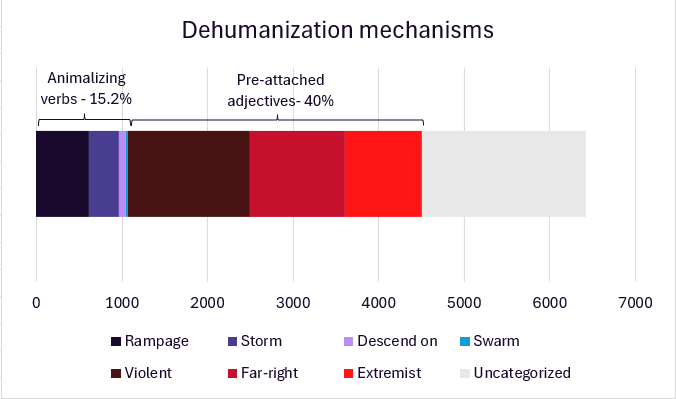
Share of collected alerts containing dehumanizing or highly charged terminology. Graph based on data from HonestReporting.ai Labs.
The report also points to the repeated use of animalizing verbs such as “rampage,” “storm,” “swarm,” and “descend on,” which appeared in 15 percent of the articles analyzed. In addition, descriptors referring to settlers as “violent,” “extremist,” and “far-right” were used in nearly 40 percent of the articles analyzed.
This framing has led to a reality in which even Israeli victims of terror attacks are labeled simply as “settlers.”
Tzeela Gez was being driven to the hospital to give birth when a Palestinian terrorist shot at her car, killing her and mortally wounding her unborn baby. Reuters originally referred to her as a “pregnant settler,” replacing her national and personal identity with a politically charged label tied to where she lived.
The Washington Post highlighted what it suspected “radical Jewish settlers” might do to retaliate. The equation is simple: violence against Israelis is used to prime an audience to assume Israeli aggression.
Tzeela Gez was in labor when she was murdered by a Palestinian terrorist.
Hamas hailed the attack as “heroic.”⁰And @washingtonpost? It ran a piece about potential “settler retaliation.”
When a pregnant mother is murdered, the story isn’t “what Israelis might do next.” It’s… pic.twitter.com/NDDo6tqv4W
— HonestReporting (@HonestReporting) May 15, 2025
Repeated use of negative adjectives in conjunction with the term “settler” influences how audiences subconsciously process a group. Over time, the label itself prepares readers for preconceived moral judgments before the details of any individual event are even examined.
Timing Matters
While coverage of “settlers” has increased, the spike does not appear random or organic in its timing.
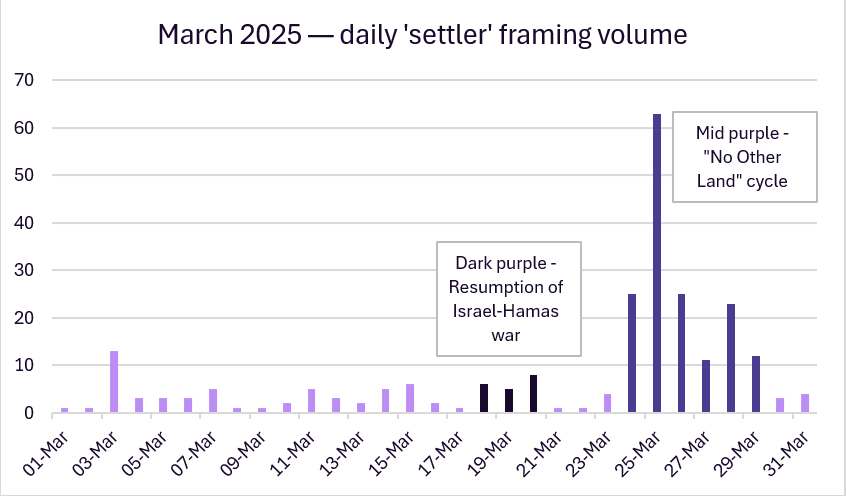
Graph based on data from HonestReporting.ai Labs.
Before the resumption of the Israel-Hamas war in March 2025, the monitoring system detected only around three “settler”-related alerts per day. Once the war resumed, that number doubled to roughly six to eight alerts daily.
The most noticeable uptick came following the Oscar-winning documentary “No Other Land.”
When the director claimed he was “attacked” by a group of “settlers,” the media immediately picked up the story, with 60 percent of the entire month’s volume picked up in just five days, from March 24 through 28.
“Israeli settlers” became the running headline immediately. But almost as quickly, once the truth of the story was revealed and it was shown that the director was throwing stones at Israeli civilians, the story dropped off again.
In May 2025, Louis Theroux released the BBC documentary Louis and the Settlers, which focused solely on extremist elements within the settler movement.
At the same time, the June 2025 Iran war further accelerated alert volume, with many outlets framing the conflict alongside claims that settlers were taking advantage of regional chaos to intensify violence in the West Bank.
How “Settler” Plays into Other Anti-Israel Libels
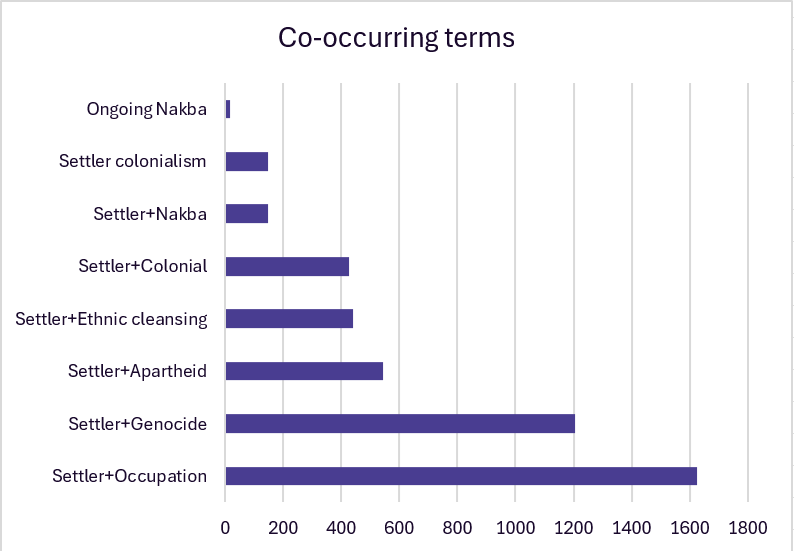
Graph based on data from HonestReporting.ai Labs.
The term “settler” does not appear alone, but increasingly overlaps with broader accusations against Israel.
The dataset found that the following terms appeared alongside “settler” alerts:
- “Genocide” appeared in 1,205 alerts
- “Apartheid” appeared in 545 alerts
- “Ethnic cleansing” appeared in 441 alerts
- “Settler colonialism” appeared in 146 alerts
- “Nakba” appeared in 146 alerts
These layers reinforce one another over time, shaping public understanding of the conflict through an interconnected framework rather than through isolated terminology alone.
In this structure, language does not merely describe events. It guides audiences toward a particular interpretation. The cumulative effect is a simplified framework through which anti-Israel narratives can more easily spread using terminology that is often emotionally charged rather than neutral or accurate.
Impact
The international media has developed a linguistic infrastructure in which Israelis beyond the Green Line are increasingly defined politically before they are recognized as human beings. As this terminology is normalized, the frame recedes from view and is treated as neutral reality rather than contested language.
The consequences reach far beyond word choice. When millions of readers repeatedly encounter the same emotionally loaded framing across headlines, wire stories, documentaries, and social platforms, the effect is not mere reporting but the building of a global narrative architecture.
By collapsing a diverse civilian population into a single political category, journalism drifts away from describing reality and toward pre‑packaging moral verdicts in advance.
Liked this article? Follow HonestReporting on Twitter, Facebook, Instagram and TikTok to see even more posts and videos debunking news bias and smears, as well as other content explaining what’s really going on in Israel and the region. Get updates direct to your phone. Join our WhatsApp and Telegram channels!
© Divuach Ne’eman R”A, 2025